29 minutes ago
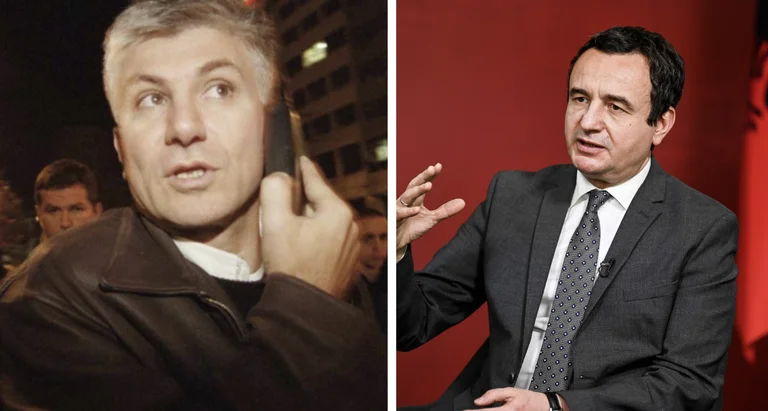
Contraverse Memorial: Why did Kurti's writing to Zoran Djindjic cause so much reaction?
Periskopi(3 years ago)
(3 years ago)Prime Minister Albin Kurti, through an essayist text, has commemorated former Serbian Prime Minister Zoran Djindjic. Such a commemoration sparked many reactions in Kosovo public opinion. For Professor Blerim Latifi, “the idea that Djindjic thought about Kosovo outside the schemes of Serbian nationalism is a myth that fed his killing even more”. He writes: “2 [...]
Prime Minister Albin Kurti, Through an essayist writing, it has commemorated former Serbian Prime Minister Zoran Djindjic. Such a commemoration sparked many reactions in Kosovo public opinion.
For the Professor Brian Latif, “The idea that Djindjic thought about Kosovo outside the schemes of Serbian nationalism is a myth that fed his killing even more”.
He writes:
The two Serbian assassinations have seen Albanians eat away. Atentate over King Alexander the First in 1903, and 100 years later, the assassination of Prime Minister Djindjic.
Both had something in common: the goal of removing Serbia from Russian influence and its approach to the West. If they lived to meet their goals, Albanians would have jobs much harder.
The assassination of King Alexander by a prorus faction of the Serbian Army has brought Serbia back to geopolitical prorus orientation. This eventually convinced the Austro-Hungarians to start work on creating an Albanian state, not allowing Russian influence to extend through prorus Serbia to the Adriatic. 28 November 1912 was the logical result of this Austro-Hungarian geopolitical.
Djindjic followed King Alexander's approach. He wanted a Serbia distanced from Russia and closer to the West. He wanted to use this policy against Kosovo's aspirations for independence. His disappearance buried this policy with him. Those who came after him did not come out of the shadow of the prorus current, and this had a significant impact on the establishment of Western conviction on Kosovo's independence as an alternate option.
The idea that Djindjic thought about Kosovo outside the schemes of Serbian nationalism is a myth that fostered even more his murder. Today we found that our prime minister is also trusting in this myth. Unfortunately, ”
Meanwhile, with the title “Why is Albin Kurti wrong when he praises Zoran Djindjic?”, noted scholar Fitim Salihu, well rids itself of Kurti's lost idea of praising Djindjic”.
Kurti's “Esence even four years ago was the contradiction of these two important figures in modern Serbian history with their supposed opposite figures { Gavrilo Princip and Alexander Vucinqi. His general idea was that had Obrenoviqi and Djindjic not been killed, Serbia would have been better off. Kurt's apology is characterized by what in history is called “over-simplification”. In short, white-reading and historical dynamics.
First, these two figures may even have been slightly more liberal than their political opponents, but their liberalisation has been only vis-à-vis Serbian domestic policy and ideological treatment for Serbian statehood. But, in relation to Kosovo, their attitude has distinguished in tiny shades, if not that it has stood out at all, with that of Karadjurgy or Sloba. Any attempt to see Obrenovijqi and Karadjurgy or Djindjic and Milosevicjq as if they were characters in a film “paggetti-western” of Sergio Leones like the best “and the bad” is, in the best case, the basic non-recognition of Serbian history. At least the last two hundred years.
Who was Alexander Obrenovitch?
Alexander Obrenoviqi led with Serbia from 1889 to 1903, when he was desecrated and killed by the Karadjordjevic Dynastian Archival family. His own royal ancestors were noted for their nationalist stances in Kosovo and the symbolic myth of Kosovo's “lavdy” can be encountered in their dynasties. Moreover, young King Alexander himself led the manifestations of the 500th anniversary of the Battle of Kosovo, which for many do not fall behind the celebrations that Milosevic led 100 years later.
In fact, those days Obrenoviqi was also crowned in the spirit of celebrations for Kosovo's “lavnia” at the Dijca monastery in Kraleva. Similarly, the young king had visited Lazarus ' church in Krushevc. The story wasn't random. This church was set up by local Lazar, the Serb commander of the Battle of Kosovo. There, Obrenoviqi inaugurated the monument “You know what? (Kosovo Heroes). Returning to Juice, he paid homage to the tomb of Princess Milica, the daughter of the Nemanjakes, and the wife of the ninja Lazarus. All these quasi-oculte processions were accompanied by a unique French of the Serbian public, fed by the Obrenovic Crey government.
Even later, Obrenoviki's policy has been actively offensive to the Kosovo issue. Taking advantage of what Serbian politics called “the Ibrit” Kolasin post, Obrenovic's foreign policy became very aggressive and put continued pressure on the High Gate to suppress Albanian rebels and ensure as many rights as possible for the Serb bribe in Kosovo's Villajet. In August 1902, the Serbian ambassador to Istanbul filed five requirements for the High Gate on the Kosovo issue, where, among other things, the sultan was required to push ahead the right of Kosovo Serbs to arm “in defence from Albanian gangs”. In fact, in advance, in the summer of 1894, Obrenovqi had personally visited Istanbul to obtain more privileges for local Serbs.
At the time of the Crayli, Alexander also saw the opening of the Russian Consulate in Mitrovica, which served as an agent's haven of Obrenovics. The end of the Russian consul, Grigori Shcherbine, you know... He was killed by Albanian rebels in April 1903 precisely because he was viewed as extending Obrenovic's nationalist policy. In fact, there's an open thought about how, if Karadjordjevi who followed the Russianfile line, the Obrenovs followed the proustria line. In fact, according to much of the evidence of time, although Alexander Obrenovics' father, King Milan, was the leading Austrian ally in the Balkans, his son Alexander, soon became a Cari ally and lacked his co-ordination with the Russians, especially in the case of Kosovo and Macedonia.
Especially after his glorious July 1900 wedding, Alexander Obrenoviqi returned completely from Russia. Even as a gift to the Russian Allies, he freed the radical plotters of Ivan-dan's <x0thatate”, who in June 1899 had attempted to kill his father, former king Milan Obrenovic. The fact that Obrenovqi has not been against Russia and the Powers of Antanta, but rather has been their friend, testifies also to Ralph Padgett, the renowned diplomat of “Freegn Office”, who in 1910-1913 was British minister in Belgrade. In his memoaries, “A diplomat in Serbia”, Padgett testifies to how England never agreed to the murder of Obrenovics and to its defrostion, and that until 1913 it did not relax relations with Karadjevices. If Obrenoviqi had been an Austrian antirus ally, the British would not have opposed his fall, but would encourage him, considering the rivalry in the Balkans between Germany and Austria, on one side and England and Russia on the other.
In fact, his liberal approach could also be questioned as to his domestic policy. In fact, if he reigned as an absolute monarch, his successor, Petar Karadjordjevic, installed a constitutional monarch and gathered parliament. So Kurt's findings are wrong and he, trying to simplify the story, ends up in a leading reader of it.
Former US Indian University professor Branimir Anzulovici in his book “Divine Serbia ʹ from the myth to genocide” ... which I have had the honour of instigating for the publishing house “Koha” He undertook reforms to free Serbia of the legacy of oppression and violence. The publication of John Stewart Milly's book, “Mbi freedom”, which the king himself had translated, was a manifestation of his intention to free Serbia from the burden of its heritage. ”
And the history professor at the University of Northern Dakota in the United States, John Cox, another well-known Serbian policy researcher in his book, “History of Serbia”, said that Serbia during the reign of Alexander Obrenovics had no development, rather, he calls his principality a “top <x> state” an isolated state and off the global trends of the time, while Alexander himself called the “=5> and <6>
That's enough for the argument that killing the Obrenovians was a disaster.
But who was Zoran Djindjic?
Djindjic is the second character to whom Kurti's apology was written and claims that if he were alive, he would distinguish from Vuciqi. Djindjic has been Serbia's prime minister in 2001-2003, and had been the opposition leader in the 1990s. Likewise, Djindjic was probably more liberal than Serbian domestic politics, but in relation to Kosovo he, though more realistic than Milosevqi, never denied the nationalist base and finalization of the myth of Kosovo. Being more realistic makes him better. Vuciqi is even more realistic than Miloshevqi in relation to Kosovo. In his speech to Gazivoda in the fall of 2018, he actually said Miloshevqi made tactical mistakes but that his fight for Kosovo was just.
To get back to the book that I have translated in 2017, “divine Serbia”, Anzuloviqi, speaking of opposition protests against Milosevic, says in a passage: “Certain protesters wore symbols like were the portraits of the Tigos ♫ showing that they admired the massacres in the war for a homogen nation and spread that they were angry with Milosevich not why he started the war, but why he did not win it. The two main politicians who took the lead in the wave of discontent -- Zoran Djindjic and Vuk Draskoviqi -- did not provide a real alternative to Milosevic's policies. They were not disgusted by nationalist obsession with Greater Serbia (which they themselves pushed with Milosevic) nor denounced the myths that prevented many Serbs from agreeing with their past. ”
In fact, even after his coming to power after the October 2000 revolution that ousted Milosevic from power, Zoran Djindjic was only in shape differently from his predecessor. In essence, his positions in relation to Albanians and Kosovo were the same. In February 2001, the newly elected prime minister, Djindjic, after a meeting with Colin Powell, the US Secretary of State, threatened with war if Kosovo declared independence.
In a TV interview, he stated that Kosovo Albanians have no right to independent ruling institutions from Serbia, and that in post-war Kosovo, it cannot be spoken merely of minority rights to Serbs, but of historical rights to the Serbian state. Moreover, during this public interview, he often gets fascist traits when talking about how no Albanian will allow him to buy property in Terazije because their money is dirty and earned by narcotics, while threatening Europe would break up Bosnia and Herzegovina if Kosovo is independent. Among other things, his phrase “We damo Kosovo!” We don't give Kosovo “So basically he didn't know anything about Milosevic. As Anzulovici says, he was simply lamenting the fact that Milosevqi lost Kosovo.
In a speech he held before Banja Luka University students in Republika Srpska a month before he was killed, Djindjic would declare that Miloschi lost Kosovo because he did not realize that there is a set of rules in international relations that should be respected. So that you can become a player according to global game rules, you have to meet certain minimum criteria to accept as a player. If you constantly break the rules, saying, "This is what I want; I only want what meets me, they're gonna kick you out of the game, and they're gonna tell you, "Sit there in your pants and play by your rules. A balance must be found between obeying the rules and, of course, bypassing those rules to some extent, so that the judge doesn't even notice it...”
So, an attentive reader, not only of this passage, but of its entire political activity, realizes that Djindjic and Milosevqi saw only tactics, not strategy. The first thought Kosovo was won by fraud and fraud, the second by force and violence. The first thought the rules should be broken, but it must be acted without the judge seeing. The second sun was too much for judges. In essence, though, they were the same as their long - term strategy.
“Stratfor” is a famous American geopolitical study platform which in February 2002 published an article entitled “The law is stealing nationalist thunder”. The article analyses how Djindjic was stealing from Serbian President Vojislav Kostunica, the dung of Serbian Great nationalism, and had begun to shift sides from a perceived politician to an anti-Western politician. Djindjic was beginning to speak against The Hague's Tribunal and the trial of former Yugoslav President Milosevic.
In fact, even this article highlights its cunning and duplicity: “The trial has multiple audiences. One eye is the Serb/voting population, where Djindjic's recently prosperous nationalism is expected to do work. The other is the West, which is providing a rescue line for aid and investment in Yugoslavia. ”
Also, Kurti's digital epidelic assessment of “The second war is over, but it seems that the first one is still not”, even though omomatopetic, is historically incorrect. Kurti's logic says the First War is not over because the report of forces and alliances continues to be the same (the link between Serbia, Russia and France), while the second is over because the conflicts have been resolved and, therefore, its alliances have dropped. If we start with this logical argument, we educationally analyze that its conclusion is incorrect. If he finds that the First War is over because Russia and Serbia are still allies, then it could easily fall down and agree, with the same logic, that it is over because the United States and Russia are no longer allies like during the First War (even after the arrival of Tramp to the White House), we can say that the US is no longer ally of both Great Britain and France).
One more thing about the end: Kurt's “findings if it was X, would be Y”, sound naive and dynamic. Historians take the lead, but circumstances do. Rather, history is stirred by the impact of a number of factors that have a dialectically developed themselves. To say that “if it were Djindjic, it wouldn't be Vuciqi” or “if it was Obrenoviqi, it wouldn't be Karadjordjeviqi or Principi” it would be to try to justify and use it to serve even Vuciqi and Karadjevic. Developing internal dynamics, combined with international developments, have produced Milosev and Vuci, Karadjordjevi and Gavrilo Principe. And that happens only in Serbia, but also find out. The laws of historical development cannot be explained in individual terms.
I understand, although I don't reason, Kurt's need to read history in a modern policy context. But speaking of Djindjic and Obrenovics as if they were Michael Archangel and Archangel Gabriel, in the best case, is elementary and ill-read amateur history of the Serbian people and politics.
I also understand Kurt's wish to find at least two positive figures in Serbian history. But they are definitely not Djindjic and Obrenovic. Maybe Dimitrije Tucowiqi and Costa Novakoviqi are. But those two, not”, he writes.
ASHPRIATION:
Journal Parim Oluri, through a reaction, explains the paradox of commemorations in this form:
This is where the battle of Koskora, the Lapusnik battle, the Pracas battle...
Now time changes. Oliver's being remembered, Zoran...”, writes Oluri.
Journal Ilir Mirena nThe while it is ironic that when Oliver Ivanovic (from prime minister) is remembered, Zoran Djindjic is also remembered.
When you remember Oliver Ivanoviqi why don't you remind me of Zoran Djindjic!...”, he writes. /Periscope.