 3 hours ago
Constitutional Breaks Down Law on KKP
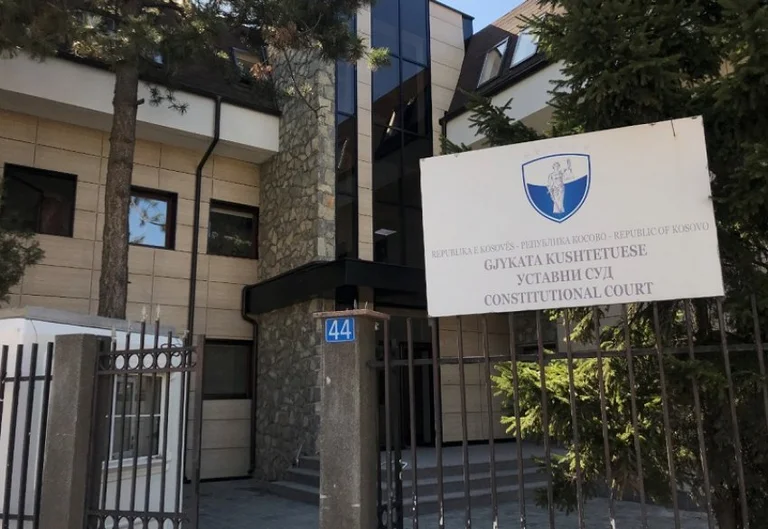
Periskopi(3 years ago)
(3 years ago)Kosovo's Constitutional Court has decided to declare the Law for the Prosecutorial Council of Kosovo invalid, following a request to assess the constitutionality of this law by MPs from the Democratic Party of Kosovo and the Democratic League of Kosovo last year. According to a media report Friday, this court has indicated that [...]
Kosovo's Constitutional Court has decided to declare the Law for the Prosecutorial Council of Kosovo invalid, following a request to assess the constitutionality of this law by MPs from the Democratic Party of Kosovo and the Democratic League of Kosovo last year.
According to a media report Friday, this court has indicated that, following the assessment of the law based on the demands of the Democratic Party of Kosovo and the Democratic League of Kosovo, some provisions of this law have been assessed in disagreement with the Kosovo Constitution.
With amendments to the Law on the KKP changed the way the Prosecutorial Council functions, but also the composition of this council.
According to the Constitutional decision, the law conflicts with provisions of the Constitution for the Formation of Governance and the Separation of Power, the Assembly Compensities, the Role of the Ombudsman, Equality before the Law, and Article for the Prosecutorial Council.
Counting the criteria for incompatibility with the Constitution, the Constitutional Court has announced it has ruled that “declared invalid, in its entirety, Law No.08/ L-136 for Change and Fulfilling Law No. 06/ L-056 for the Kosovo Prosecutorial Council”.
By the time the opposition took this law to Constitution, they had declared it violating the independence of the prosecutorial system.
Changes to the Law for the Kosovo Prosecutorial Council were adopted on June 23rd, with 60 votes for a abstention.
Below is the full announcement of the Constitutional Court:
Decision notice in KI 100/22 case and KI 1 0122 Skip AddAvertery
The Constitutional Court of the Republic of Kosovo has decided today regarding the combined demands in the cases of KO 100/22, with the forger: Abelard Tahiri and ten (10) other deputies and KO 1/01/22, with cheating: Arben Gashi and ten (10) other deputies of the Republic of Kosovo Assembly, in terms of assessing the constitutionality of Law No. 08/ L-136 for Change and Fulfilling Law No. 06/ L-056 for the Kosovo Prosecutorial Council.
The court unanimously has decided to (i) declare acceptable requests and to state that (ii) points 1.3.2 of Article 6 and Article 8, respectively, Article 10/A of the Conflicted Law, are incompatible with Article 1 [The Foundation of Governance and Power Division], paragraph 10 of Article 65, and Article 132 The Constitution's [Roley and the Ombudsian Lawyership]; (ii) paragraph 2th paragraph 13 of the countered Law is not compatible with paragraph 1 of Article 4 [The Government of Governance and Power Separation] and paragraph 1 of Article 110 [Prosecution Council of Kosovo] of the Constitution; (iv) paragraph 5 of Article 16 of the Law counter is not in accordance with paragraph 1 of Article 24th, and paragraph 3st before the Constitution; we (aly) Article 32th) respectively, in the Law of the 31rd of the Law is not compatible with the 31rd ordinance and the 3st Constitutions of the Law, we do not use the command of the command of the command to render it with the 3st of the command. L-136 for Change and Fulfilling Law No. 06/ L-056 for the Kosovo Prosecutorial Council.
The core of the pre-professors, supported by the Prosecutorial Council, Oda of Lawyers, but, in essence, by the ombudsman as far as cases relating to his competencies and independently rejected by the Ministry of Justice, links with violating the constitutional independence of the Prosecutor's Council, and disseminating the balance of powers, contrary to the guarantees of Article 4 and Article 110 of the Constitution, respectively, because the controversial Law, prior to the criminalist, against the prosecution of the prosecution, among other prosecutions (professsing) the Prosecution Council, by reducing the members of the ruling and non-profesopinciency among the prosecutions, not simply by the prosecuting of the procurators, by the procuratorsing of the pro-profectoral prosecution (profectoral laws) by the prosecution) by the prosecutions, not simply to the prosecutions and the prosecutions, by the prosecutions, by non-profectorsing the prosecutions, by the prosecutions, by the prosecutions, by non-prodictions, not-prodictions, by the prosecutions, not
In assessing the constitutionality of the conflicted Law, the Court has, and among other things, expounded: (i) the fundamental constitutional principles regarding the justice system, such as they are precise with the Constitution; (ii) the short history of the Prosecutorial Council, through its respective laws since its establishment, as long as it is relevant to the actual circumstances; and (ii) the relevant judicial practice of the Court, the ECHR and the Court of Justice of the European Union <0). The court has also outlined the fundamental principles stemming from the Venice Commission's reports and opinions, including but not being limited to: (i) Summary of opinion and reports concerning prosecutors of April 26th 2022; (ii) Report on European Standards concerning the independence of the Judiciary System: Part II “The Prosecutor's Service”; (ii) Opinion on the qualified majority and relevant de-blocking mechanisms; (iv) relevant opinions of the European Prosecutors' Consultative Council, including opinion No. 9 (2014) and No. 13 (2018), as well as relevant recommendations of the Council of Europe Committee of Ministers; and (v) the two opinions of the Venice Commission for Kosovo, concerning the controversial Law adopted on December 13th 2021 and March 23rd 2022, respectively.
In applying higher principles to assessing the constitutionality of the controversial Law, the Act (i) at first (i) points out based on Article 16 [the scope of the Constitution] of the Constitution, the governing power stems from the Constitution, like the highest judicial act of the Republic of Kosovo, in accordance with which laws and other judicial acts should be in place; and (i) re-exemplifies its consistent judicial practice, based on which, the Constitution consists of one whole constitutional principles and values, on which it is built and on the basis of which the Republic of Kosovo should function, and that the conditions cannot be interpreted by each other, but because of each one of them, in the context, the constitution is to be drawn in the proper sense of the 7th of the Republic.
Furthermore, the Act explains that based on the Venice Commission's relevant opinions, but also those of the Council of European Prosecutors Consultative Council and relevant recommendations of the Council of Europe's Committee of Ministers, among other things, it turns out that (i) in contrast to the judicial systems, standards in the context of organising the prosecutorial systems are less consolidated/uniform; however, (i) there is a widespread tendency towards the independence of the prosecutorial systems, and the DECNJ judicial practice but also the ECBG, also emphasis on this aspect.
In that statement, the Act of Justice explains that in the constitutional order of the Republic of Kosovo, the prosecutorial system is fully independent. More precisely, the Prosecutorial Council is part of Chapter V. II of the Constitution regarding the System of Justice and along with the Judiciary Council have the competence of administration of the judicial and prosecutorial system, respectively, and despite the similarities and respective differences in exercising their positions, the Constitution grants both “full constitutional independence”. The prosecution explains that this complete constitutional independence, based on Article 4 of the Constitution regarding the division and balance of powers, is also subject to balance and interaction with other powers, always in line with democratic values as defined in Article 7 of the Constitution.
From joint reading of the constitutional provisions and as long as it is relevant to concrete circumstances, in principle, and in the context of the Prosecutorial Council, it is important to interact with the Parliament's Prosecutorial Council, according to the definitions of Article 65 and 110 of the Constitution. Interaction of these provisions, in essence, defines the exercise of the framework's competence to determine the composition of the Prosecutorial Council and to select Council members, yet always in office of maintaining full independence of the Prosecutorial Council in exercising its constitutional functions, as defined in paragraph 1 of Article 110 of the Constitution; and simultaneously, respecting the division and balance of powers, as defined in paragraph 1 of November 4.
In the Court Act, the principles outlined above have been applied in the examination of each valued article of the Law, which was disputed separately. In this and for the purposes of this summary, the Court will explain the findings and the main findings regarding the most controversial cases of the passed Law -- (i) the altered composition of the Prosecutorial Council and the proportion among the members of prosecutors and non-prosecutors; (ii) the selection of non-procural members through most of the votes present and voting in the Assembly; (ii) the competence of the ombudsman to appoint, respectively, a (1) non-proudal member; treatment among non-prosecutors, and non-prosecutive prosecutors in judicial law and protection of the councils, after their rulings and prosecutors.
Prosecutor and Non-Professional MPs at Prosecutorial Council
The indictment explains that the controversial Law stipulates that the Prosecutorial Council consists of seven) members, including the chief prosecutor who is represented in the Council under official office, three (3) members of prosecutors elected by the prosecutorial system and three (3) non-prosecutor members, in contrast to the Basik Law under which, the Prosecutorial Council consists of 13, members, respectively, chief prosecutor who is represented according to official office, nine (9) members of prosecutors selected from the prosecutorial system, and three non-prosecutor members elected by the Parliament, according to the Councils of Lawyers and Public Courts's Councils Councils and Courts Councils proposals regarding a specific member of civil law (1).
The assessment of the constitutionality of the provision of the controversial Law specifying the above structure, the Act explains that the Constitution contains two determining provisions -- Article 65 and 110 of the Constitution -- respectively. The constitution, through paragraph 4 of Article 110, has established, among other things, that the composition of the Prosecutorial Council is regulated by law, while through paragraph 10 of its 65th article, it has determined, among other things, that members of the Prosecutorial Council choose the Parliament in accordance with the Constitution. In contrast to the Judiciary Council, in the case of the Prosecutorial Council, the Constitution does not specify the report between the elected members of the prosecutorial system and its non-prosecutors, by delegateing the regulation of this proportion to the legal level, always as long as full constitutional independence of the Prosecutorial Council is not violated, as is specified in paragraph 1 of Article 110 of the Constitution.
Taking into account the lack of specific constitutional regulation in the context of proportion among the prosecution and non-prosecutor members of the Prosecutorial Council, the Act also refers to the opinion of the Venice Commission, including two opinions on Kosovo, which, among other things, stress that it is more important that the composition of the prosecutorial council avoid two dangers, (i) in the context of the members, the tendency of “corpatisation <x1) or such perceptions, taking into account the hierarchy of the system and the Prosecution of the subjectial system, and (at) at the same time, in the context of the members, not the <x>x>, by means of their own political influence. This balance, in principle, and among other things, according to top opinion, can be achieved through a pluralistic composition of the Council, in which prosecutors elected by the system itself make up substantial “ ”, but not necessarily the majority of Council members and which enables prosecutors to rule alone, but at the same time, it is impossible that non-prosecutor members can block or “they easily overdo it.
Based on the previously summed clarifications and the fact that (i) in paragraph 4 of Article 110 of the Constitution, among other things, the composition of the Prosecutorial Council is regulated by law; and (i) the standards of the Venice Commission reflect the importance of the Prosecutorial Council councils balanced among the members of the system-elect and non-professional prosecutors, always with the guarantees necessary to avoid the risk of “posorisation” but also <x>) the Council's <x>, the Court finds out of proportional and non-proposal members respectively, according to the prosecution, the constitution is not controversial to the constitution.
(i) The necessary majority in the country for the election of non-prosecutor members of the Prosecutorial Council
As far as the majority is needed for the election of non-prosecutor members of the Prosecutorial Council from the Parliament, the Act puts emphasis on two determining provisions -- Article 65 and 80 of the Constitution, respectively. Article 65 of the Constitution, in its paragraph 10, stipulates that members of the Prosecutorial Council are elected by the Parliament in accordance with the Constitution, while Article 80 of the Constitution, in its paragraph 1, determines that laws, decisions and other acts are approved by the Parliament with the majority of votes of MPs present and voting, unless otherwise defined by the constitution.
The election of non-prosecutor members of the Prosecutorial Council from the Parliament, taking into account that the Constitution has not defined otherwise, falls within the scope of paragraph 1 of Article 80 of the Constitution. As a result and in the absence of another specific arrangement in the Constitution, the Act makes clear that the election of non-prosecutor members of the majority prosecutorial Council of MPs present and who vote is not contrary to the Constitution.
They say this and take into account Article 1 of Article 110 of the Constitution regarding the complete constitutional independence of the Prosecutorial Council and in the context of the principle of dividing and balancing powers as defined in Article 4 and 7 of the Constitution, respectively, the Act also highlights that (i) reports and relevant opinions of the Venice Commission, including the opinion on Kosovo regarding the controversial Law, stress prefers that the election of non-proud members of the prosecutorial councils, be made by a majority and non-profesitable, including the majority, including the possibility of post-responal mechanisms or voting, as well as having the same parliamentary procurities that do not, and most of the parties, including the most of the prosecution's and the prosecution's -- including the most of the most of the prosecution's, and the Council, including the most of the most, not-prognosors, and the Councils, including the most, and the most of the most of the prosecutions.
(ii) Ombudsperson's Process to elect non-prosecutor members of the Prosecutorial Council
The context of the relevant Law provisions contested through which the Ombudsman is determined to appoint/elect and dismiss a (1) non-prosecutor member of the Prosecutorial Council, the Act first highlights the fact that, according to the opinion of the Venice Commission, (i) in determining the proper proportion among members of prosecutors selected by the prosecutorial system and non-prosecutor ones chosen by the Parliament, a number of members can also represent independent institutions and/or civil society; and (i) in the composition of the prosecutorial councils, they can also be represented in the same position by official or proposal of individual candidates. Such a combination of mechanisms is reflected among others, as well as in the basic Law for the Prosecutorial Council, which includes the mechanism of representation under official duty at the Council of State Prosecutor and the role of the Council of Lawyers, Juridical Faculets and civil society in proposing/nomining the non-prosecutor members of the Council and later elected by Kuwait.
In that statement, the Courtial Council's amendment, among other things, explains that the starting to assess the ombudsman's competence to establish/elect, but also dismiss one of the non-prosecutor members of the Prosecutorial Council, is the Constitution, respectively (i) paragraph 10 of Article 65 of the Constitution, under which, among other things, the Parliament elects members of the Prosecutorial Council; (i) the constitutional competency competencies of the constitution for electing the positions of independent constitutional institutions defined in Capit Vllus and XII; and respectively, the constitution, under which 132 of the constitutions, among other MPs, the councils, including the constitutional offices of the rulings of the authorities, including the constitutional and the constitutional rights of the constitutional authorities, with the constitutional rights of non-religence. In terms of the latter, the Act also recalls that since the Venice Commission's opinion had clarified that the involvement of the ombudsman in the composition of the Prosecutorial Council, not necessarily contrary to standards, it had also drawn attention that such involvement “does not harm his or her [Ombudsman] ability to make independent definitions concerning issues related to the KKP at”.
In the context of the above provisions as a whole, the Act first explains that as far as in the case of the Prosecutorial Council, in contrast with the Judiciary Council, the definition of the composition and manner of appointing of the respective members is divided between the Constitution and the law, the competency of the Assembly to elect the relevant members of the Prosecutorial Council is determined by the Constitution and therefore, given the principles stemming from the court's practice, cannot be conveyed to the ostracal institution through the law adopted by the 2003th Constitution. In this and second regard, the Court explains that in context of all independent constitutional institutions defined by Chapter VII regarding the Justice System and Chapter XII regarding Independent Institutions, and whether the Constitution (i) has specified the competency of the Parliament to elect/appointed at the level of the Constitution; or (ii) has correctly specified that the method of choice is regulated at the law, the carriers of the functions of independent constitutional institutions, elected by the Parliament, except the members of the Central Election Commission, for which is defined in the constitution. This is the case with the precise members of the Judiciary Council, the Ombudsman, the deputy ombudsmans, the general audience, the governor and members of the Central Bank Board and members of the Independent Commission of the Media, who are elected by the Parliament in the manner correctly defined in the Constitution and/or relevant laws. Third, based on Article 132 of the Constitution, the Ombudsman has constitutional competency of oversight, respectively, (i) oversees and protects the rights and freedoms of individuals from illegal and irregular acts of public authorities, including those of the Prosecutorial Council; and (ii) has the obligation to reject instructions of interference from any authority exercising power in the Republic of Kosovo and the same are obliged to respond to its/her demands. Based on these constitutional characteristics, the Assembly of the Republic of Kosovo, through relevant laws, has assigned the ombudsman -- pronounced authorisations, including surveillance functions -- to the context of the disciplinary procedures of judges and prosecutors, which are managed by the relevant councils. In fact, and takes into account the nature of the constitutional functions of the Ombudsman, the same, the lawmaker has not even granted the authority to appoint his/chosen deputies, who choose the Parliament with the majority of deputies present and vote. Consequently, the Act explains that the ombudsman's competence to elect non-prosecutive members of the Prosecutorial Council is not in accordance with the Constitution.
(iv) Most decisionmakers at the Prosecutorial Council
In terms of decision-making in the Prosecutorial Council, the Court initially explains that Article 110 of the Constitution has two determining paragraphs, paragraph 4 of Article 110 of the Constitution, under which, among other things, the rules of the Council procedure are determined by legislation adopted by the Parliament; and paragraph 1 of Article 110 of the Constitution, under which the Council has full independence in the exercise of constitutional competencies. In the context of the latter, the Act also recalls that based on the opinions referred to by the Venice Commission, but also in its judicial practice, the way of decision making independent constitutional institutions is essential in meeting their functions independently.
The bias further explains that, the relevant provision that defines the way of decision making, correctly ensures that the decisions in the Council are taken by five (5) vote, respectively, the qualified two-thirds majority (2/3) in a composite of seven (7) members, provided there are two and (2) votes of non-prosecutor members in this majority. Following the Venice Commission's remarks on the possibility of blocking decision-making and subsequently recommending the inclusion of a de-blocking decision-making mechanisation, the controversial Law has been completed in the Assembly, adding the second round of voting, again determining the two-thirds decision-making majority (2/3) of the Council members, meaning the vote of at least (1) a non-prosecutor member of the Council, elected by the simple majority from Parliament.
In the context of the constitutional assessment of this controversial Law provision, and if the same violates the Council's full constitutional independence, the Act stresses that it is important to consider (i) the nature of issues subject to such decision-making; and (ii) the composition of the Prosecutorial Council, including the way its non-prosecutor members are elected.
Regarding the first issue, the Court explains that the Council's decision subjecting the qualified two-thirds majority (2/3) to two sets of voting, among other things, is linked to the most essential functions of the Prosecutorial Council, whose exercise has full constitutional independence, defined with Article 109 and 110 of the Constitution, in terms of (i) the State Chief Chief of State's proposal; and the adoption of acts related to (i) recruit, proposal, promotion, transfer and discipline of prosecutors. While in terms of the second case, the Court explains that (i) in the context of the Court's conclusion that the powers of the ombudsman to appoint a (1) Council member are not compatible with the Constitution; and (ii) taking into account the determination of the Law disputed that non-prosecuted members of the Council be elected simultaneously and in a simple majority in the Assembly, results that decision on the Prosecutorial Council regarding its more fundamental constitutional functions could be granted by one non-prosecutive members elected by a simple majority. The court stresses that such a solution is neither in line with the Venice Commission's opinion nor with constitutional independence guaranteed for the Council under paragraph 1 of Article 110 of the Constitution, nor with the principle of separation and balance of powers in a democratic state. As a result, the Act explains that the established way of decision making the Council under the controversial Law is not compatible with the Constitution.
In that statement, referring to the Venice Commission's opinions, the Act also points out that in the context of the precise composition of the Council through the contraryed Law, even the simple majority, but qualified majority, they have their own shortcomings, because (i) in the case of simple majority voting, it would enable members of prosecutors to govern only and such a solution would also violate the essence of the principle that the councils should have pluralistic composition; whereas (i) in the case of qualified majority voting with no significant and de-intellance mechanism, it would enable members of non-progressed and the majority of the decision chosen by any potential decision. In this context, the Act highlights the principles of the Venice Commission, regarding the possibilities of compositions of prosecutorial councils, including balance between members of prosecutors and non-prosecutors and the manner of electing the latter.
(v) The difference in treatment regarding legal means and judicial rights protection
In terms of law in the judiciary and judicial protection of rights for members of the Prosecutorial Council in case of their dismissal, the Act initially explains that articles 24, 32 and 54 of the Constitution should be interpreted in the context of paragraph 1 of Article 110 of the Constitution, respectively, the Council's full independence in exercising its functions. The prosecution highlights the fact that the Council's independence is related to the independence of the respective members and the manner of electing and firing its members is essential in this respect. The indictment notes that this issue was not the subject of considering the Venice Commission's two opinions regarding the controversial Law.
The prosecution further explains that the controversial Law, unlike the preliminary laws, stipulates the difference in treatment between the prosecutor and non-prosecutor members of the Prosecutorial Council, as regards the available legal means in the event of their dismissal. The indictment also explains that under the controversial Law, (i) Council prosecutors are dismissed after the two-thirds majority vote (2/3) at the Council and then have the right to a direct complaint with the Supreme Court, which makes decisions within thirty days; whereas (i) their non-procurial colleagues, following the Council's proposal, are dismissed from the Assembly, with the simple majority of MPs present and voting, for the majority of all MPs in the country defined by the Law, and have no direct appeal to the Supreme Court. In applying the principles stemming from its judicial practice and that of the ECHR in this context, the Court found that while a legal means, respectively, the procedure of administrative conflict at the Constitutional Court, exists even for non-professional members, the difference in treatment between prosecutors and non-prosecutor members concerned with proper legal means and judicial rights protection, is not compatible with the constitution.
(vi) Cutting off mandates of an independent constitutional institution through law
As for the suspension of the Council members' mandates, respectively, the interruption of existing and unfair mandates in legal means (i) for six (6) by nine (9) members prosecutors by lot; and (i) non-prosecutor members through the law, the Act initially explains that the Constitution has two determining provisions, Article 4 and Article 110 of the Constitution, respectively. The first, in his paragraph 1, determines that Kosovo is the democratic Republic based on the principle of separation of powers and balance between them, as defined by the Constitution, and (i) the second in paragraph 1 it determines that the Prosecutorial Council is fully independent in carrying out its functions in accordance with the law; and (i) in its paragraph 4 stipulates that the composition of the Prosecutorial Council, including the requirements for the mandate, is regulated by law.
In the context of the security of the mandates of members of independent constitutional institutions, the Action initially explains (i) the court's respective practice; and then (ii) the trial practice of the GEDNJ and the JUDBE. In terms of the first, the Court has held the stance that the premature interruption of constitutional mandates and/or legal mandates of independent constitutional institutions are subject only to conditions defined in the Constitutions and/or laws on which the respective mandates have been won.
Such an attitude, in principle, is taken by the GEDNJ and the JUDBE, among other things, through the Baka vs Hungary, Grzeeda vs Poland, C-619/18, the European Commission against Poland and C-192/18, the European Commission against Poland, respectively. In context of these judgments and always taking into account the differences and similarities between them, in principle it turns out that (i) the premature interruption of the violations of the European Convention and the law of the European Union, among other things, as a result of the adoption of new laws in the name of reforms in the justice system, and the JDRJ of the JBE, in the agreement of the early violations of European Convention and the right of the European Union, they had not taken into account the arguments of relevant governments that keep existing mandates would be intended for security reform; (the) constitutional security warrants for independence, and the pre-resumptions can only be done in the proper legal procedures, and procedures that have been based on the proper laws, and the proper laws, and the primary procedures that have been ruled, and that are in effect of the correcting of the laws, and that are in effect of the laws, and in effect of the primary laws, and in effect, and in effect, and in effect, and that the prodial laws can be carried out of the law can be carried out of the law, and the process of the law can be carried out on, and the results.
The Venice Commission's relevant opinions, as clarified in Action, in principle, also take the same stance. The same stress the importance of preserving the mandates of members of constitutional institutions, regardless of whether the same are defined with the Constitutions and/or law. In principle, and according to the Venice Commission, the early outcome of the mandates should always be linked to an identifiable violation or failure to perform the task of the relevant member and follow the basis, including the constitutional/legal procedure for the dismissal or end of the mandate under which they were won because otherwise and, among other things, the interruption of the mandates of constitutional institutions could depend on continued preferences of executive and/or legislative power.
In this regard, Venice's two opinions regarding the controversial Law, in this context and among other things, point out that (i) the provisions of the disputed Law which allow for the continuation of the mandates of a portion of the Council's membership of Prosecutorial Council members, are “most respectful towards international standards in relation to the preliminary model of the countered Law, which had proposed the partial suspension of all legal mandates; and (i) the Council members of the Prosecutorial Council, in principle, should be allowed to complete their exemption, but the execution of the mandates of acceptable mandates, if the current <2> results from the present x-> and the (definance of their) public interest, if you are to determine that you are to have to be able to do so in a more and to replace the <84.
In this context, the Act explains that improving the balance between members of prosecutors and non-prosecutors at the Prosecutorial Council in principle contributes to advancing the democratic legitimacy of the same, always if followed by the mechanisms needed to ensure its full independence. However, and carefully highlighted in the highest principles, and taking into consideration that (i) the judicial practice of the Court, consistently stressed that the interruption of the members of an independent constitutional institution should be interrelated to the grounds laid down for the ruling of mandates under the law on whose grounds were won; (ii) the continued reforms related to the Prosecutorial Council over the years, including the amendments in its composition, with the exception of the fact that the profiling of the profilation of profilation by the author, the prosecutor can definitely rule of justice, the provision of the Constitutional authority of the Council could not provide for its respective members, (the prosecution) the prosecution of the Council has been repeatedly preserved by means of their own constitutional ordinance, with the constitutional order of parliament, with the pre-pronegation, and the prosecutorial order of the prosecutoratement of Kosovo, and the prosecutor's of the verdictal order, the verdictal order, as it is to establish that the verdictal order.
In the end, the Act makes clear that the requirements of the petitionors have been submitted to the Court based on paragraph 5 of Article 113 of the Constitution, and that this category of requests has Suspenziv character, respectively, such a law could be submitted only to the president of the Republic of Kosovo for the declaration after the court's decision and in accordance with the court's final modalisations defined in the court's ruling on the contested case. In the context of its judicial practice, as discussed in the Act of Judgment, the Court estimates that taking into account the nature of the controversial Law provisions pronounced contrary to the Constitution and that the rest of the controversial Law would be difficult to enforce after the declaration of the above provisions as invalid, the controversial Law, in the service of the principle of judicial security, should be declared invalid in its entirety.
Warning:
This news release has been prepared by the Court Secretariat only for information matters. The full text of the decision will be handed over to the parties involved in the case, will be published on the tribunal's website and the Official Journal, after the relevant procedures laid down in the Law for Constitutional Court and its work regulation have been completed. The summary released through this announcement could undergo linguistic and technical corrections in the final draft of the decision.
To accept reports of decisions by the Constitutional Court, please register on the tribunal's website: https://gjk-x.org











