5 hours ago
Only an Association
Periskopi(3 years ago)
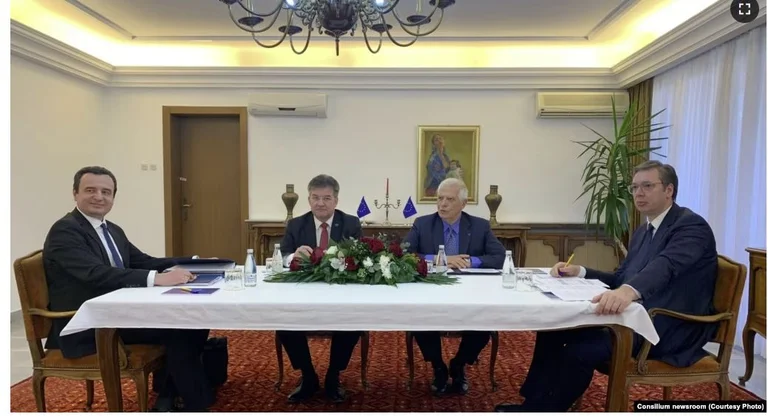
(3 years ago)The durability of words used in the Annex of implementing the Agreement towards normalising Kosovo-Serbia relations adds uncertainty to opinion and narrows the right interpretation of this agreement, say connoisseurs of political developments in Pristina and Belgrade, Beftman Pajarizi and Dusan Janjic. Kosovo Prime Minister Albin Kurti, and Serbia's president, Aleksandar Vuciq, have agreed to [...]
Kosovo Prime Minister Albin Kurti, and Serbia's president, Aleksandar Vuciq, have agreed to this annex during a meeting in Ohrid on March 18th, while the agreement, supported by the European Union, has been agreed in principle during a meeting in Brussels on February 27th.
The deal has 11 articles, and <x0lore in words” is made especially at Article 7, analysts say.
This article requires Kosovo and Serbia to engage “to ensure a proper level of self-advancing for the Serb community in Kosovo”.
Anex 5th point, meanwhile, says that to implement Article 7, Kosovo will act “in line with previous relevant dialogue agreements” with Serbia.
Among these agreements is the 2013 one for forming the Kosovo Serb majority municipal association, which the government in Pristina has so far refused to implement, with the argument that it risks the functioning of the state.
Neither the Anex nor the February 27th agreement specifically mention Association, but is it, in fact, about Association?
We still don't know what self-management means. The agreement says self-enamination in which areas self-management will be implemented, while the 2013 Agreement and the principles of 2015 clearly describe what association will look like. Now, we don't know what it means with the term Serbian community, which rights will describe such a formation, and whether it will be at all formation”, says Pacarizi of Radio Free Europe.
According to him, negotiations on this issue have not ended, because “must be found a modus, which will accommodate Article 7 and previous” agreements.
Radio Free Europe has been addressed to the Government of Kosovo on March 19th with the question in which sense the Kosovo side has accepted the term “only senamed” or “sofmanagement” (in English version) as “governance”, <6>ved ministerialization”, “organisation <x9, or <x10ut>onomi, in the sense of the minority's self-manitation <x>> But until the publication of this text, the executive has returned no response.
Self - Defense as a Protection Mechanism
Dusan Janjaq, from the Forum for Ethnic Relations in Belgrade, explains that in the practice of protection of minorities and in the practice of international public law, when it comes to minorities and local communities, there is the term “alone self-management and self-management (in English: Self-administration). According to him, in essence, these are translated into Serbian language as “governance”.
Janzic expresses confidence that the issue of decentralisation of municipalities -- which is envisioned with the Ahtisaari Document, on whose basis Kosovo's independence was declared in 2008.
Given that Serbia has not accepted this document, he says, the agreements in Brussels have not addressed cultural, linguistic and other minority areas autonomy.
These issues are now, according to him, intensified in the term “self-enamination of the Serb community”.
We're on the right track to create a defense mechanism or, as others call it, minority autonomy... In essence, that means there is no executive competence. International opinion does not know that, but with decentralisation in Kosovo, the mayors of municipalities are the small Maczots”, Janjic tells Radio Free Europe.
“association is not excluded”
After the meeting in Ohrid, Kurti, responding to journalists' questions about whether to allow the formation of the Serb majority municipalities, has said it is about “an adequate level of self-awareness of the Serbian community” and “for self-rule”.
Vuciq, on the other hand, has said that the formation of association “has been made with priority”.
Parisi says that the various statements of the two leaders and Anexes, for which they are reconciled, do not clearly specify whether there will be a structure with the appointment of Asociacion.
But, referring to the February 27th agreement, he says, association is not excluded.
The “does not mean that it should be Asociation, because this is about implementing Article 7, a proper level of self-awareness, self-management for the Serb community, which would be in line with earlier agreements. That means in line with the Association Agreement. This sentence itself means the accommodation of association within this formation if it's formation. But there is no exception for association as such”, says the Pajarizi.
Janjic adds that the term “alone -- ” -- would have to be defined correctly in the text of the final agreement -- which should be drawn out of the process of normalising Kosovo-Serbia relations.
According to him, this process will be a long one, but, he adds, if “self-awareness for the Serb community” means “authonomim for the minority community”, then nobody, including Serbia, could blackmail Kosovo for the rights of the Serb community.
The Serbian community, meanwhile, would ease the acceptance of the legitimacy of Kosovo institutions, says Janjic.
Kosovo and Serbia have reached the Association Agreement in 2013, while two years later they agree on its principles.
Kosovo's Constitutional Court has found that some principles are not in the spirit of the Constitution, but has said that if they adapt, the association could be formed.
This association would enable the Serbian community to manage such issues as economic development, education, health and urban and rural planning in its areas.
Kurti has said earlier that he refuses to form, arguing that the one-ethnic associations with executive competencies violate the Kosovo Constitution and threaten the functioning of the state.
Even Kosovo's previous governments have been reluctant.
Serbia's government, on the other hand, sees Association as significant protection for Serbs in Kosovo.
The agreement, expressed in Ohrid by Kurti and Vuciq, though not signed, has been met with criticism from both the opposition in Pristina and Belgrade.