18 minutes ago
“Amadeori” Kosovo in Serbia: I expect dialogue to end with mutual recognition
Periskopi(3 years ago)
(3 years ago)The fact that Kosovo Prime Minister Albin Kurti and Serbia's President Aleksandar Vuciq have agreed in Brussels on February 27th that they will work on implementing the European plan, Jeanish Jashari, chief of the Kosovo Interconnecting Office in Serbia, sees as a turning point in dialogue. “is essential for implementation of the proposal to begin [...]
“It is essential that implementation of the proposal begin without delay and trust”, Jashari said in an interview for Radio Free Europe in the Serbian language.
The liaison offices between Kosovo and Serbia and Kosovo have existed since 2013. The offices were established under the Brussels Agreement to facilitate its implementation.
They are located at the European Union delegation facilities in Belgrade and Pristina.
Since 2013, Dejan Pavicevic holds the position of the liaison officer between Serbia and Kosovo. He was the head of the negotiating team in technical dialogue between Belgrade and Pristina at the government of Ivica Dacic in 2012.
Jetish Jashari praised that the European proposal for normalising relations provides solid ground for resolving most open issues between Serbia and Kosovo.
He expects the dialogue to end with mutual recognition.
The plan for normalising relations in opinion is known as a European proposal and has received support from the United States of America (SHBA) and the United Kingdom.
It defines future relations between Serbia and Kosovo, which have negotiated under the EU-brokered dialogue since 2011.
Official Belgrade refuses to recognise the independence of the former Kosovo province, declared in 2008.
REL: How did you comment on the results of negotiations between the leaders of Serbia and Kosovo on February 27th in Brussels? Do you see it as a step towards normalisation between the two countries?
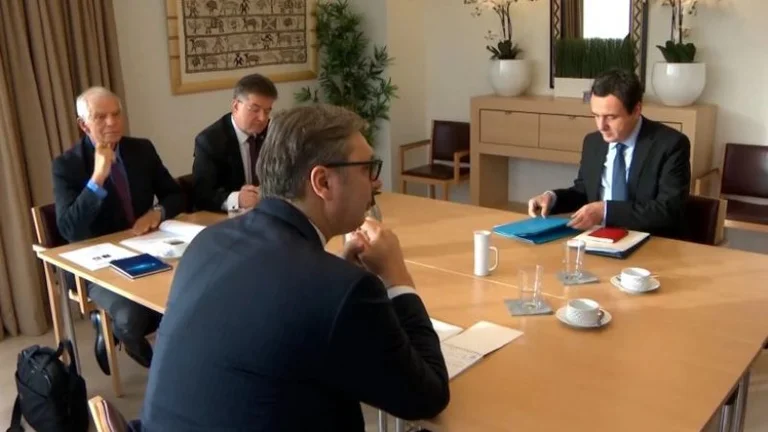
Yasar: The meeting of Republika Kosovo Prime Minister Albin Kurti and Serbian President Aleksandar Vuciq in Brussels on February 27th, with EU mediation, undoubtedly presents a turning point in dialogue between the Republic of Kosovo and Serbia for normalising relations between the two countries.
The Republic of Kosovo has accepted the European Union's proposed plan for normalising relations between the Republic of Kosovo and Serbia, which is strongly supported by the US, the UK and other democratic countries, considering it a good basis for continuing dialogue, which we expect to end with mutual recognition.
Even at that meeting, Prime Minister Kurti has expressed his readiness to sign the document, which is also a confirmation of the Republika Kosovo Republic's commitment to this proposal.
REL: What do you see as the key obstacle to the normalisation process between Serbia and Kosovo?
Yasar: The EU proposal provides a solid basis for resolving most open issues between the Republic of Kosovo and Serbia in this transitional phase. These issues otherwise present obstacles to normalising bilateral relations. In that sense, it is essential that implementation of the proposal begin without delay and trust.
The meeting, warned between Prime Minister Kurti and President Vuciq on March 18th in Skopje, North Macedonia, should be understood as an important step forward in this direction. Of course, we believe that the full normalisation of relations will be achieved when we reach the point of mutual recognition.
In all this process, the role of the EU, the US and the United Kingdom remains irreplaceable because it is expected that details of the implementation of the proposal (European) will require much work and perhaps difficult decisions. The respective representatives have already warned that they will play an active role in the process, including ship diplomacy, which is extremely encouraging.
REL: The liaison offices between Serbia and Kosovo were established in 2013. How do they work today?
Yasar: The liaison office between Kosovo and Serbia, as envisioned in the 2013 Liaison Office Agreement, in addition to its partner, Serbia's Interconnection Office with Kosovo, has served as the primary channel of communication between the Government of the Republic of Kosovo and the Government of Serbia since its establishment.
In a practical sense, the Office was involved in organising official visits by representatives of the Government of the Republic of Kosovo to Serbia and representatives of the Government of Serbia in Kosovo, including religious leaders.
Also, I, as head of the Liaison Office, like my predecessors in the past, try to keep in touch with representatives of the diplomatic community in Belgrade, to inform them of our government's position on events involving the Republic of Kosovo.
The liaison office is also active in providing adequate support to Kosovo citizens who face legal and other problems during their stay in Serbia, such as persons arrested by Serbian authorities or persons serving prison sentences in Serbian correctional institutions, or in cases of victims in traffic and similar accidents.
The liaison office pays particular attention to the ethnic Albanian community in Presevo, Bujanoc and Medvedja as part of the support provided by the Government of the Republic of Kosovo, mainly in preserving their national heritage and identity. This segment is accomplished mainly through visits to municipal and political subjects or under visits by the Kosovo Republic of Kosovo delegations to this region.
REL: How would you assess communication as a liaison officer with authorities in Serbia?
Yasar: Our only communication channel with Serbian authorities is through our partner, the Office for Liaison between Serbia and Kosovo. This communication has been accurate so far.
REL: What do you see as the main challenges in your daily work?
Yasar: The 2013 Brussels Agreement envisions the liaison office having three staff members, a liaison official, a helper and a driver. Consequently, the current status of the Interconnective Office and the functional restrictions that bring such status, on the one hand and the very small number of staff, on the other hand, present significant obstacles to achieving the defined goals, namely, <x0->monination of all issues related to the normalisation of relations and resolving of all day-to-day problems that could arise”, as reported in the provision of the Brussels Agreement.
It is expected that with the implementation of the EU proposal, which, among other things, envisions the founding of the <x0-> permanent sections”, the existing Interconnecting Office of Kosovo with Serbia will advance on permanent mission. This, in turn, would undoubtedly create better opportunities for achieving the mission's goals and objectives.
What do you see as the main achievements of the Liaison Office?
Yasar: Despite the frequent political tensions that shaped relations between the Government of the Republic of Kosovo and the Government of Serbia, the Interconnecting Office, however, managed to realise its mission's goals, regardless of how stressed tensions were.
REL: To what extent does the EU support the Liaison Office? Are you in any way involved in negotiations between Serbia and Kosovo?
Yasar: The European Union has backed the Kosovo Liaison Office with Serbia since its establishment. The agreement on which the Liaison Office was established was reached under the auspices of the EU. Consequently, the EU Delegation to Serbia is in close and regular contact with the Office. Last but not least, the offices of the Liaison Office are located at the EU Delegation building in Belgrade. The liaison office is not involved in the negotiations process.
REL: We have recently seen negative comments on social networks after a small event in Belgrade on the anniversary of Kosovo's independence. How do you comment on those comments?
Yasar: Yes, unfortunately most social media and representatives of certain political subjects in Serbia reacted negatively to the news of waiting on the 15th anniversary of the independence of the Republic of Kosovo, which I hosted at my residence on 22 February in Belgrade.
In this regard, I would like to stress that this event has had no intention of provoking the Serbian people or the public, as media report. The celebration was part of ceremonial activities that all missions of the Republic of Kosovo abroad held in the host country, while the reception held in Belgrade was part of the programme of such activities.