11 minutes ago
Earthquake in Turkey: Where did he hit and why was it so deadly?
Periskopi(3 years ago)
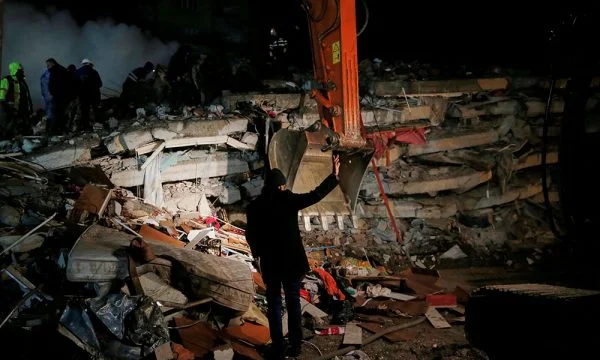
(3 years ago)Tens of thousands of people have died and dozens more have been hurt by the huge earthquake that struck southeastern Turkey, near the Syrian border, in the early hours of Monday morning. The quake, which struck near the city of Gaziantep, was followed closely by numerous setbacks, including an earthquake that was [...]
The quake, which struck near the town of Gaziantep, was closely followed by numerous follow-up ʹ including an earthquake that was almost as big as the first.
Why was it so deadly?
The first quake was huge. He registered as 7.8, classified as “the largest” on the official scale of the magnitude. It exploded along about 100km of the fault line, causing serious damage in nearby buildings, reports the BBC.
Professor Joan Faure Walker, head of the Institute for Risk Reduction and Disasters at University College London, said: “From the deadliest earthquakes in each given year, only two in the last 10 years have been with equivalent magnitudes and four previous in 10 years.
But it is not just the power of the shake that causes destruction.
The event occurred in the early hours of the morning when people were in and asleep.
The sustainability of buildings is also a factor.
Dr Carmen Solana, reader of volcanology and risk communication at Portsmouth University, says: “The resistant infrastructure is unfortunately in southern Turkey and especially in Syria, so saving lives now largely depends on the response. The next 24 hours are crucial to finding survivors. After 48 hours the number of survivors decrease dramatically. ”
This was a region where there had been no major earthquake for more than 200 years or any warning signs, so the level of readiness would be smaller than for a region that was more accustomed to coping with the quakes, the Klankosova broadcasts.
What caused the earthquake?
Earth's crust consists of separate pieces called plaques, which take refuge next to each other.
These tablets often try to move but are prevented by friction. Sometimes, however, the pressure increases until one plaque withdraws suddenly, causing the surface to move.
In this case, it was an Arabic tablet that moved north and jumped against the Anadol tablet.
Onion by plaques has been responsible for very harmful earthquakes in the past.
On August 13, 1822, an earthquake of 7.4 magnitude was triggered, evidently less than 7.8 on Monday.
However, the 19th century earthquake resulted in major damage to the towns in the area, with 7,000 deaths recorded only in the town of Alepos. The harmful consequences continued for about a year.
There have already been some setbacks after the current earthquake, and scientists expect it to follow the same trend as the former great one in the region.
Like earthquakes?
They measure on a scale called the magnitude of the moment. This has replaced Ritter's most popular ladder, now considered outdated and less accurate.
The number attributed to an earthquake represents a combination of distance that has moved the line of breach and force that has moved it.
A quake of 2.5 or less usually cannot be felt, but it can be discovered by instruments. Earthquakes up to five have felt and cause minor damage. The 7.8-magnitude Turkish quake is classified as large and usually causes serious damage, as has happened in this case.
Everything over 8 causes catastrophic damage and can completely destroy communities in its center.
How does this compare to other major earthquakes?
On December 26, 2004, one of the largest quakes ever recorded hit the coast of Indonesia, causing a tsunami that snatched entire communities around the Indian Ocean.
The 9.1 magnitude earthquake left about 228,000 people dead.
Another earthquake on the coast of Japan in 2011 é registered with magnitude 9 and caused widespread damage to the earth and caused a tsunami. It led to a major accident at Fukushima nuclear power plant along the coast.
The largest quake ever recorded is 9.5 and registered in Chile in 1960.