2 minutes ago
30% of Albania's population does not live normal lives from health problems, highest level in Europe
Periskopi(3 years ago)
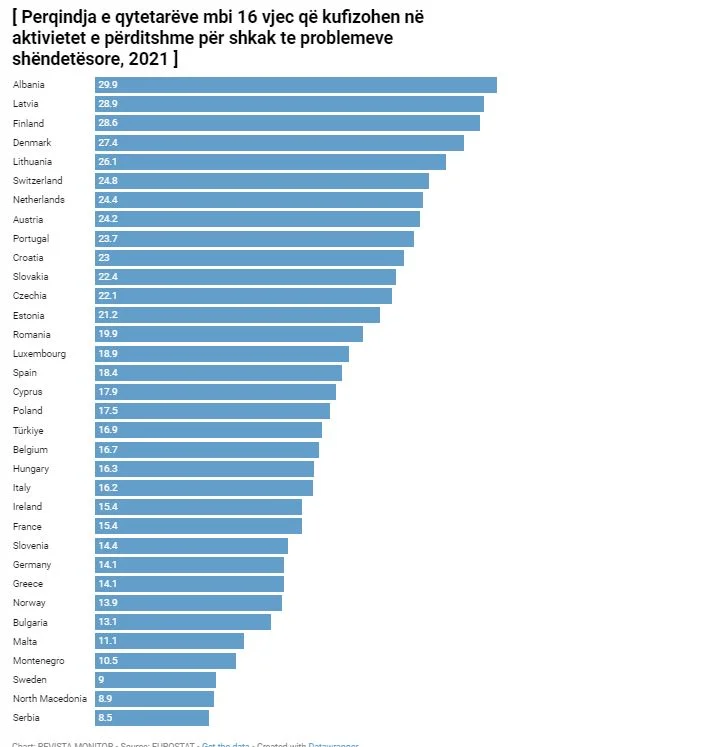
(3 years ago)Nearly a third of Albania's adult population is limited to daily activities due to health problems. Eurostat data shows that 29.9% of the population over 16 in Albania does not perform the daily routine due to illness, the highest percentage in Europe. Second place is listed [...]
Eurostat data shows that 29.9% of the population over 16 in Albania does not perform the daily routine due to illness, the highest percentage in Europe.
In second place, Latvia ranks 28.9 percent of the population, Finland with over 28.6%, Denmark at over 27 percent and so forth.
Serbia had the lowest percentage of the population (only 8% of it) that are hampered by health to make the life they want. Furthermore Macedonians with 8.9%, Sweden at 9% and Montenegro with 10.5 per cent of the population.
But Albanians have conflicting perceptions of health. But according to Eurostat data based on national surveys of countries 54% of Albanians perceive very good health, this is the highest percentage in Europe, but when asked whether health is an obstacle to their routine, Albanians are still majority, acknowledging that aspects of their lives are limited by disease.
As a country with the highest poverty rate in Europe, Albania has an under-financed health system, an aging population, with a growing trend of diseases from lack of time diagnosis, poor access to health services and poor health care culture.
Our country funds only 3% of GDP for health, one of the lowest levels in Europe. Access to drugs and innovative treatment therapies is very low.
Another 2021 IQVIA study found that the consumption of drugs per capita is 35 euros in Albania, when in Adriatic countries, it is 158 euros.
There are only 255 molecules on the Albanian stem list, while in Adriatic countries, 962 molecules.
The largest gap is noted in oncology, where only 40 out of 165 (24%) the molecule is remanded by 75% moat towards Adriatic consumption per capita.
The health insurance fund's budget has increased year after year, but growth rates have not been the same for the recovery fund. In 2019, the funds for stem of drugs totaled 27% of the total health insurance fund, and in 2021, 23% of the total insurance budget.
The (FSDKSH) budget has increased year after year, but the increase has mostly gone towards financing contracts with the Public Partnership-Private as basic medical control (check-up, sterilisation of surgical vehicles, dyalysis and recently laboratory).
According to World Health Organisation data, Albania covers only 70% of its population from the Forceable Security Fund. Albania's gap in population coverage relates to the low budget of the BiH Health Insurance Centre. /Monitor. al