42 minutes ago
The prime minister's office issues with meeting notice in Brussels: It's not about the selection, it's about the Association draft.
Periskopi(3 years ago)
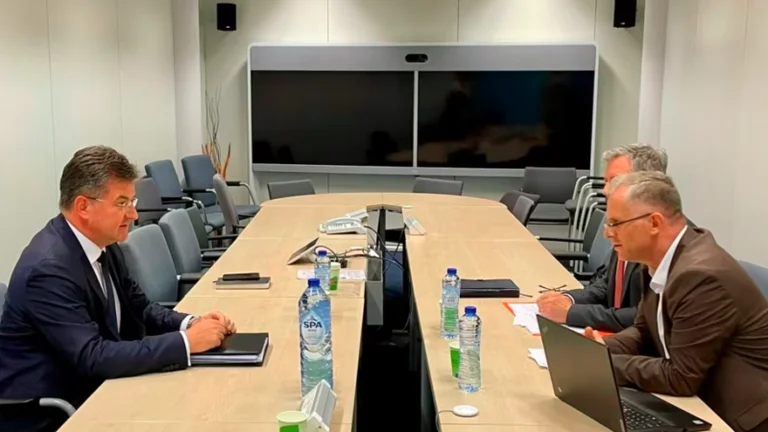
(3 years ago)The first Deputy Prime Minister for European Integration, Development and Dialog of the Republic of Kosovo, Besnik Bislimi, along with the team, had bilateral meetings with EU Special Representative Miroslav Lajcak. There was no trilate meeting between the parties, the prime minister's office announced. At the meeting, topics were addressed that connect with the implementation of the 27th Basic Agreement. [...]
The first Deputy Prime Minister for European Integration, Development and Dialog of the Republic of Kosovo, Besnik Bislimi, along with the team, had bilateral meetings with EU Special Representative Miroslav Lajcak. There was no trilate meeting between the parties, the prime minister's office announced.
At the meeting, topics that concern implementation of the 27 February Basic Agreement were addressed, the March 18th Enex Impulation Anex and the new plan for walking ahead of October 21st.
ZKM says this was the next meeting of the process after October 26th with leaders of Germany, France, Italy and the EU, where the Republic of Kosovo highlighted its positions as well as readiness for full signing and implementation of agreements.
“Draft-proposed to implement Article 7 related to Article 10 was not part of the discussion, but the position of Prime Minister Kurti presented on October 26th to the leaders, meaning that moving forward must be done in accordance with the principle that only signing implies accession and implementation of the” agreements, the announcement said.
In discussing the implementation sequence plan, the ZKM said the Kosovo side presented its comments insisting on full implementation of the Basic Agreement.
“U addressed and agreements which have faced obstacles and non-compliance in the process from the Serbian side, such as energy and the issue of violent missing persons. Kosovo agreed with the draft document for reference terms for the implementation of the Declaration on Undiscovered Persons, following EU accession of our” comment.
The government of the Republic of Kosovo said it remains committed and the constructive party in the process, fully committed to full normalisation of relations with Serbia and mutual recognition.
The bill for Association has been handed over to parties in Pristina and Belgrade in October by a joint delegation of the United States, the EU, Germany, Italy and France
The EU views this draft as the modern European “plan” and insists that the parties accept it.
Although the contents of this draft continue to be incontinent to the public, the EU and the main member states view it as the best proposal and as compromise which parties should use to move forward.
The European Commission has criticised Kosovo and Serbia for its unwillingness to implement obligations stemming from preliminary agreements.
The Commission's Progress Report has found that the parties have not started at all to implement the agreement towards normalisation.
In this report, the European Commission has extended an invitation to Kosovo and Serbia to approach obligations from the dialogue more responsibly, reminding that something like that is key to their progress in the process of European integration.
In recent meetings that have had leaders of Kosovo and Serbia, with leaders of the EU, France, Germany and Italy in Brussels on October 26th, they, according to European diplomats, “have expressed readiness to accept the proposal as a good basis“.
Kosovo Prime Minister Albin Kurti has expressed readiness to move ahead with this proposal, as well as with implementation of the normalisation agreement.
He has said he wanted to sign the document, since “signing alone means accession and guarantees implementation“.
But Serbia's president, Aleksandar Vuciq, has refused to sign it.
In the EU, they believe Thursday's meetings will pave the way for a new dynamic in the process of implementing agreements.
The normalisation agreement, of 11 provisions, envisions, among other things, a level of self-awareness for the Serb community in Kosovo and mutual recognition of state symbols, while calling for Pristina and Belgrade to implement, as well, all previous dialogue agreements.
Kosovo and Serbia are part of the EU-brokered dialogue for normalisation of reports since 2011.
The sides have signed a host of agreements, but not all have been implemented.