14 minutes ago
Specific requirements and deadlines for Kosovo and Serbia: That's how five comes in tomorrow.
Periskopi(3 years ago)
(3 years ago)Western envoys coming to Kosovo and Serbia tomorrow will demand Kosovo and Serbia that “engage much more seriously in implementing the Ohrid Agreement”. Washington, Paris and Berlin are counting on continuing dialogue with EU mediation and, in line with circumstances, pressure Kosovo Prime Minister [...]
Western envoys coming to Kosovo and Serbia tomorrow will demand Kosovo and Serbia that “engage much more seriously in implementing the Ohrid Agreement”.
Washington, Paris and Berlin are counting on continuing dialogue with EU mediation and, in line with circumstances, would pressure Kosovo Prime Minister Albin Kurti and Serbian President Aleksandar Vuciqi to return to the negotiating table.
Recent events in Kosovo, which have dramatically changed the atmosphere, will force visitors to seek concrete action -- for Belgrade to strongly and unequivocally condemn the recent armed incident, as well as for both sides to engage much more seriously in implementing the Ohrid Agreement, writes Demostat referring to sources from Western diplomatic circles.
The same sources are quoted as saying that “the large key” comes to Pristina and Belgrade with “requests and specific deadlines”, as well as to “providing specific consequences if they refuse to implement the” agreement.
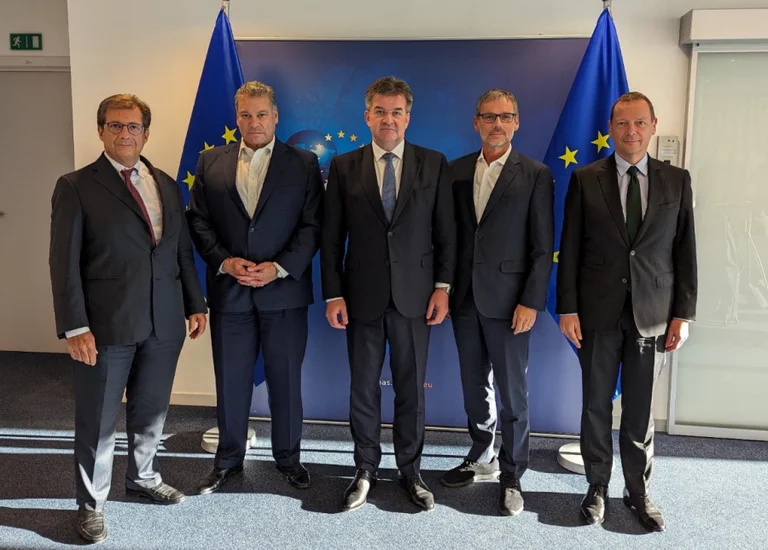
On Saturday, originally in Pristina, and later in Belgrade, a group of five envoys -- Miroslav Lajcak -- will arrive on behalf of the European Union, Gabriel Escobar (SHBA), Emmanuel Bon (France), Jens Plotner (Germany) and Francesco Talo (Italy).
European Union spokesman Peter Stano told Beta agency that they are going to talks =with Kosovo Prime Minister Albin Kurti and Serbian President Aleksandar Vucic, “with clear expectations that both sides will continue the process of normalising relations and implement their obligations without delay and without conditions”.
Johanna Deimel, an independent German analyst for the Western Balkans and Southeast Europe, tells of Demostati that “Quinti, despite the wars in Ukraine, in the East Bini, which requires much attention, decides that “the large key” travel to Belgrade and Pristina, shows how concerned and important de-scalfaction is. This is in itself a very clear message”.
Deimel estimates that “Alexander Vuciq has been cornered after the violence in Banjska”.
“Quinti will surely wonder to what extent Vuciq keeps everything under control and how reliable he is. Not Alone The US, who have clearly stated that the 24 September responsibilities should be prosecuted”, estimates.
According to Deimel, the fact that Vuciq chose travel to Beijing before the summit, which was held in Tirana and that he ignored the EU and neighbouring countries, does not help much and that he will now probably be “bee on his knees”.
“Do you really want Vuciq to join the European Union? Is he the right partner? If not, of course, it will be considered on which points, for example, the sanctions aimed at other people from the narrow circle of Vuchiq” can be used, says Deimel, under which only normalisation and implementation of what has already been discussed and agreed will help both countries.