8 minutes ago
Hill: Early to say dialogue between Kosovo and Serbia is unsuccessful
Periskopi(3 years ago)
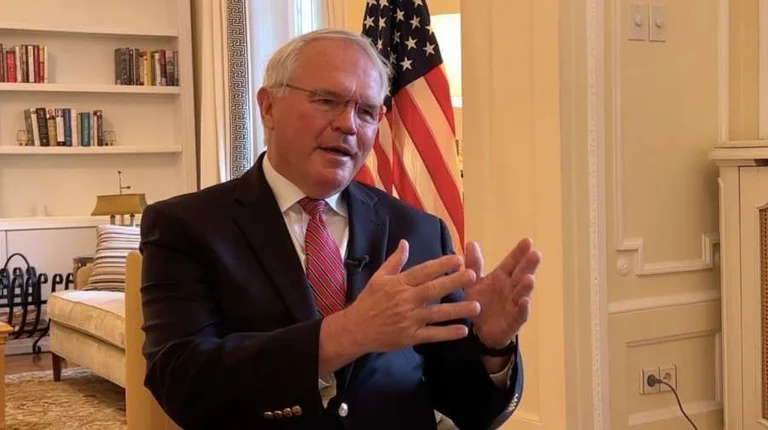
(3 years ago)It is very early to say that dialogue between Serbia and Kosovo is unsuccessful, said Christopher Hill, ambassador of the United States of America (SHBA) in Belgrade. In an interview for Radio Free Europe (REL), Hill said he did not expect the full “ “success of the negotiations and that his expectation was the return to [...]
In an interview for Radio Free Europe (REL), Hill said he did not expect the full “success of the negotiations and that his expectations were to return to the negotiating table.
“Now we need to see [the following]”, he said.
The aim of the dialogue, as he emphasises, is a political solution that awaits “the approach of the” on both sides.
“A can achieve a situation where Serbs in Kosovo feel comfortable and have a kind of Serb majority communities association. And secondly, can Pristina achieve what it wants, which is a clear way for membership in international organisations”, Hill said.
He stressed that the armed attack on Kosovo police in Banjska is a major obstacle to negotiations in Brussels. According to him, the US is closely monitoring investigations in Belgrade and Pristina.
“Fokus is to reveal exactly what happened, who is responsible. And finally, create circumstances where this can't happen again”, the American ambassador stressed.
Radio Free Europe: Mr. Ambassador, let's start with yesterday's [Kosovo and Serbia] talks in Brussels. Looks like they're off the hook. Have you expected such a result?
Christopher Hill: I didn't expect any complete success. But, of course, I've been waiting for some effort to turn into the core elements of dialogue. In that sense, there has been an important meeting, both sides have been on the meeting. So we'll see. For the time being, however, it is clear that it has not solved all problems that remain in dialogue.
Radio Free Europe: EU and US diplomats also say it is important that the leaders of Serbia and Kosovo return on track, return to the table. But is it now time for a new kind of format, since it is not producing much results? So what should the process look like?
Christopher Hill: I don't want to speculate about the process the European Union has created. I think he's got a lot of attention in the European Union. It has been important to see the participation of the president of France, the Chancellor of Germany... So, I think Europeans have contributed an important level of effort.
The real issue is the essence of dialogue. Can we get to a situation where Serbs in Kosovo feel comfortable with their own environment and have a kind of association of [most] Serbian municipalities? And, secondly, can Pristina achieve what it wants, which is a clear path towards more internationalization?
These are complex issues, difficult problems, of course inherited. But I also hope there will be an inspiration for the future. It's too early to pretend this is failure. Let's see how it goes from here.
Radio Free Europe: But how close are we?
Christopher Hill: I'll know when we're there. It's very hard to measure how close you are when you're not there. What I know is that this process of dialogue has been interrupted by a very, very difficult situation and, in fact, something that has been quite harmful to the overall process. These are the events that happened in Banjska.
Radio Free Europe: The United States has called on Serbia to participate in the probe into the Banjska attack. But are parallel investigations in Serbia and Kosovo alongside co-operation the good way to clarify what happened?
Christopher Hill: I think the point is to focus on exactly what happened, who's responsible, why they did it and, in the end, create circumstances where this can't happen anymore. I think this involves many different structures. What can KFOR do, container NATO, this way? What other aspects should be discussed?
It's not easy, but I think it's a process that has to be complete, it has to be clear to people and, in the end, should be effective and make sure that this never happens again.
Radio Free Europe: How can this co-operation be achieved, since both sides have completely opposite interpretations?
Christopher Hill: Yeah, that's definitely a problem. That's why we have to intercede for this. Clearly, investigations are under way... The Serbian side has said it will make a thorough investigation. The Kosovo side is doing the same. I think the U.S. is watching very closely. All in order to ensure that he has responsibilities and does not repeat himself. So it's a big factor.
But, in the end, what we need is a process of dialogue aimed at a political solution. So we can never forget dialogue. And, in this respect, I'm happy that Mr. [Muoslav] Lajcak [EU representative in the Kosovo-Serbia dialogue] has gathered the parties, has received a high European attention. The best thing we can do is support Mr. Lajcak's process and try to make sure he's finally successful.
These things do not occur at the time that everyone wants to happen, especially when you have big obstacles, such as what happened in Banjska.
Radio Free Europe: In that process, in the Brussels process, Pristina called for sanctions against Serbia. So, what would be the consequences if authorities in Belgrade are declared responsible for the attack?
Christopher Hill: Well, again, I don't want to ask that question. Of course, there's a lot of investigations, so I can't, actually, get into a hypothesis about it.
I want to stress once again, risking a tremendous repeat sound, that this is a problem that needs a political solution, not a military solution. And there should be a respect for the opinions of each side and see if some of these problems can be addressed through a process of dialogue. I don't know a better way to do this.
I don't think you'll have a situation where one side will be able to just dictate the other side. I think there should be a process of giving and taking. And, I think that's what Mr. Lajcak is trying to do. And, for him to work hard... you know, he has had many achievements in his life and is working on a very difficult case and I think he deserves our support.
Christopher Hill: Well, actually, I can't discuss what the Government wants or doesn't want in Pristina. What I know is that Mr. Radoic, through his lawyer, has taken some responsibility for what happened. So, I'd like to see what the future process would be with Mr. Radoiciq. I understand that it is in Serbia, it has been told not to leave, and, in fact, has been told to expect a criminal process in the future. So let's see how it goes. So I'd rather not ask these kinds of questions, except to say there must be a complete account of what happened.
Radio Free Europe: How do you see those political messages regarding the attacks on Banjska from Belgrade, since Vuciq said the attackers are not terrorists to him and the interpretation of the event?
Christopher Hill: You know, the question of who is a terrorist and who is something else is an old question. And this isn't the first time he's shown up. We often talk about these unique situations in Serbia and Kosovo. Well, there's nothing unique about these kinds of situations. So we need... you know, we've seen these kinds of problems before.
And, again, the road ahead... and everyone needs to understand this and understand much better the need for both sides to sit on the table, [to show] what they want from this process and make it more accessible to the other side. And that includes giving and receiving. No one can get away from this dialogue process and say I want everything and I force the other side to agree with everything.
I think people should also reflect on the fact that Kosovo and Serbia will be around for a long time. And what we really need in general in the region is a capacity for countries in the region to work better together and, in this context, to be better candidates for the [membership] process in the EU.
And, I think we have seen from the EU a desire to do more, for [to carry] one step further on its processes.
I think that in terms of Serbia, it is important to be on the line in this process of growth, which Mrs. Von der Leyen has been talking about in recent weeks. I think that many solutions for these things remain in an EU that is considering as best and as soon as you bring these countries, like Serbia, to EU structures. So this is something that's happening and I'm sure Serbs will pay very much attention to this, and I'm sure that even Serbian authorities are doing just that.
Radio Free Europe: When you mention EU integration, there is an open question about sanctions against Russia. Serbia is not imposing sanctions, and officials want to stress very often that Serbia has not imposed sanctions for 20 months
Christopher Hill: Yes, Serbia has insisted on not imposing sanctions longer than the Russian military insisted on parts of Ukraine. Look, this is a clear case of aggression, terrible aggression, aggression that doesn't just... Russia has not only threatened its neighbours, but has threatened global food supplies, global power supplies. This is really the Russian savage behavior.
I think Serbia has spoken very clearly about this. I think we've seen some kind of developing relationship. It is not a new relationship, but a strengthened relationship between Serbia and Ukraine. We have seen bilateral meetings between the two presidents of the two countries. So I think Serbia is doing some things.
You know, in terms of sanctions, I know it's a very sensitive topic in Serbia.
My view, my country's view, is that all should join sanctions against Russia. I think it is better for Serbia to understand something like that and take action based on its understanding.
So I'm not here to tell Serbia what to do about it, but I will urge everyone to look at the objective circumstances of a country attacking its neighbour in order to steal neighbor's territory. And, this is a big problem, and I hope everyone will see it under these conditions.
Radio Free Europe: You have once said that Serbia is paying a high price for failing to impose sanctions. So, what was deprived of Serbia?
Christopher Hill: You know, I think in the sense that, you know, the European Union expects an approach to foreign policy issues. They're waiting to be approached. And, of course, if Serbia were to move on to the issue of sanctions with Russia, I think there would be an assessment of the fact that Serbia would bring itself into a closer line with the European Union for this.
I want to stress that we believe that Russia should, frankly, be sanctioned for the crimes it committed against its neighbour. But I'm not sure it's useful for me to sit here and tell Serbia what to do. Serbia should, you know, think these issues for itself to understand its aspirations for the European Union, to understand that this is Serbia's future. Serbia has nowhere else to go. And so I hope they'll decide for themselves in this direction.
Radio Free Europe: Ties with China have also deepened. During his recent visit to Beijing, a free trade agreement was signed. How will this affect bilateral relations between Belgrade and Washington?
Christopher Hill: You know, Serbia has the right to maintain its relations with other countries. The U.S. has relations with China. Frankly, we have much more trade with China than Serbia has with China. So, I repeat, I am not here to lecture on what Serbia should do about China. I think we see in newspapers in Serbia, we see in the press an effort to make it known to readers and the public that there are good sides and there are bad side effects.
China's relations with some of the smaller countries, whether in Africa or Southeast Asia, have at times had many concerns about some of these economic ties.
So, I think Serbia has maturity and understanding to deal with these kinds of things carefully and in Serbia's interest. Of course, our interests are sometimes affected by these issues and we certainly are in contact with the Serbian government. But, again, I think the best foreign policy is when you have good consultations, when you don't surprise each other, when you have a free exchange of thought and when you don't think you can just tell the other side what to do. So that's the kind of relationship we want to have with Serbia and I think we're working on it.
Radio Free Europe: When it comes to co-operation and relations, are the close ties between Serbian officials and persons on the US blacklist from Serbia and Serbian entity in Bosnia, Republika Srpska, an open issue between Belgrade and Washington?
Christopher Hill: Yes, I think we have had some real problems with the Serb leadership in Bosnia. This is definitely a big problem for us. And when we look at some of these officials, whether they're individuals or what they've done and what their views are, we have the right to make decisions based on our needs and our security. And, some of these people we don't want to give them visas, we don't want them to have their bank accounts in the United States, we honestly don't want to do anything with them.
We, of course, have the right to declare those people persona non grata. We've done this with Mr. Dodik, we've been doing this lately with his grown children, by the way.
We call them kids, but they're actually adults. We've made it very clear, we're not going to deal with people who abuse other people's money and who behave in ways that we think are not compatible with any kind of standards. And we will take measures to protect ourselves from such people.
Radio Free Europe: Do you think Belgrade is investigating these very serious charges, which are highlighted in explanations of US Treasury Department sanctions?
Christopher Hill: I know Belgrade certainly has his thoughts on these issues. I'm really talking about sanctions against the Republika Srpska, which, I think, are properly designed to follow people who, in various ways, have caused major problems, starting with the fact that they do not support the Dayton Peace Agreement.
I would stress, I think the Dayton Peace Accord was a very good thing for the ethnic Serb people in Bosnia. I think the Dayton Peace Accord is quite appropriate and really a good approach. And Belgrade authorities have said that on many occasions they support this and support Bosnia's territorial integrity.
So when we see people in Bosnia, and whoever, we feel, like any other country, the right to take action against such people and keep these people out of our territory and make sure they don't do business with us. So this is kind of a base of these sanctions.
Radio Free Europe: You have been present here in this region for a very long time and many of the political figures and political parties have been active in the 1990s and now in the region, even in Serbia. Was it easier for you to talk to them then or now?
Christopher Hill: I represent the interests of the United States and believe that US interests are best served by well-informed diplomats, so I speak to everyone I can because in the plurality of opinions you will learn things.
I don't try to limit myself to talking only to certain people, because some people don't want me to talk to certain people.
I'll make my choices about who I'm talking to.