43 minutes ago
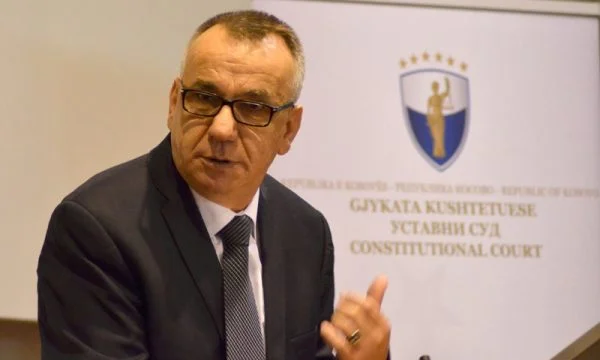
Former head of the Constitutional Court: The president violated the Constitution can have serious consequences
Periskopi(3 years ago)
(3 years ago)The former head of the Constitutional Court says the final insistence on the interpretation of the Constitution of Kosovo cannot bring down Blerim Isufaj's failure to bring President Vjosa Osmani down to chief state prosecutor. But it says that “could have serious consequences” for the head of state, because according to him, it “has violated the Constitution” by [...]
The former head of the Constitutional Court says the final insistence on the interpretation of the Constitution of Kosovo cannot bring down Blerim Isufaj's failure to bring President Vjosa Osmani down to chief state prosecutor. But it says that “could have serious consequences” for the head of state since, according to him, it “has violated the Constitution” by holding “in the drawer of” the Prosecutorial Council file with the candidate proposal for the chief prosecutor.
Hasan told Gazeta Express that Osman is right when he says the Prosecutorial Council can send another proposal to the chief prosecutor, while he said the Isufaj selection procedure was “without integrity and thoroughly manipulated” while chief Special Prosecutor's Prosecutor considered the “unworthy of the position of chief state prosecutor<3>. Now, according to him, the competition needs to be reopened.
International law professor says Osmani has had to make the decision earlier, as “has had rights and constitutional obligation”. By inaction, Hasani says that apart from the Constitution, the president has violated even “the rights of the other candidate that was refused, the candidate-victimim, who, listening to the president as to having to wait for the regular judiciary verdict, has gone through trials and has lost the legal deadline”.
The Constitutional Court recently made the decision to appeal candidate Albanian Fazliu, who had rejected the process of electing the chief state prosecutor to regular courts. The Constitution found that the other courts had acted directly that they had rejected his indictment as ineffable, while his request was addressed, not on the basis of the legality of the process, but on the legality of the decisions of the preliminary courts. Had we been a member of the Strasbourg Court, I assure you that this victimised candidate would thus have won with dignity his” case, says Enver Hasani.
Express newspaper: What does the Constitutional Court's recent decision regarding one of the candidates' complaints to the chief prosecutor say about you?
Hasani: The decision has been expected, but the candidate has been victimised by the highest state institutions. It has all started with the President's public statement, which initially said court decisions on the matter should be expected. With this statement, the candidate, whom the Constitutional Court without waiting told him that he had to forge legal means, an absurdity of his own kind after the previous five Constitutional Court precedents concerning identical cases, or all the same. When the victim's candidate went to court regularly, he was told that you lost your deadlines and, ironically, when he came back to the Constitutional Court, that he told him that the regular judiciary had well you lost your deadlines and therefore the case is unacceptable for consideration and merit settlement due to the procedural barriers. If we were members of the Strasbourg Court, I assure you that this victim candidate would thus win his case with dignity. One day we will become members, and many cases will end up there. Kosovo must be ready for a budget reserve for the damages its organs have caused. You see with international arbitration how many millions we lose as a country, and no one answers to that. This vicious circle must cease, as soon as possible.
Express newspaper: The president said the Prosecutorial Council cannot again propose for decree. How is the matter envisioned?
Hasani: Here's the President's right on the whole. The procedure must be repeated. The Council has no right to submit the same proposal and no other proposal based on the old procedure, which is rightly considered without integrity and entirely manipulated, with candidates opposed to their overall and unworthy of the position of chief state prosecutor.
Express newspaper: Can the Constitutional Court bring down this presidential decision?
Hasani: No. It's not the work of the Constitutional Court to bring down reports. There's no decision. There is an announcement by which the president of the republic announces the Prosecutorial Council for not decreeing. This announcement was to be sent by Presidents of the Presidency, not by the President. The chief of State does not directly communicate with this level. This is the first one. The second and most important is that there must be formal decision for decree, because the constitutional license and dismissal of the head prosecutor of the state by Article 84.17 of the Constitution is within the authorisation for taking the decision to refuse the decree when it considers that the procedures of the candidates' proposal to the Prosecutorial Council have been marred by legal and constitutional violations.
Express newspaper: Can there be consequences for the president if the case goes to Constitution and the Court decides against its decision?
Hasani: Yes, there can be serious consequences. The president of the Republic has the primary institutional obligation to take care of the law and the constitution for parts of constitutional authorisations that it has from Article 84 of the Constitution, is the first dam of constitutional protection and law in these competencies it has. With the contents of the prosecutorial Council file containing the candidate's proposal for chief state prosecutor, the president has violated Article 84.2 of the Constitution because it has hampered the constitutional post and full authorisation of the state prosecution's title. This violation has been ongoing, while today's announcement has no legal effect, nor the elements of the judicial act as defined by Kosovo's positive legislation. You know that when it was the case of Mrs. Valdete Daka's constitutional dismissal, the president has made the decision and has widely reasoned as if she were the first-degree court. I had to act the same way here because there was a right and constitutional obligation, while in the first case there was no such thing. So using the facts that there have been, including the verifications that carry out the country's intelligence organs, but other actors who have done research and monitoring the process of chief prosecutor selection, the president has had to act. By inaction, it violated the Constitution, but also the rights of the other candidate that was rejected, the candidate-victim, who, listening to the President, should wait for the regular judicial verdict, has gone into court and lost the legal deadline. They are not competent to assess the legality of the Judiciary Council's procedures for the head prosecutor of the state, because those procedures produce only one proposal, not the final decision that rules for one's right. That decision is made by the president of the Republic, who cannot submit to control of legitimacy.
Express newspaper: What happens now to the prosecutor's case? What is the solution?
Hasani: The competition must be reopened, while determining the president's eventual constitutional responsibility depends on whether the case is sent to the Constitutional Court. Of course, this case is on the list of serious constitutional mistakes, I would say among the most serious to date.