13 minutes ago
Havenier: Ohrid Agreement Implementation Increases Kosovo Security Scale
Periskopi(3 years ago)
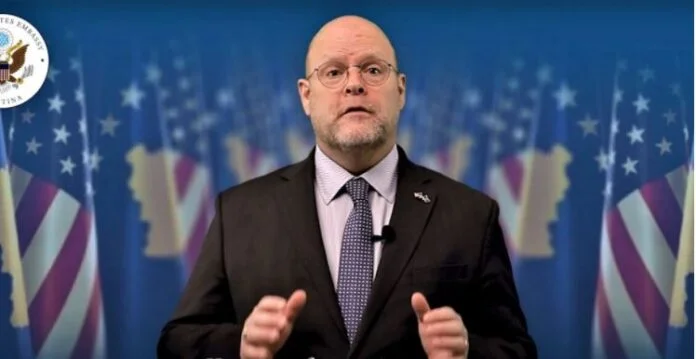
(3 years ago)US Ambassador to Pristina Jeff Hovenier said in an interview with Voice of America that implementing the agreement on normalising relations with Serbia is one of the ways to boost Kosovo's security, which he described as fragile after the events of 24 September. Ambassador Havenier said the United States will receive [...]
Ambassador Havenier said the United States will take measures after proving who stands behind that attack carried out by individuals who have weapons that cannot be bought on the local market but need a form of state structure to offer them. Ambassador Havenier reiterated the request for Serbia to co-operate for full lighting of events and bringing authors to justice.
Voice of AmericaAmbassador, more than two weeks from the attack on the village of Banjska in northern Kosovo, how do you assess the security situation in this country?
Jeff Havenier: The security situation remains something that we are very concerned about and the United States and our partners have taken steps because we were deeply concerned about what happened in Banjska and more widely about the security situation in the north. As you may have heard yesterday during the change of KFOR command, Admiral Munch, commander of NATO Joint Forces with headquarters in Naples, announced that by 24 September, NATO has tripled the number of patrols. The North Atlantic Council made the decision to significantly increase the number of KFOR forces. We take this seriously. I would characterize the current situation as fragile but quieter or more. But you know, there is a fragility and we are very focused on helping manage the situation and trying to avoid other incidents that could lead to violence and that would affect the civilian population there, but even legal security forces there, the Kosovo police and, of course, the international presence.
Voice of AmericaAmbassador, from the outset you said that there was no spontaneous group of citizens involved, but it was a trained and organized group. What do you think? Who was the organizer and coach of that group?
Jeff Havenier: First, I think it's important to talk about what we know and what we're still trying to understand. And there are some things we know. As you quoted earlier, we know that this group of individuals was not spontaneous. These individuals, all ethnic Serbs as we know, had access and possessed sophisticated weapons that these individuals, all ethnic Serbs as we know, had access and possessed sophisticated weapons that you cannot buy on the local market. You need some kind of structure, usually state structure that offers you.
You can't buy them on the local market. You need some kind of structure, usually state structure that offers you. We know that most of the material they left behind was of Serbian origin. We know that an individual, Mr. Milan Radoicic, who was deputy chairman of the Serbian List party, made a public statement through his lawyer taking responsibility, saying he had organised the attack and participated in it. These are the things we know now and we're trying to understand more. We know that this could not happen only spontaneously. So, as I said before, there were structures or organizations after that. What we're still trying to figure out is exactly how it worked.
Voice of America: Allow me, ambassador, if the weapons are originally from Serbia and we have a public character who claimed responsibility, so Milan Radoicic. Isn't that the argument Serbia stands behind the attack?
Jeff Havenier: There are a lot of people who say that. I have heard many officials in the Kosovo government say this in particular. We want to be very careful before we make the final definitions of what we call atrium, to make sure we understand correctly. But, as I said, we're taking this very seriously and working with our friends in the Kosovo government and elsewhere to better understand this.
Voice of America: Kosovo leaders say it was an attack of Serbia's aggression against Kosovo and require punitive measures against Serbia. Could such measures be made by the United States?
Jeff Havenier: One of the things I've said, one of the things Secretary Antony Blinken and others has said is that those responsible for this criminal attack, those responsible for his execution, those responsible for his planning, those responsible for providing his support, must be held responsible. And while we understand who is responsible, we believe they should be held accountable. We have called on the government of Serbia to participate fully in this investigation and to seek accounts from the people there. Of course, we support the efforts of Kosovo authorities here in their judicial system to hold people responsible. So I don't rule out future actions. We are still looking to understand what happened, but we will make decisions about what steps we should take as we arrive at our final definitions of responsibility. But let there be no qualms, those responsible for this terrible crime and the killing of a police officer must and will be held accountable.
Voice of America: But we have Mr. Radoicic, who emerged and said he is responsible for the attack, but was soon released by Serbian authorities. Judged by this, how can you calculate in Serbia that it will co-operate to clarify the event and bring the authors to justice?
Jeff Havenier: I can only talk about the view and attitude of the United States government, which we have publicly expressed to the government of Serbia. So this was a crime, it was a threat to the sovereignty and stability of the region, threatened Kosovo citizens, and threatened international peacekeepers in the region as well. And we believe those criminals involved in this should be held accountable. And we have called on the government of Serbia to play a role to ensure that this happens. I can't talk about the specifics of a court decision regarding home arrest. I understand, Mr Radoicic has been arrested and charged with some very serious crimes. My government expectations are that he will be held responsible for those crimes.
Voice of America: But he's free...?
Jeff Havenier: As far as I understand, he's under house arrest, subject to a criminal process.
Voice of America: Are you ready to take measures against Serbia if you do not co-operate with justice?
Jeff Havenier: This is not a decision I will make as an ambassador of the United States to Kosovo. This is a decision my government will make. But let me say again, we believe that those responsible for this crime should and will be held responsible.
Voice of America: Ambassador, many in Kosovo express concern that without measures against Serbia could repeat similar actions like this of September 24th. Are you concerned about this possibility?
Jeff Havenier: We are concerned about any action that would destabilise the situation in the north. We are concerned about any action resulting in armed and trained individuals acting in a way that is contrary to the legal order. We believe this is Kosovo's sovereign territory. We believe Kosovo authorities have the responsibility to enforce the law. So we take it very seriously.
Voice of America: Mr Ambassador, international observers, especially some American analysts, say Washington and, of course, Brussels were very severe in their attitude towards Kosovo, but not hard enough towards Serbia. It took only a few hours to impose some sanctions against Kosovo due to tensions in the north, but we have no move on Serbia now, after 24 September?
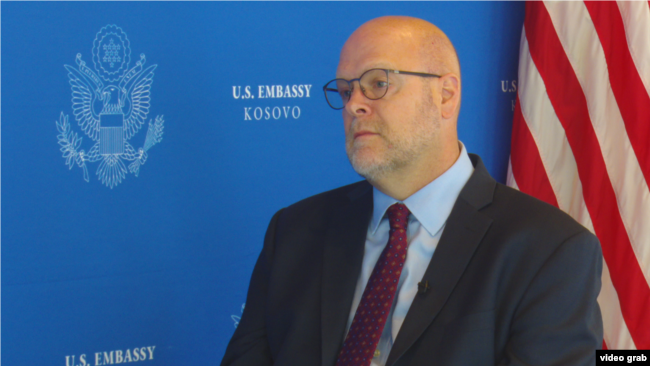
Jeff Havenier: What I can say is first of all, I wouldn't even equal these two circumstances. Second, I would say that the United States government decided to take certain actions after the prime minister (of Kosovo) against our advice took the action they used, from our point of view, unnecessary strength to provide access to municipal buildings, contributing to a destabilisation in the north. We knew this was a problem. We did not take the measures the European Union took, but the United States government did some things, making it clear that we expect the Kosovo government to work with us to strengthen stability and security in the north. We have similar expectations for Serbia. And again I'm going to say that as we reach our conclusions, for our final responsibility or what we call objectivity for these acts, we will hold responsible those responsible. But while we expect the Republic of Kosovo and the Kosovo government to work with us to create conditions for greater stability and reduced tensions in the north. This is still a very important part of our work here. So that's why I've made a number of statements, as well as other American officials, of the need to move forward with the facilitated dialogue from the European Union. If nothing else on the 24 September shows that there is an urgent need to reach a reposition of relations between Kosovo and Serbia, a relationship in which there is mutual respect, one in which disputes are resolved by peaceful means, one in which the ethnic Serb community in Kosovo feels respected and may enjoy certain rights to protect its members. All of this is part of the EU facilitated dialogue. It is very essential to move towards this, to return to the process of achieving full implementation by both sides of the agreements reached, the Constitutional Agreement and the annexes of its implementation.
Voice of America: But, Mr. Ambassador, in light of these recent events, can the common “work often --x1> dialogue facilitated by the European Union? You are diplomats and would not use the late “dialog”, but some in Kosovo have called it.
Jeff HavenierWell, I would contest the claim that he died and also raise the question, what do people with the usual “work” mean? If “business as usual” means the European Union and the United States will make their maximum efforts to promote an agreement that benefits both countries, then yes, we will continue that action. Right now, I think we have a problem. The problem is less the issue of an agreement that is, in fact, good enough for both countries and more, a question of political will on both sides to actually implement obligations that have taken over freely. They have to do this. And we will continue with that work of implementing a good agreement that changes relations and creates conditions of greater stability and security for the people of Kosovo and for the people of Serbia. And I don't think we're gonna apologize that this will continue to be our approach. However, we will certainly be clear about the fact that we must see greater political will on both sides to fully apply those obligations.
Voice of America: ...Even though Kosovo leaders are now saying dialogue is not a priority, but Kosovo security is a priority?
Jeff Havenier: I agree that Kosovo's security is a very high priority. I believe, my government believes that one of the ways to urgently boost Kosovo's security is through implementation of the Constitutional Agreement and the Annex of Implementation. This will greatly boost Kosovo's security. Therefore, we feel that it is so urgent to move forward in dialogue to achieve this.
Voice of America: Ambassador, when we talk about the agreements, the Association of Serb majority municipalities has long since the first day, has been considered Achilles' “back to the negotiations process, raising concern that it can affect Kosovo's functionality. How can this agreement be implemented by addressing at the same time Pristina's concerns about its impact?
Jeff Havenier: I am so glad you asked this question because it is something we talk about very much, both publicly and with the Kosovo government. The United States has been very clear about this. We believe that Kosovo has a permanent obligation since 2013 to advance the foundation of the Serb majority municipalities' Association. But we have also done everything possible to recognize this concern. And we do not rule out concern that if it is done wrongly, it could actually harm the good functioning of the state of Kosovo, something that none of us wants to have the association to comply with the current Constitution of Kosovo, so without constitutional changes. It must be in line with the 2016 Constitutional Court's decision. It should be in line with the EU's commitment that there is no executive competence. It should be in line with a public document designed very carefully by State Department Adviser Derek Chollet and our special envoy for the Balkans, Gabriel Escobar.
I see. But that's why my government has been so clear to what I call rails or restrictions on how it should be founded. And let me repeat them. The United States believes that no matter what association is established it should be in line with the current Kosovo Constitution, so without constitutional changes. It must be in line with the 2016 Constitutional Court's decision. It must be in line with the European Union's commitment that there is no executive competence. It should be in line with a public document designed very carefully by State Department Adviser Derek Chollet and our special envoy for the Balkans, Gabriel Escobar, who revealed all of this. What we see is co-ordination among Serb majority municipalities and how they exercise positions that they already have according to the Kosovo Constitution based on the Ahtisaari plan and areas where they have these responsibilities, such as education, health care, land exploitation, such things. We also believe that it should ensure transparency. Under Ahtisaari's plan, Serbia's government is eligible, if it wants to exercise it, to provide support to the ethnic Serb community in Kosovo. But this should be done in a way that is in accordance with Kosovo's legal structure and to respect Kosovo's sovereignty. So the whole health care issue or educational system issue should be transparent and in line with Kosovo laws. This would be a notable improvement in the current situation. He would address the concerns of the ethnic Serb community and, we believe, would help stability. So we challenge those who say that, by its nature, the association of Serb majority municipalities is harmful to the good functioning of the state of Kosovo. We strongly believe that there are ways to do so that it actually improves the function of the state of Kosovo by also fulfilling the critical role of addressing the real concerns of the ethnic Serb community in Kosovo.
Voice of America: When explaining this to Kosovo leaders, how do they react?
Jeff Havenier: I will let Kosovo leaders speak for themselves. All I can say is I think we have a convincing argument.
Voice of AmericaAmbassador, but when you talk to people in Kosovo, sometimes they say that, you know, even with those guarantees, people like Milan Radoicic can lead that community association. How can we feel at ease with people like him?
Jeff Havenier: That sounds hypothetical. And after all, we believe that there must be some trust in the international community and in ourselves that we will be able to apply it in a way that is for the people of Kosovo, including the ethnic Serb community in Kosovo, by respecting and accepting the current legal framework.
Voice of America: Ambassador, Kosovo authorities expressed disappointment with EU mediator Miloslav Lajcak, perceiving his approach as, they said, many unbalananized. At the same time, there are increasing demands for more direct US involvement. What are the chances for more US in this process?
Jeff Havenier: I'm not sure how much more the United States can get involved in this process. This is for good reason a dialogue facilitated by the European Union. That is appropriate, because ultimately, incentives to do difficult things belong to the European Union. After all, as High Representative Josep Borrell stated in Ohrid, these commitments that have been taken should become part of the membership processes for both countries. And since it is a European process of European obligations and European commitments, it is appropriate for the European Union to take the lead and facilitate what is ultimately not a dialogue with Europe, but between Kosovo and Serbia. I think the United States has shown how serious we take this, how committed we are to seeing this issue resolved successfully. Miroslav Lajcak enjoys our full support. This dialogue enjoys our support. I spend more time on these issues than on anything I do as an American ambassador to Kosovo. My colleague in Belgrade is very involved. Our special envoy is very, very involved. So sometimes I'm embarrassed when people ask how much more involved we can be when I think about how involved we are already. After all, we want to see success for Kosovo. We want to see success for Serbia as well. And we want to see success for the European Union to see these countries fully on the road to bloc integration, which would increase sustainability, increase progress and help realise this view that we all share for a whole, free and peaceful Europe. That's the ultimate goal.
Voice of America: Can we expect any moves in the coming days to advance this dialogue process? Is there a plan?
Jeff Havenier: We are very committed to seeing progress in dialogue. I can't speak for particular, but I expect new efforts because it's urgent. As mentioned earlier, September 24 showed that we have no time to waste. We must move forward urgently with the achievement of common understanding on how to fully implement, effectively, obligations that are taken by both countries under the basic agreement and the annex of its implementation.
Voice of America: I'll be back on September 24th. Do you see any sign of Russia's intervention in what happened in the north, given that some would argue it would benefit the Kremlin's intention to draw attention from Ukraine?
Jeff Havenier: I think we should all be concerned about anything that would draw attention to the critical issues in Ukraine and the kind of brutal war of (Vladimir) Putin and this principle that Putin believes will decide for the future of a neighbouring country and not the citizens of that country. We can't accept this. And, of course, it benefits when there is instability elsewhere in the region. I'm sure he's happy when there is instability and conflict. On the other hand, for now I cannot say that we have any information that would directly suggest Putin or the Kremlin lies behind some of the instability we have seen between Kosovo and Serbia. But what we want to do is avoid conflict by moving forward to achieve the full implementation of the Constitutional Agreement and application annexes, which would remove this source of potential instability. From our point of view, this is urgent.