an hour ago
EU offers new growth plan for Balkans that partially opens access to common market
Periskopi(3 years ago)
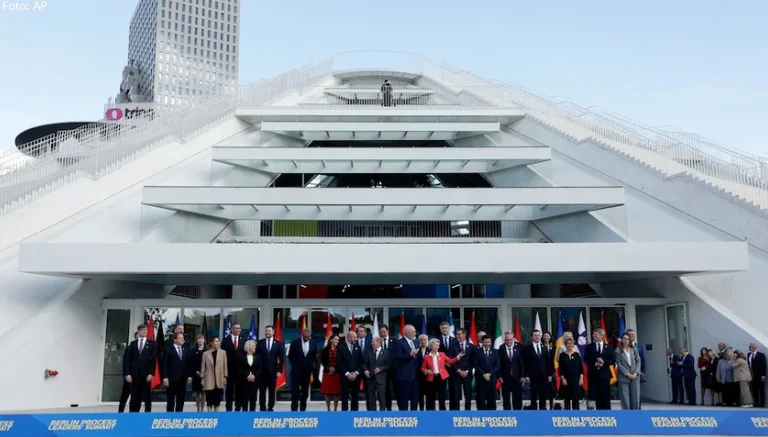
(3 years ago)Leaders from the European Union offered a new growth plan to the Western Balkans at a summit in Albania's capital on Monday, opening part of the common EU market and urging deep reforms ahead of bloc membership for the six countries in the region. The main topics in the annual talks called Process [...]
Leaders from the European Union offered a new growth plan to the Western Balkans at a summit in Albania's capital on Monday, opening part of the common EU market and urging deep reforms ahead of bloc membership for the six countries in the region.
The main topics in the annual talks called the Berlin Process are the integration of the Western Balkans into the common market and the support of their green and digital transformation. The nations in the region are Kosovo, Albania, Montenegro, Northern Macedonia, Bosnia and Serbia, the AP reports, broadcasts Klankosova.tv.
Senior EU officials attending the summit in Tirana were European Commission President Ursula von der Leyeen and European Council President Charles Michel. German Chancellor Olaf Scholz joined them.
French President Emmanuel Macron did not join the summit, due to the recent incident when a teacher was stabbed to death and three people were injured in a school attack in northern France. He was represented by Secretary of State Lawrence Boon.
Macron would begin an official visit to Tirana later Monday.
The six Western Balkan countries are in different phases of bloc integration. Serbia and Montenegro were the first Western Balkan countries to start membership negotiations several years ago, followed by Albania and Macedonia last year, while Kosovo and Bosnia have only started the first step of the integration process.
Scholtz said the Berlin process is the best instrument not only to release the full potential of regional co-operation, but also to accelerate the integration of all Western Balkan countries.
Russia's war in Ukraine has put Western Balkans' integration into the EU at the helm of the 27-nation bloc's agenda. The EU has been trying to revive the entire enlargement process, which has stalled since 2013, when Croatia became the last country to join.
The EU made a request for the Western Balkans to reform their economies and political institutions before membership.
Von der Leeyen cited a new growth plan for Western Balkan countries: opening new trade routes in specific areas of the EU's common market for Balkan countries, such as free movement of goods and services, road transport, energy, electricity and the common digital market. All six countries must implement rapid reforms, which in turn will be accompanied by investments.
The EU has already mobilised 16 billion euros for investments in the region from 30 billion euros promised three years ago.
“We really need to seize the potential that is here in the Western Balkans and bring it to the single European market”, she said.
The six countries must move with deep reforms to improve the business climate, make the regulatory environment more attractive and create access to each other's markets, she added.
“If there are jams, block yourself”, von der Leen said.
A bitter dispute between Kosovo and Serbia remains a major concern for the EU.
The EU-brokered dialogue on normalising relations has stalled, following a recent shootout between masked Serb armed men and Kosovo police that left a Kosovo police officer and three of the Serb armed men dead, thus raising tensions in the region.
Scholtz called on Serbia and Kosovo to return to the negotiating table, underlining the urgent “need to work together and overcome antagonism”.
“It is time to overcome the conflicts that have been going on for a very long time and that hold only two places behind”, he said.
EU officials have urged Balkan countries to overcome regional conflicts and stay together while Russia is waging war in Ukraine.
Any progress you make on the common regional market will be significantly brought closer to EU standards”, Scholtz said.
Von der Leyen considered the new growth plan “a very strong incentive... to open the doors economically, but also to seek the opening of borders between Western Balkan countries and to make necessary reforms. And with that comes investment financing”.
By working together alone, we will bring the Western Balkans where you belong to the heart of the European Union”, she said.
Michel urged Western Balkan countries to fulfil your commitments, starting with necessary reforms, and in the EU, we must prepare to welcome new members”.
I repeat, to do that, I think we should be ready from both sides by 2030 to expand”, he said, adding, “It is an encouragement, a support to double our” efforts.
Albanian Prime Minister Edi Rama hailed the new plan as very promising after supporting the “ide of a more functioning relationship as partners sharing a house with better understanding, better sharing the burden”.
The summit, which is held for the first time in a non-EU country, is held at a Pharaohic landmark known as the Pyramid. It was built in 1988 as a posthumous museum for Albania's hard man, Enver Hoxha.