 an hour ago
EU, US expected to boost pressure on Kosovo, Serbia for normalisation of relations
Periskopi(3 years ago)
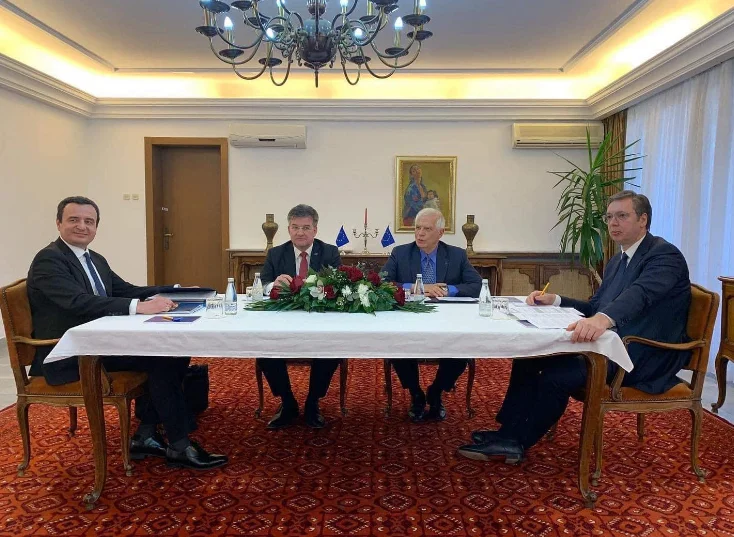
(3 years ago)The European Union's envoy for talks between Kosovo and Serbia, Miroslav Lajcak, along with US envoy Gabriel Escobar, as well as advisers of the leaders of France, Germany and Italy, will remain Saturday in Pristina and Belgrade in an effort to renew talks on normalisation of relations, amid [...]
The European Union's envoy for talks between Kosovo and Serbia, Miroslav Lajcak, along with US envoy Gabriel Escobar, as well as advisers of the leaders of France, Germany and Italy, will remain Saturday in Pristina and Belgrade in an effort to renew talks on normalisation of relations amid concerns following the September 24th attack on Kosovo police in its north.
Western diplomats say September 24th witnessed the importance of normalising Kosovo relations, Serbia and the return of the parties to the negotiating table for implementation of the agreement reached in Brussels and in Ohrid on February 27th and 18th of this year.
The European Union said that “we have clear expectations on the parties to continue the normalisation process and meet their obligations unconditionally and unconditionally”.
French President Emmanuel Macron said on 17 October in Tirana that France is following with attention to tensions between Kosovo and Serbia, naming the agreement “a solid and good guide”.
Tensions between the parties reached an unprecedented point since Kosovo's declaration of independence, following an attack by an armed group of Serbs on 24 September in northern Kosovo.
“This would contribute to restoring the calm at the” border, President Macro said, extending expectations on both sides.
The next “steps and what we expect from Kosovo authorities and Serbian authorities are simple: reshuffle of the elections in municipalities where these are done under inadequate conditions; Serb participation in these elections; and in institutions; and the foundation of the majority Serb municipalities Association by Kosovo authorities. Conditions must be met in this alignment, as a whole and a total of”, said President Macron, who sparked much debate in a statement with which he warned Kosovo of keeping promises related to stressing the situation with Serbia
I want to say one thing very clearly. We have made a gesture of confidence on the visa issue. As for France, they are removed because France keeps its promise. While the word today is not being held”, the French president in Tirana said.
Mr. Macron's comments were initially interpreted by the press in Albania and Kosovo as a message that France was withdrawing from the visa liberalisation decision.
The European Union's decision on visa liberalisation for Kosovo is expected to take effect on January 1st, 2017.
Albanian Prime Minister Edi Rama said on Thursday evening in an interview with Blendy Fevziun that President Macron, “s all others, but even a little bit more than others, is naturally hurt with the fact that even though he is personally engaged with the Chancellor (German Olaf) Scholz to put on the table a plan called the Franco-German plan and that the best thing that can happen to Kosovo at this stage of its history and, he told me that I am not ready to open the way to Pristina if they want to open up the process on the Franco-German plan.
Prime Minister Rama said President Macron spoke for the next few weeks as a period of opportunity for Kosovo.
The “So there should be movement in the right direction that cannot be taken hostage by the entire community of allies and friends of Kosovo, cannot be taken hostage by the entire Euro-Atlantic community to bring about a very, very determined and equally sincere effort to resolve the issue of Kosovo's own”, Prime Minister Rama said.
On Friday, Kosovo Prime Minister Albin Kurti said that the basic Brussels Agreement on February 27th is central to recognition de verifiably mutually, and that as soon as it is implemented, we will have not only democratic and European normalisation but also security for our country and the country”.
Independent observers, meanwhile, said President Macron's statement could be seen as a form of pressure on the parties before Saturday's meetings that Western representatives will hold in Pristina and Belgrade, while the visa issue for Kosovo citizens is not currently a political issue but a legal issue.
According to European Union officials, a bloc state cannot unilaterally suspend visa liberalisation for another state. This could happen only through procedures on the Council of the European Union through a “mechanism for suspension of visas”, which allows for suspension to “cysitate”.
This framework mentions the European Commission's rejection in June 2019 of the Netherlands government's request to suspend visa-free travel to the area of ʹSengen '% for Albanian citizens, since, as stated in the Commission's statement, “does not have enough reason to suspend Albania from the visa-free travel regime”.
The mechanism for suspension of visas could be activated in the event of an increase in irregular migration, increased housing requirements, non-co-operation in the process of repatriating those who violate the rules of staying in the Schengen area and in the event of increased risk for the security of the European Union member states.
Independent observers say this mechanism cannot be used in this period for Kosovo, and the suspension would require a new legal framework within the bloc. But at the same time, they draw attention that France is one of the most important and influential countries in the European Union. / DW











