41 minutes ago
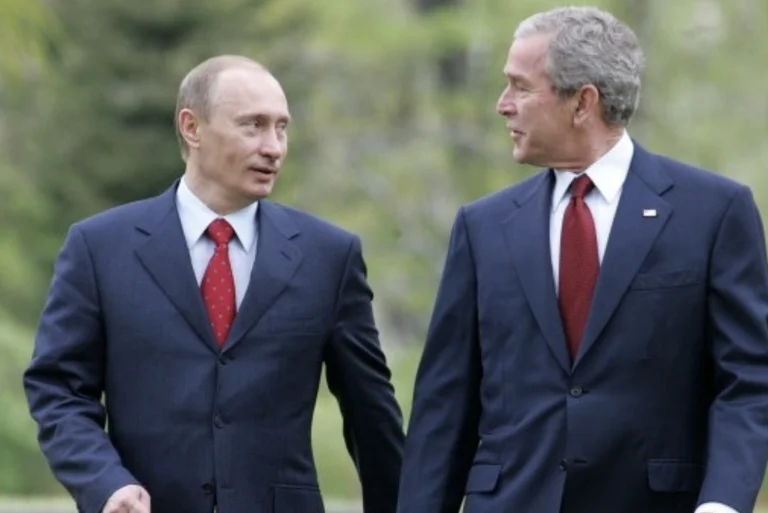
From archive: When Putin told Bush: “what? George, Ukraine isn't even a country! ”
Periskopi(4 years ago)
(4 years ago)It is April 4, 2008. During a meeting in Bucharest, George W. Bush and Vladimir Putin discuss Ukraine. Bush would like it in the European Union and NATO, where several Eastern European countries have already joined, but the Russian leader opposes. “What is Ukraine?” Putin explodes. You must understand, George, that you do not [...]
For former CIA Director and US Defence Minister Robert Gates, who attends the meeting, the message couldn't be any clearer. “Putin ) tells Gates Bush ) will never give up control of what he considers to be the small Russia “ “, or his section of Ukraine”, much less the control of the Crimea, a semi-autonom territory where it is one of the most important Russian bases. And it adds that the Kremlin will find no peace until a philrus government has not replaced the movie government in Kiev, in power since 2005.
Bush answers that he will try to stop him. Among the measures to be taken, the president proposes opening an American representation in Sevastopul, a warning to Putin, who has already given his right-wing Dimitri Medvedev Russia's presidency but not power. Kiev agrees, but the Crimean Parliament rejects the proposal by voting 77 to 9. It is a loss of the White House, passing quietly, and Bush no longer does anything. Ukraine and Crime are one of the unresolved problems his offspring will face.
According to documents made public by Washington, Ukraine and Crimea archives, there have been unresolved problems for Bush's predecessor, Bill Clinton. In 1996, as the Ukraine's deregulation process sought by Kiev, Moscow and Washington closed two years ago, The CIA informs the White House that “Russia has installed long-range Sam missiles of the Tallinn type and that a chemical weapons facility” is in operation. Clinton has a good relationship with President Jels, and he doesn't want to be ruined. Three years later, an expert studio whose opinion is sought by the White House concludes that “in Ukraine deepens the cultural gap between those who have lived under Russia and under the USSR for 200 years and those who lived under Austria and under Poland”.
The report confirms that the latter “requires greater political and religious autonomy from Kiev and that there is a danger of a” conflict, but cautions the White House not to intervene. Clinton agrees. The American president knows he has not fulfilled the promises made by George Bush his father, his predecessor. In 1990, Bush had secured then-RSS President Gorbachev, “NATO would not extend to the East by even one centimeter” following the dissolution of the Warsaw Pact. In 1991, during a speech in Kiev, Bush had criticised the former Soviet republics' “suicide attacks”. But Clinton had gone the other way. And in 1999, he realizes that he can get into a collision with Jelsin's successor, Vladimir Putin, as long as he asks Jelsin “to be careful and not miss out on”.
The documents suggest that the conversation between Bush and Putin about Ukraine and Crime is a two - deaf conversation. Putin is not only a former KGB agent, but also a large Russian “” that wants to retain neighbouring territories in his area of influence.
In 2001, when Bush tells “that he has read his heart and that he thinks he is a man who can trust”, Putin helps America in the fight against terrorism, but soon starts to react strongly to American initiatives in Eastern Europe. The 2004 orange revolution in Ukraine leads to the rift between the two leaders at the Slovakia summit in 2005: Putin sees the hand of America. Although in disguise, it's the Cold “” between Washington and Moscow. Tension increases in 2007 when Bush asks Poland and the Czech Republic to deploy American space protection missiles formally to curb Iran. In August 2008, Russia invaded Georgia, which Georgian President Saakashville wants to join the EU and NATO. That same year, the final clash between Bush and Putin took place. Bush: I told you that Saakashville is a hot head”. Putin: “I'm also a hot head” Bush: “No Vladimir, you're a cold head”
It is a clash that returns in 2009 between Putin and the descendants of Bush, Barack Obama. During a visit, Joe Biden, Obama's deputy, offers Kiev full support in the event he wants to integrate into the EU and NATO. Bush has not hidden his fears of crime and Ukraine from Obama. The impression that forms documents is summed up by Jack Matlock, the American ambassador to Russia at the time of Gorbachev: very little and too late. Putin is guilty, writes Matlock, “but America has treated Russia as a loser of the Cold War, whose end, in fact, was negotiated”/bota.al/