10 minutes ago
US-EU: new efforts for Kosovo-Serbia reciprocity agreement
Periskopi(4 years ago)
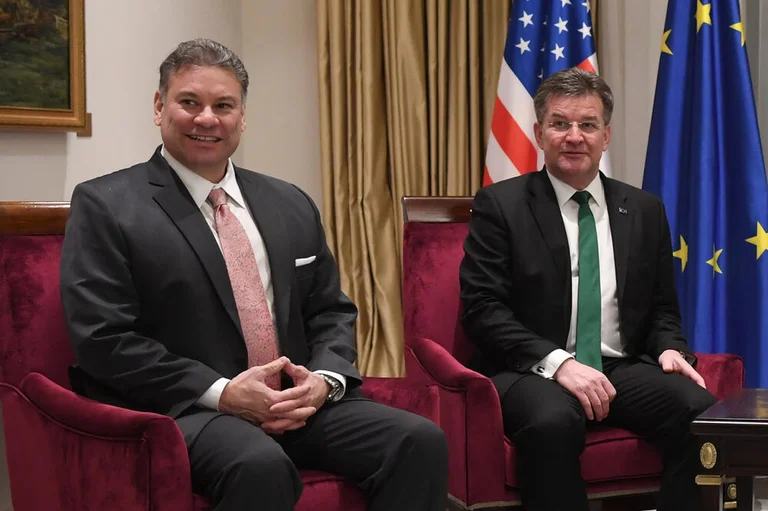
(4 years ago)The US and European envoy for Kosovo-Serbia dialogue Escobar and Lajcak hold two-day talks in Kosovo and Serbia in an effort to secure a reciprocity agreement. The United States and the European Union are making efforts in Pristina and Belgrade to secure a reciprocity agreement on [the] plates....
The United States of America and the European Union are making efforts in Pristina and Belgrade to secure a reciprocity agreement on vehicle plates and travel documents. For this reason in Pristina and later in Belgrade are the United States envoy for the Western Balkans, Gabriel Escobar, and the EU's charge for dialogue, Miroslav Lajcak. The American in charge met last night with Kosovo President Vjosa Osmani, while Wednesday afternoon along with Lajcak, they meet Prime Minister Kurti and opposition leaders in the continuation of efforts to mark progress towards an agreement that would avoid tensions on the ground, especially in northern Kosovo.
A report by the president's office says that “with Mr. Escobar, president Osmani discussed the dialogue process with Serbia, as well as recent developments, with particular emphasis on northern Kosovo. “The president has suggested that Kosovo will continue to be a constructive, equal and dedicated party to the dialogue process, contributing to peace and stability in the country and the region.” According to President Osmani, Kosovo's “institutions are in constant communication and co-ordination with international partners and every decision, reflects the country's constitutional spirit and democratic values”. The priorities of Kosovo institutions is law enforcement, and in this context the decisions of Kosovo institutions are in line with Brussels' agreements on freedom of movement and are not directed towards any community, the president Osmani's announcement noted.
Vuciq: Serious Serbia to find solution to current crisis
The visit to Kosovo by the American and European in charge of dialogue, Escobar and Lajcak, follows last week's meeting in Brussels between Kosovo Prime Minister Albin Kurti and Serbia's president, Aleksandar Vuciq, where no reconciliation was reached, but was said that efforts continue to find a solution. Serbia's President Aleksandar Vuciq, after a meeting he held with US Ambassador to Belgrade Christopher Hill, said that “Serbia is serious about finding a solution to the current crisis caused”, as he said “by Pristina's unilateral movements”. According to the office of the Serbian presidency, Vuciq has told Ambassador Hill, “it is important that Pristina maintains the agreement that special police forces can move to northern Kosovo only with the consent of KFOR and the heads of the four northern municipalities where Serbs live.
For his part, US Ambassador to Belgrade Christopher Hill said that “Serbia went and prepared in the last round of Kosovo-Serbia dialogue that was held in Brussels on 18 August, while according to him, other parties that did not name, “were not prepared to talk about specifics”. The Serbian side did well. They knew what they were going to talk about, what was important. Unfortunately, some of the others were not prepared to talk about specifications”, Ambassador Hill said, during an interview for media in Belgrade, N1. According to him, in the dialogue between Kosovo and Serbia, mediated by the EU, two things are being tried: addressing urgent issues, Kosovo Prime Minister Albin Kurti's decision, for Serbian license plates and documents, as he said, important.
Internal Dialogue With Kosovo Serbs
In Pristina, a study published by the Democratic Institute of Kosovo is called for Kosovo and Serbia to focus on reaching a final agreement that would resolve all technical issues. So far we have seen that dialogue on technical issues has not brought the expected results, so it is necessary that Kosovo and Serbia discuss the final agreement. In this respect there is a political will on the part of the Kosovo side to discuss the elements of the final agreement, but there seems to be a reluctance by the Serb side for dialogue to go towards the final agreement, which may also be why the demand of both the US and the EU is that the final agreement be at the centre of mutual recognition, and therefore we have a reluctance by the Serbian side to discuss this accord”, the study says.
According to the Democratic Institute report, Kosovo's government on the other hand, “should also push forward the idea for internal dialogue with Kosovo Serbs, in order to avoid uncertainty and disinformations as in the case of reciprocity with ID documents and license plates”. In the report, titled “The Kosovo-Serbia Dialog, a step forward, three behind “says the lack of political will to move towards the final agreement will continue to reflect on the ground, maintaining an unstable situation that occasionally produces tension”.
What is known is that, Kosovo Prime Minister Albin Kurti has said his government by September 1st implements reciprocity' decision on car plates and Serbia's travel documents. Two dialogue supporters -- Escobar and Lajcak -- in an effort to find a solution, from Pristina tomorrow -- will travel to Belgrade, where authorities there after meetings with the list of {Srpskaão -- have declared that unless a compromise solution is found, “Serb representatives will leave Kosovo institutions<1>. “S first in politicians, and then all in a row, both prosecutors and judges, and the police”, has declared Goran Rakiq, the head of the Serbian List, and thus according to him, “will have a total breakup of the Brussels” dialogue. / DW