11 minutes ago
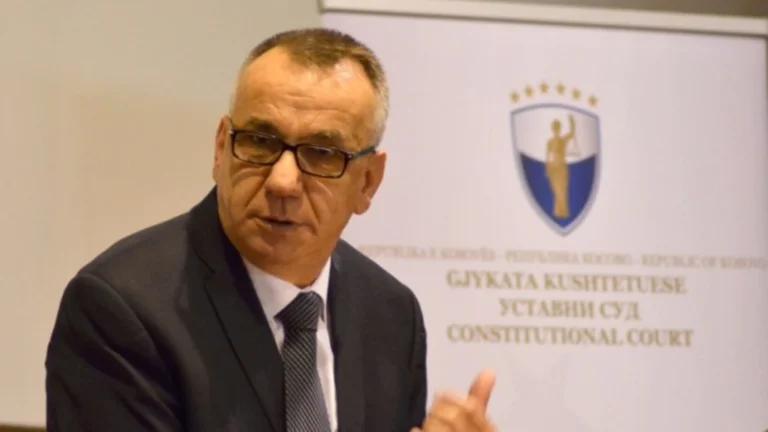
Enver Hasani: The more resistance to association, the closer Serbian idea to it
Periskopi(4 years ago)
(4 years ago)Establishment of the Serb majority municipalities is Kosovo's international duty, so the current government must draft a draft state for it, says former Kosovo Constitutional Court Chairman Enver Hasani. “The more resistance to the formation of association is pushed, the closer we approach the Serbian idea of association as political-territorial autonomy, [...]
The more resistance to the formation of association is postponed, the closer we approach the Serbian idea of association as political-territorial autonomy, such as Republika Srpska or as the political community of local Serbs, which emerges from Kosovo's constitutional order. The longer it takes, we approach the Serbian idea”, Hasani says.
Within the context of dialogue mediated by the European Union, Kosovo and Serbia in 2013 reached the Association Agreement. In 2015, the parties signed the Agreement on Principles to Form Association. That same year, the Constitutional Court found that some points are not in harmony with the constitutional spirit and that they must be harmonised.
Hasan says that association as a concept has no content, but it is only a principled document which cannot be implemented as provisions, because they are not self-executable. Therefore, according to him, Kosovo should approach and insist on establishing the statute for Association, according to the ability of the Constitutional Court assessment.
Serbia insists that the association have executive competencies, meanwhile Kosovo Prime Minister Albin Kurti, has voiced opposition to a single-ethnic association.
But, Hasan says that the Serbian insistence on executive competencies on association does not explain anything, as according to him, current municipalities, including those of Serb majority, have a lot of executive competencies.
The decision of the [Kosovo] Constitutional Court has not been made with executive competencies or not, but it has only shown that the nature of association, as proposed [in 2013], as has been operationalised in 2015, conflicts with the existing Constitution. The evil of this [Kosovo] government, as well as all others, is that they do not face association, make a draft for it and discuss it. They have to sit down, make a draft and say this is our position on this issue, apply it and say it's like that, and that's exactly what it is, Hasani estimates.
The EU repeatedly reiterates the position that Kosovo and Serbia should implement all agreements reached in dialogue, including that of Association. The same demand goes to the United States.
At the beginning of the year, US Special Representative for the Western Balkans Gabriel Escobar, and the bloc's emissary for Kosovo-Serbia dialogue, Miroslav Lajcak, said in Pristina that Kosovo is obliged to implement the agreements reached so far and that the international community does not impose solutions regarding disputes between Pristina and Belgrade, but that both sides should agree on their own.
The Kosovo government has not responded to the REL question why it is reluctant or refusing to launch the Association process, according to the Constitutional Court's decision, as well as to initiate drafting the Association statute in line with the Constitutional decision. Where did the Association draft end?
However, in 2018, the government that the world was led by Ramush Haradinaj had taken steps towards forming the Association.
Given the agreements reached in Brussels, a management team consisting of four Serbian officials was engaged in drafting the statute for Association. This team had until 4 August 2018 to send its first draft of the Law on Association to Brussels.
At the time, authorities in Pristina said they did not accept such a draft and that they had no information whether this document was handed over to the EU.
The management team for drafting the Association statute in Government of Kosovo had delivered only the processes. Through these processes, this team has been tasked with informing Government of the statute drafting process.
Neither of the European bloc has ever claimed or denied that they have accepted this proposal.
Free Europe has recently been addressed to the European Union with the question of whether it has accepted the draft association status from the management team that has been tasking its drafting.
But, EU spokesman for foreign policy and security issues Peter Stano says that “generally, we never comment on in public any details of the ongoing processes or interactions, related to our commitment to partners on any of the issues in our joint agenda”
“The same applies to the Belgrade-Pristina dialogue”, Stano says.
What do Serbs in Kosovo know about association?
While authorities in Serbia say forming association is key to the survival of Serbs, some Serbian citizens in Kosovo, surveyed by Radio Free Europe, say they do not know what is important to them. As a result, they say that they have no information as to what authorizations there would be and in which areas.
Zoran Stanic of Northern Mitrovica ʹ the Serb-run municipality says that according to what it has understood from the media, the association will have the form of a non-governmental organisation and will deal with municipal issues. But it will be without executive competence and, according to him, will not matter much to Serbian citizens.
I don't think so. As it functions according to Kosovo's laws and has no executive competency, it is beyond any reason to have any particular significance for Serbs. I think a very dirty game is playing with the agreement between Serbia, Kosovo and the international community“, Stanic says. Petar Milenkovic believes that association should be a community that will serve the protection of the Serb community in Kosovo, as well as for realising its rights.
“But it is quite another thing, for the Serbian people to organise and have what is said in the agreement, and I hope it will take place“, he says.
Likewise, some Serbian citizens living in Gracanica, the majority Serb municipality located near Pristina, feel. Srdjan Djordjevic believes that the Association of Serb majority municipalities would represent some kind of security for Kosovo Serbs, though he does not know what exactly it means or which areas he would cover.
“We don't have enough knowledge, they [authorities from Belgrade] say it will be good for us, but we need someone to explain what the Association of Serbian municipalities in Kosovo” means, he says.
Neither Dragan Stojanovic from Gracanica is informed of details of the Brussels Agreement on forming Association, either, or he does not know what it should involve and how it will work.
The “alone mention the Association of Serbian municipalities and I don't know what they're all about in principle, because the Albanian side, but the Serb side, also, starts by maximum position”, Stojanovic says. Albanian citizens: Association must not be formed
But, some Albanian citizens in Pristina, estimate that the Association of Serb majority municipalities should not be formed.
Lum Rexha says the Serbian side is trying to ensure executive competence for association, which, according to him, would hurt the state of Kosovo.
They're actually building a state inside our country, which we've already built. As I have heard, they will have their own police. I think the police should be for all communities and function as a whole and not for each ethnic group to have their own police”, Rex says.
Meanwhile, Driton Tahiri says one of the reasons why the Association should not be created is the assessment of the Constitutional Court that it is not fully in line with the Kosovo Constitution.
“National shrinks, especially Serbs, are guaranteed [rights] with the Ahtisaari Pack. For this reason the package has been formed, which guarantees equal rights to all minorities and in particular to Serbs. However, these are guided by Belgrade structures and institutions”, Tahiri says.
Earlier in the opinion, several new models of association were discussed. One such opportunity has been mentioned by the ambassador of the United States of America to Kosovo, Jeffrey Havenier.
“There are models that we think can work out and we have encouraged [Kosovo's] Government to examine those models and consider the matter”, Havenier declared on January 26th of this year.
However, he has presented no further details to new model Association, while Belgrade has later told him that it will not accept anything like that, insisting that association be formed on the basis of the Brussels Agreement.