35 minutes ago
Former KFOR Commander: Sė danger in Kosovo, NATO troops ready to avoid attack
Periskopi(4 years ago)
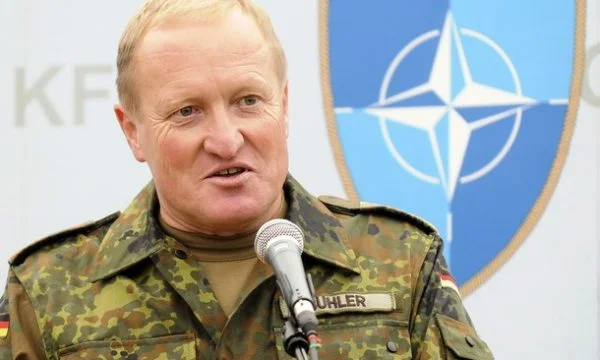
(4 years ago)How much can the Ukraine conflict in the Western Balkans affect? How the security situation in the Balkans is presented, is there a risk of new conflicts? Former KFOR Commander General Erhard Bühler answers DW questions. Deutsche Welle: Mr. General Bühler, there are still many unresolved issues in the Western Balkans: Serbia does not recognise the state of Kosovo, Republika [...]
Deutsche Welle: Mr. General Bühler, there are still many unresolved issues in the Western Balkans: Serbia does not recognise the state of Kosovo, Republika Srpska often mentions secession from Bosnia and Herzegovina, Bulgaria is blocking northern Macedonia on the road to starting EU membership negotiations, while Montenegro has entered a kind of permanent crisis of power, and has also had accusations of mixing factors from abroad. As former KFOR commander in Kosovo, do you fear another so-called powder barrel in the Balkans?
Erhard Bühler: No, I'm not afraid and I don't see any danger to such a scenario. But you rightly cited many open problems and issues that still exist in the Western Balkans. In this context, I also have my own concerns about how things will develop on medium- and long-term trails, in particular now from the perspective of the crisis in Ukraine and the addition of the influence of some foreign states in this region.
This is exactly what I wanted to ask you: Can Russian aggression in Ukraine have consequences even for the Western Balkans, because it is known that Serbia, and in particular, the Serbs of Bosnia and Herzegovina, account for one of Russia's closest partners, and Russia can surely be interested in opening new crisis centres?
Erhard Bühler: Like I said, an acute risk to new conflicts there I don't see. But in the past we have experienced that in the shadow of great conflict, frozen conflicts suddenly break out. Here we should also consider the close reports between Russia and Serbia, so I think not only Germany but the whole of Europe, we should take care of the Western Balkans in a much more intensive way. Germany is doing much in this direction and it has clear positions, which the Chancellor, the foreign minister and the entire government have expressed. But that's not enough. We must convince our European partners that it is in our strategic interest, that the BP offers a clear European perspective. In this context, I have to say that it has been a major disappointment for me to have the last European Union summit, because on one side it is said that the BP has a clear perspective of EU membership, while on the other, concrete steps have not been taken for years. I hope that in the coming weeks and months, agreement will be reached and that after this summit very soon we will have concrete measures to bring BP closer to the EU.
DW: The last EU summit has been a major disappointment not only for you but for all BP countries, because there was no concrete result in this summit. How much can this affect the decline of the European idea in the Balkan peoples, because the so-called prospect of membership was given nearly 20 years ago, but has this not been accompanied by significant concrete steps?
Erhard Bühler: I deal with the Western Balkans as long as the first promises have been made. I've often been on different missions there, and that's exactly my impression. Consider Kosovo: European representatives have come past and have always given promises. Visa liberalisation has also been promised, and when we talk about visa liberalisation we must know that this does not mean freedom of access to the labour market, but only freedom of movement for three months on EU territory, while after three months they must leave again. Visa liberalisation is thus only the first step that has been done with many and many other states, but not with Kosovo. In Kosovo and other countries, I see great enthusiasm for the EU, in particular in the new generations. But inaction can turn into boomerang towards this idea. This may add to the frustration and strengthening of nationalisms in these countries, which may result in the outbreak of high and frozen conflicts.
DW: How can the reluctance of France and several other countries be explained to visa liberalisation for Kosovo citizens, when it is known that Kosovo has met all the required conditions?
Erhard Bühler: I can't explain this either, and no one has until today publicly stated what the causes of this hesitation are. There is another problem, that of Kosovo's non-recognition by five EU countries and four NATO countries. This non-recognition of Kosovo from these countries can be explained perhaps with the internal political problems or problems these countries have with their minorities. But on the issue of visa liberalisation, there is really no explanation.
DW: Mr General, after you mentioned it NATO: How real are Kosovo's requirements for NATO accession and membership?
Bühler: This is a long road and depends on the transformation of the Kosovo Security Forces (FSK) and its development towards an army, which is envisioned with Kosovo laws. There's a lot of work to be done here on the strategic level.
As far as KSF is concerned, it has become an excellent body, but it must be placed in proper conventional bases, have the necessary military strategy and become compatible with NATO forces. A few more steps must be taken here, primarily in terms of multilateral function. But I think Kosovo could soon be integrated into the Partnership for Peace programme. But even here, the main problem is that all member states, including the four NATO countries, have not yet recognised Kosovo, must agree with this decision. Even here, greater commitment is required to convince these countries that the membership of the Western Balkans and Kosovo in NATO is in our strategic interest.
DW: How do you assess the security situation in Kosovo, in particular in northern Kosovo, and is KFOR's current contingent able to protect Kosovo in the event of an outside attack?
Erhard Bühler: I don't see any danger of an outside attack. KFOR is guaranteed for this and behind KFOR lies NATO. KFOR troops have been dropping a lot lately. That's right, because there's no need for thousands of NATO soldiers to stay there. That would not be good for Kosovo's image either, and it would not be in line with the current security situation there. But in case of an outside attack, NATO troops are willing to avoid that.
DW: Not only in Kosovo but also in Bosnia and Herzegovina and other countries in the region have been viewed with concerns of Serbia's arms of Russian and Chinese. How do you see this matter?
Erhard Bühler: Arming an army is each country's legitimate right, so is Serbia. Serbia has not only bought Russian but western weapons. She recently bought helicopters who were sent from Germany. But crucial is the desire to use these weapons, and I don't see this danger. However, an aggressive rhetoric of responsible politicians in Serbia is clearly seen, threatening to use military forces. This causes fear in people, and this aggressive rhetoric then goes into public debate, although I don't think there is any purpose here in using these weapons. However, all should avoid this aggressive rhetoric, aimed at internal political benefits. This should not be used, but is being used.
DW: That's right, because the combination of this aggressive rhetoric, which has recently been heard by Serbia's own president, as well as the purchase of weapons, causes fear in people and other countries in the region. You're not afraid of using these weapons?
Erhard Bühler: No, like I said, I'm not afraid. But the fact is, it stimulates fear in citizens. This toughens unresolved issues and does not contribute to reconciliation. And reconciliation has to happen because the conflicts in the former Yugoslavia have spent more than 20 years. The reconciliation is in the interest of all Western Balkan countries, primarily for Serbia. The reconciliation should therefore be Serbia's interest, in the interest of well-being of people in Serbia. Lack of stability does not dare to return to the Western Balkans, because this paves the way for extreme nationalists, which in extreme cases can also result in new open conflicts.
DW: Sustainable Stability certainly does not contribute to either the EU's non-determination for concrete steps, such as opening negotiations for North Macedonia and Albania's EU membership or intensifying dialogue and resolving problems between Kosovo and Serbia. Can Germany do even more in this regard?
Erhard Bühler: Germany is doing much, very clearly defined and during the trips of the Chancellor and foreign minister to the BP. Germany should try to convince EU and NATO countries that its positions are relevant and that it is. It is in strategic interest that BP is not forgotten and gradually integrated into the EU. You mentioned Wei's Macedonia: Bulgaria and many other countries must know that they have been admitted into the EU, though they have not met all the initial conditions. But in these cases strategic interests have been given priority and that is right.
DW: How do you assess the processes in The Hague against former former leaders - KLA, who are charged with war crimes? I'm asking you, because you've been commander of KFOR and you've probably had a lot of important documents in your hands. Have you been aware of the crimes former President Thaci and others from The Hague tribunal accused of in Kosovo?
Erhard Bühler: No. While I was in command, the Swiss Dick Marty report was published: Former head of is h - The KLA is charged in the Dick Marty Euro-Depute Report with crimes and human organs trading. Of course, we have looked at all the archives and made efforts to find concrete evidence on these charges, but we have not found them. We have found no evidence of such claims. I know three of them and I always go by principle, that every man is innocent until the court's final decision. Of course, we have conveyed the entire debate on this issue and expressed regret over the length of the processes. Sad to say, the evidence has been so scarce at the beginning of the process that the prosecution is now being forced to make numerous more investigations after publishing the first indictment.
General Erhard Bühler was born in 1956 in Aich.
Among other things, he has been commander of German troops in Kosovo and then KFOR commander.
From 2019 until April 2020, he was also commander of Allied Joint Force Command of NATO in Brunsum. It is valued as one of the best security connoisseurs not only in the Balkans and Europe, but even wider. Meanwhile General Erhard Bühler has also been elected president of the German-Albanian Associations in Germany? / DW