a minute ago
Loans for Daily Expenses
Periskopi(4 years ago)
(4 years ago)Mihrije Gashi has received three thousand euros in loans to help cover daily expenses. Mihrija, in her 50s, lives with her husband, three children and father-in-law in the neighbourhood “Calabria” in Pristina. She works in a clothing store where she pays 300 euros a month like her husband, who [...]
Mihrija, in her 50s, lives with her husband, three children and father-in-law in the neighbourhood “Calabria” in Pristina.
She works in a clothing store where she pays 300 euros a month like her husband, who works as an electrician in a private business.
The loan says it received it earlier this year and, for two consecutive years, will pay the bank a monthly installment of 130 euros, at an interest rate of about 6 percent.
With steady price hikes, Mihrija says otherwise she couldn't get out.
I've got Chredine to have money at home, for the need of the house, for the drugs... Laters are sick and must have cash at home”, Mihrija tells Radio Free Europe.
We're surviving with these salaries. Even though we are trying to save every day, we are getting money [even] from loan”, she says.
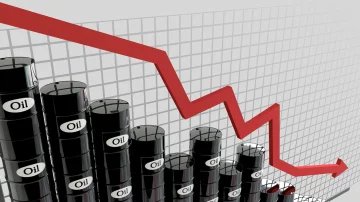
According to the Kosovo Statistics Agency, product prices have increased by 11.2 percent in April, compared to the same period last year.
Price Movement in Kosovo
In Kosovo, prices of some products are continuing to be raised. Kosovo's Statistics Agency has published the data on March 28th.
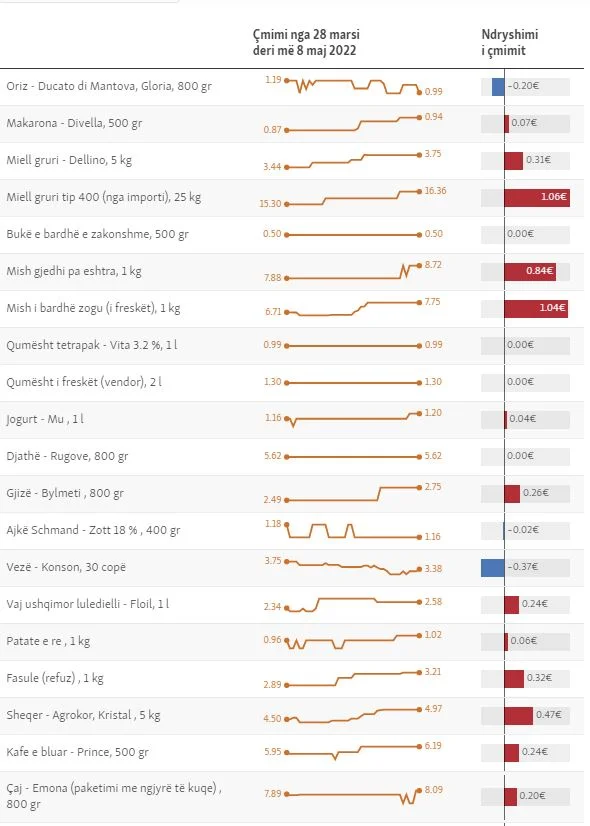
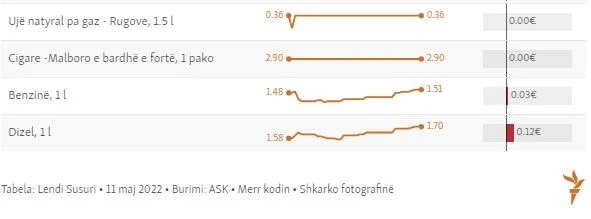
The increase has begun gradually, after the outbreak of the coronary pandemic in 2020, as momentum has also given Russia's war in Ukraine, which began in late February. Both countries are large grain exporters, so their struggle has shaken markets.
Kosovo Central Bank data confirms that domestic credit increases in the banking sector.
In December last year, the overall credit value in ten commercial banks in Kosovo has reached over 3.75 billion euros.
Of them, more than 1.4 billion euros have been loans to family economies, aimed at consumption.
According to BQC data, the amount of consumer loans has increased by 45 percent in 2021. In 2020, the value of consumer loans has been around 1.2 billion euros, while in 2019 that amount has been 1.1 billion euros.
From the CEC, they tell Radio Free Europe that consumer loans have increased by 19 percent even during the first few months of this year, but do not comment on what the reasons for this trend might be.
However, in the Banking Credit Credit Agreement, published by the BEC in March, the need for consumer financing and increased consumer credibility to banks is said to have contributed to increased consumer loans.
Bektash: Falling Standards
Economics Professor at the University of Pristina, Medi Bektashi, says citizens are indebted to financial institutions due to the decline of their living standards.
According to him, the increase in credit value for consumer purposes is “phenomen worrying”. These people, in the future, must lower their purchases in order to pay the monthly installments of loans they have now received”, Bektas says.
Mihrija confirms that her family has begun to reduce spending due to the return of the loan installment.
We're not buying any more things that aren't necessary... less fluids, less candy... Neither we nor the children go to the locals often. Even weekend exits have been eliminated by”, Mihrija says.
Edon Thaci, a private sector employee in Kosovo, relates similar situations. He says that, for two years now, he pays a loan he has taken for the renovation of the house.
Server return has become a problem. Prices have increased, credit value and salaries have remained the same”, Edoni says.
The average gross salary in Kosovo is estimated to be around 460 euros.
In the private sector, the average salary is around 380 euros, while in the public sector around 620 euros.
Price hikes, meanwhile, have suffered nearly all products from bread to current.
Unionists of different sectors in Kosovo have called for several times wage increases.
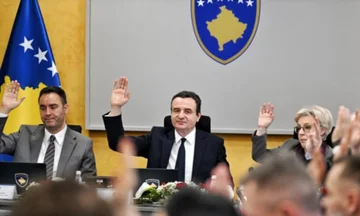
The Kosovo government, in April, has adopted the draft law on the growth of the minimum wage from 130-170 euros, currently at 250 euros net.
It has been pre-resistent for this bill to come to the polls in the Kosovo Assembly on June 6th, but this has not happened due to lack of quorum.
In April, the Kosovo government has earmarked 100m euros for different categories of society, to help, as it has been said, cope with the situation created by rising prices.
However, economic experts have interpreted this as short-term aid and not as permanent solutions.
Professor Bektash says citizens should be careful with spending, but also with loans, as, according to him, the next wave of price hikes could be expected in autumn.
“During the summer months, the crisis can ease remittances and the arrival of the diaspora, but in the months of September and October a deeper crisis could arise due to the reduction of the amount of cash available in circulation”, he says.
Remititions, or remittances from the diaspora, constitute a major source of income in Kosovo.
Last year alone, according to data from the Central Bank of Kosovo, remittances have seized the value of around 1.2 billion euros ʹ this record for Kosovo.
The World Bank has also warned, continued price hikes, if the war in Ukraine continues for a long time.