5 minutes ago
Serbia's Armatta Belgrade between Moscow and Beijing
Periskopi(4 years ago)
(4 years ago)Belgrade's acquisition of FK-3 air defence systems from Beijing marks a change in Serbian President Aleksandar Vuciq's diplomatic and military policy. As the world's attention focused on Russian military aggression in Ukraine, a major military transaction took place between Serbia and China. On April 9th, six Y-20 transport planes [...]
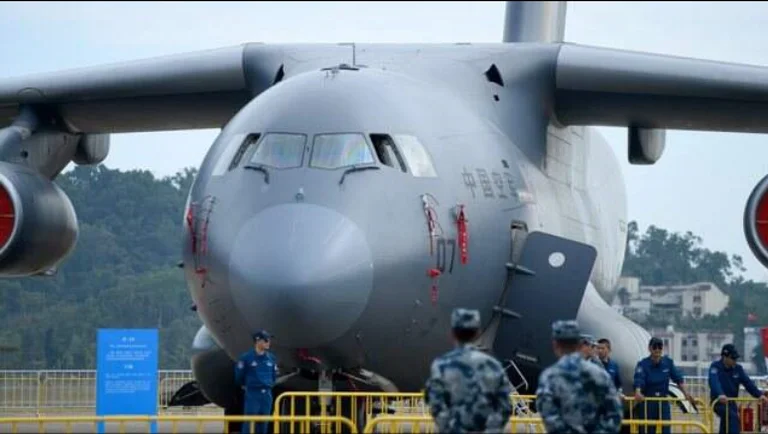
As the world's attention focused on Russian military aggression in Ukraine, a major military transaction took place between Serbia and China. On April 9th, six Chinese Air Force Y-20 transport planes landed at Belgrade'sNikola Teslax1> airport, handing over a FK-3 air defence missile system to the Serbian Army.
The agreement was signed in 2019 and made public a year later. In March, the Serbian Army formed a new unit tasked with taking over the KK-3 system. The time of this transaction is surprising considering the war in Ukraine. For Beijing, this is part of the ambition to enter European defence markets via Serbia. For Belgrade, the agreement is based on the need to modernise its outdated defence systems, the foreign policy initiative to balance major foreign powers and the desire of leadership to gain domestic support.
China has had the ambition to establish defence industry co-operation with Europe, a bid hampered by the European arms embargo in response to the crackdown on protests in Tiananmen on China's part. Serbia as a candidate for membership in the European Union is a useful subject of testing for Beijing, as it seeks ways to enter the European defence market.
This is the first known purchase of the FK-3 system in Europe. Similarly, in 2020, the shipment of CH-92A drones to Serbia was its first export of military aviation equipment to the continent. In March 2021, Chinese Defence Minister Wei Fenghe went to a regional tour of Southeast Europe, visiting Serbia, Hungary, northern Macedonia and Greece, all important countries for China, as it seeks to connect with Europe.
Greece is a strategic maritime country connecting Europe with the Middle East and North Africa. Farther north is Northern Macedonia, a channel for land traffic as it borders with several Balkan countries, followed by Serbia a country connecting the Balkans with Central Europe via Hungary. All these countries, except for Serbia, are NATO members, while Greece and Hungary are also members of the EU. The visit showed China's ambition to win other defence markets in the Serbian neighbourhood, and the distribution of the FK-3 system is part of the venture.
For Serbia, buying up the Chinese air defence system is part of its efforts to modernise the outdated military equipment, most of which originated in the former Yugoslavia period. Much of its arsenal dates back to the days of the communist Yugoslavia's large military industry, which was partly based on Soviet standards. For a moment, this created a war force that successfully hindered NATO from a ground invasion of Yugoslavia during the 1998-1999 Kosovo war. Until then, it wasn't enough to develop technologically advanced XXI wars. Logically, technology has advanced even more since.
After aforism that generals always fight the last war, control over airspace has always been at the centre of Serbian defence planning. Serbia was involved in a conflict of great powers, facing superior air powers the Belgrade Nazi bombing in 1941 and NATO intervention in Kosovo in 1999, when Belgrade and other cities were also bombed.
The need to provide air protection for the capital and other urban centres helps boost defence modernisation. Within this process and driven by historical experiences and technological transformations, the Serbian Army is focused on every weapon system that flies or hits things in the air.
Procurement of weapons is also part of Serbia's established model to diversify its defence partnerships and play with world and regional powers against each other. Serbia's available military equipment testifies to this fact.
In 2019, Serbia received MiG-29 fighter aircraft from Russia and Belarus, but since most of these planes are ready to age, they can be replaced by French Rafhale aircraft. Beyond that, Serbia bought Mistral missiles from France, an infrared mobile air defence system and an antiaircraft system Pantsir -S1 from Russia. In addition to taking Chinese fears, Serbia is in talks on buying Turkish Bayraktar TB2 drones, motivated by their performance in Nagorno-Karabakh, Ethiopia and Ukraine.
By taking weapons systems from power like China, the Serbian government hopes to increase its negotiating power with the West. Russia too has influence. Specifically, Serbia in the past two years has replaced Russia with China as its main partner in the East. In fact, in 2020, when the purchase of the FK-3 system was announced, Russian media articles expressed anger at Serbia for the purchase of the Chinese system instead of the S-300 missile system produced by Russia.
While the Russians have developed more advanced missile defence systems like S-400 purchased by NATO member Turkey and recently inaugurated S-500, while S-300 had a mythic status in Serbia, as there is a belief that NATO would not have intervened in 1999 if Serbia had access to this system. The FK-3 represents a new wave of Chinese missile technology and the fact that Serbia decided to use this system instead of Russian means something.
With eyes directed by Russia, Serbia and China believe they have more breathing space to develop bilateral ties. The ongoing struggle in Ukraine is already forcing Serbia to reduce some of its ties with Russia. After voting in favour of suspending Russia's membership in the UN Human Rights Council, Serbia received an exception from EU sanctions against Russian oil companies that would have prevented Serbia from importing crude oil, as Serbia's National Oil and Gas Industry (NIS) is owned by Russian Gazprom Neft.
Although Europe certainly has influence over Serbia, it is true that Beijing can also fill many empty spaces that will be created by Belgrade's distance from Moscow, as Serbian politician Stefan Vladissavyev writes. Co-operation with Russia and Moscow's mixed military performance in Ukraine may move Serbia to get more Chinese military equipment.
Although Serbian-Russian ties are usually described as an alliance of Slavic and Orthodox nations, it is an opportunist partnership that depends much more on the need for geopolitical leverage than on historical equity. While, it remains unclear whether Vuciq will join EU sanctions against Russia to avoid the wrath of benevolent voters towards Russia, his survival instinct certainly tells him he must keep a low profile against Russia, making China even more valuable.
After all, domestic politics informs Serbia's foreign and security policy. In Belgrade, the military is among the most trusted national institutions with 65 percent. In this direction, the Serbian ruling regime led by Vuciq, caused by the war in Ukraine, shifted the electoral naturtur from economic performance towards the idea that Serbia needs a strong and experienced leader to keep the country safe in times of global uncertainty, as illustrated by the electoral slogan, “Peace, stability, Vuciq”.
In fact, during the military exercise “, the infrastructure 2022”, where the public could see, in addition to other equipment, the FK-3 system and the Chinese CH-92A fears, Vuciq had said that “does not interest me in Western or eastern embassies. I don't care about Americans, Russians, Europeans or anybody. I will make decisions in line with the interests of the Republic of Serbia”.
A government that receives advanced weapons and adopts itself as guarantor of the country's security in turbulent times increases the regime's position in the post-election period.
In spite of this, the return of war to the Balkans is very unlikely. Serbia is surrounded by NATO members. Kosovo has the presence of NATO troops in the form of the Peacekeeping Force. In Bosnia and Herzegovina, the EU peacekeeping mission, Operation Althea, has been reinforced in response to the war in Ukraine. Despite all disputes, Serbia is a member of NATO's Partnership for Peace programme. The country practices a Individual Partnership Action Plan, the highest level of co-operation that a non-member state could have with NATO.
Serbian leaders may be able to wait by saying to the West, “we are slowly moving away from Russia, so give us a break for China”.
It is a game that can be rewarded in the short term, but not in the long run, as the Chinese-American rivalry will reach Serbia, making the aftermath of the war in Ukraine look like a picnic for Belgrade. /Foreign Police/