15 minutes ago
Why is Russia “Victory Day” different this year?
Periskopi(4 years ago)
(4 years ago)The Russian invasion in Ukraine means that fewer Russian tanks and other military equipment will be seen at Moscow Red Square on May 9th, when this state commemorates victory over Nazi Germany in World War II. However, patriotic enthusiasm can be more powerful than ever. Victory Day this [...]
However, patriotic enthusiasm can be more powerful than ever.
Victory Day this year will not only honour the conflict that has ended 77 years ago.
Many Russians will also think of the thousands of troops in neighboring Ukraine.
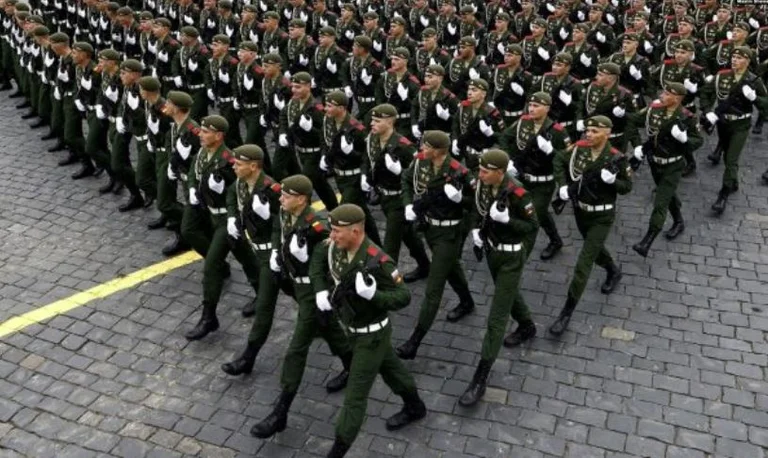
The Russian invasion in Ukraine means that fewer Russian tanks and other military equipment will be seen at Moscow Red Square on May 9th, when this state commemorates victory over Nazi Germany in World War II.
However, patriotic enthusiasm can be more powerful than ever.
Victory Day this year will not only honour the conflict that has ended 77 years ago.
Many Russians will also think of the thousands of troops in neighboring Ukraine.
The signs of support for the army have increased since the Russian invasion in Ukraine began on February 24th, especially through the character “Z”, which appears in pano, street, subway, television and social networks.
The signs of support for the army have increased since the Russian invasion in Ukraine began on February 24th, especially through the character “Z”, which appears in pano, street, subway, television and social networks.
The Kremlin does not refer to fighting in Ukraine as <x0 war>”, but Russian President Vladimir Putin's decision only refers to as “special military operation”.
Some believe Putin can use this day to declare the operation as a war in order to boost Russia's national commitment to it.
War and Memorial
The Soviet Union has lost 27 million people in World War II, and it has called the Great Patriotic War.
The conflict, which has destroyed entire cities and regions, has caused much pain and left a grave in national psychics.
Victory Day is a rare event among deep national divisions, which is admired by all political players.
The Kremlin has repeatedly used that initiative to encourage patriotic pride and claim that Russia plays a role as a world power.
Annual celebrations include the massive military parade at Red Square, including tanks, fighter planes and interclinetic ballistics missiles.
This year, it is expected to have far fewer weapons than last year, thus disseminating military engagement in Ukraine.
Combating “neo-Nazi”
When he ordered the invasion, Putin said his goal was to demilitarise” Ukraine, in order to avoid the military threat from “neo-nazis” rhetoric that has been condemned by Ukraine and the West as a false pretext for war.
To support their claim, Putin and his officials have mentioned those who were once nationalist leaders of far-right groups in Ukraine, Stepan Bandera and Roman Shukhevych, who joined the Nazis in World War II and used Nazi symbols.
This rhetoric has been used by the Kremlin to increase public support for the war, as Russia is facing major human losses and military equipment, but also economic damage as a result of Western sanctions.
Ukrainian President Volodymyr Zelensky, who is Jewish, has rejected the Kremlin's claim to “denaziification”.
Russian Foreign Minister Sergei Lavrov has drawn parallels between Zelensky and Adolf Hitler, the declaration that has provoked much anger from Israel.
Speeding up offensive?
Some in Ukraine and the West expect Putin to mark progress ahead of the May 9th holiday, as attempting to introduce it later as decisive victories, and as the reason to flee what seems to be a bloody conflict threatening the stability of the state.
Following failed attempts to take control of Kiev and other major cities north of Ukraine, the Kremlin has shifted its focus to the eastern region of Donbas, where Moscow-backed separatists have fought Ukrainian government forces since 2014.
This conflict has erupted weeks after Russia annexed the Ukrainian Crimea Peninsula.
The Russian Army has re-armed and refuelled its forces that have withdrawn from Kiev and headed towards Donbas, with the aim of siege and destruction of Ukrainian troops who are concentrated there.
However, Russian forces have faced fierce Ukrainian resistance, so they have achieved only minor progress, dimming the Kremlin's hopes of quick victory.
Major victories seem impossible before May 9th.
Our military will not artificially link its actions to any date, including Victory Day”, Russian Foreign Minister Sergei Lavrov said days ago.
The Double of War Price
Some heavyline Russians have criticised the Kremlin for limited use of forces and have called for national mobilization.
Some Western officials believe Putin can use 9 May to officially declare war and full mobilization to increase the number of troops in offensive.
He set the ground so that he can say look, this is a war against the Nazis, and I need more people.”, British Foreign Secretary Ben Wallace said about Radio LBC.
Ukrainian intelligence chief Kyrylo Budanov has made a similar warning on 2 May, saying Russia has started preparations for wide mobilization.
Kremlin spokesman Dmitry Peskov has dismissed these claims, considering “pointless”.
Russian authorities have claimed that only volunteer soldiers are fighting in Ukraine, though many recruits have been captured in the early days of the war.
The Russian Army serves about 1 million people out of them -- 400,000 soldiers with contracts, including 147,000 ground forces.
Western officials have estimated that the initial invading force has gone to about 180,000.
The military has admitted it has lost 1,351 soldiers by March 25th and has not made any further updates from that date.
Western officials have said Russia's losses are much greater and that a quarter of Moscow's initial force has become inadequate for fighting.
If the war lasts, the current Russian forces may not be enough to continue operations, forcing the Kremlin to depend on poorly trained recruits or to call for reserve.
The Kremlin faces difficult elections amid attempts to win the war with limited force, or through the strengthening of troops in Ukraine with militia, a step that could spur public anger and destabilise the political situation.