 2 hours ago
Putin's speech: The Importance of What He Did Not Say
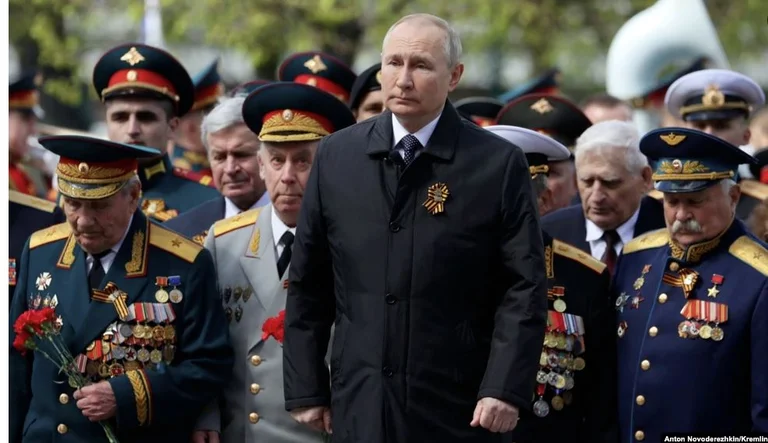
Periskopi(4 years ago)
(4 years ago)Finally, what caught sight of Russian President Vladimir Putin's speech during Victory Day celebrations was what he did not say. He did not announce general mobilization for the overall fight against Ukraine. He did not declare victory for the war, which is now on the 75th day. He [...]
He did not announce general mobilization for the overall fight against Ukraine.
He did not declare victory for the war, which is now on the 75th day.
He did not pose any threat to the use of Russia's nuclear arsenal, something he and other officials have repeatedly done in recent weeks.
He mentioned the Nazis, but not the “denification”, which was one of the Kremlin's declared goals of fighting in Ukraine.
He didn't even make a general call to join the army, unite the Russian population for major sacrifices in, or because of war.
For close observers of Putin's presidency, his 9 May speech was expected to be one of the most important speeches in his 22 years as leader of Russia ʹ a warning of more war, or perhaps peace, to come.
If there were these big statements, Victory Day a holy holiday for millions of people in Russia and coming at the time when Putin is at the center of global attention, it would be the date possible for something like that.
As in past speeches on Victory Day, Putin honored millions of Soviet citizens who died fighting Nazi Germany. Just as in some earlier talks but not at all, he used this talk to attack the United States.
While the Kremlin has been waging the largest land war in Europe since World War II, many observers have sought to analyze the details of how Putin would present the war in Ukraine, which in all accounts, except for his thinking, and some others, is not doing well for Russia.
In the end, the 12-minute speech offered little or no clarity.
Also, this speech offered no transformational policy change in the biggest foreign policy crisis, under Putin's leadership.
My first “reaction is that he is making long-term planning, but is waiting to get through the same problems as after the crime was annexed, but by taking territories south of Ukraine”, Vladislav said
Zubok, a Russian Cold War expert who is at the same time a professor at London School of Economics.
He referred to the Russian annexation of Crime in 2014 and the takeover of parts south of Ukraine, since Russia began the invasion of this neighbouring state on 24 February. “Even an option is possible: with the iron curtain around Russia being built by powerful Western sanctions, Putin has secured his regime and he will be satisfied with it for several years.”, Zubok said.
“After all, he is almost 70 years old. However, this option presupposes a totally cold and cynical leader, whose rhetoric for sacrifice and victory is just a large ʹblla-bllaʹ, he added.
The regular participation of hundreds of soldiers, marines, and other military personnel who marched near the Kremlin as the noises of tanks, armoured vehicles, and trucks carrying interctinctical ballistic missiles were heard, which also preceded.
Amazingly, there was no air parade this year of bombers, warplanes, and helicopters that flew over Moscow's sky in previous years and presented the key point for many. The absence of such a parade is not necessarily an indication of any major event, even though the annulment of the air parade was announced by Kremlin spokesman Dmitry Peskov, a few minutes before the ceremonies began. He said there would be no air parade due to weather conditions.
Putin's speech had important elements of the mythology of World War II, whose memories have been distorted, as some Russian observers argue, or as the Kremlin critic Yulia Latyina, “Qual of Victory”.
This war cult has nothing to do with the true history of World War II”, she said. “is a cult of new Russian totalitarianism, whose ideology is very simple”.
Close to 27 million Soviet citizens died during the four - year war with Nazi Germany. Putin honored citizens killed in the war.
The Day of Victory is an important day for all of us. There are no families in Russia who have not been affected by the Great Patriotic War. The memory of him will never be forgotten”, he said during his speech.
In contrast, Russia's losses in the war in Ukraine have been kept hidden by the public. The March twenty-seventh was the last time the Defence Ministry published official data on soldiers' deaths, and the number presented at 1,351 dead soldiers is only a small part of what Ukrainian and Western officials say is the real number of losses, estimated to be more than 15,000 Russian soldiers killed.
On battlefields in Ukraine, in the early days of the occupation, Russian forces were caught in their progress, failing to take control of Kiev or other major cities before being recalibrated, moving troops to an offensive in the eastern region of Donbas.
The offensive in Donbas is still under way, but there is little signal that any major victory has been achieved for Russian troops.
Even the port city of Marioupolis, which Russian commanders have made a priority because of its strategic location and for other reasons, was expected to be taken over weeks ago, but who has control of the city still remains a controversial issue, despite Putin's 21 April victory at Mariupol.
During his talk on May 9, he did not mention Marioupolis or any other territory Russia has occupied.
My “Wood, former ambassador of Britain to Russia. “There is no triumph, for example, in Mariupol. Actually, I don't think he knows what to do.
There's a feeling that something is wrong and they have no idea how to fix this. That's how I think of the matter”, he told Radio Free Europe.
A growing number of Western military experts say that the high number of deaths among Russian troops, but also the high rate of loss of equipment, pose a major obstacle to any claim to a decisive victory, which is an important problem that can only be solved with the involvement of a larger number of troops.
This either means calling the reserve or sending in relatively young and inexperienced recruits to war or, in the most extreme case, proclaiming general mobilization, a massive mobilization of society.
Some observers have speculated that Putin can do something like that, using the symbolic Patriotic Great War, as often in Russia is called World War II.
This did not happen, possibly because it would include proclamations of war, something the Kremlin has refused to call the invasion of Ukraine. Instead, Russia uses a “special military operation” to refer to the invasion of Ukraine.
“Putin once shone on attitudes, manipulations and bluffs, and it seems lost in managing a real war, which has been completely driven by him”, said Pavel Baev, professor of politics, simultaneously researchers at the Oslo Institute of Peace Research.
“Even called the war by its true name, which could be logical in the context of its connection to [the Great Patriotic War], is a very distant step to the”.
“Recognition, whether of partial mobilization, would imply accepting a more serious responsibility than the execution of special operation) and his empty speech implies a major failure of leadership, which is in particular evident compared to the extraordinary performance of Zelensky”, Baev said, referring to Ukraine's president, Voldymyr Zelensky.
Besides honouring Soviet heroism and losses experienced 77 years ago, Putin also reiterated earlier attitudes:
He criticized the West, NATO and separately the United States, accusing them of taking over not only the entire world, but also of its satellites, who must claim they have noticed nothing and gently swallow everything”.
As Soviet forces helped overcome Nazism in Europe, he said, Russian forces have been forced to act against Ukraine “for preventing aggression” from those he described as neo-Nazi and “Bander” supported by the West. The last term has been used as an offensive term by Russian officials for Ukrainians, which is a reference to the Ukrainian nationalist leader during the 20th century Stepan Bandera.
“Everything was an indication that a clash with neo-notists, with banners who rely on the US and its smaller partners, would be inevitable”, he said.
Kiev, Western governments and Kremlin critics say Putin's efforts to justify the invasion, saying it has been a preventive move, are completely unfounded efforts. Officials have repeatedly argued that neither Ukraine nor NATO have planned to attack Russia and that Putin's efforts to compare Ukrainians or their leaders with the Nazis are baseless and absurd.
In a speech given shortly after Russian President Ben Wallace spoke, British Defence Secretary Ben Wallace said Putin and his generals were reflecting the fascism and tyranny of 77 years ago, repeating the errors of past century's totalitarian regime”.
As he spoke of the neo-notors, Putin made no statement about the “ratification” of Ukraine, something he had presented as the primary goal of announcing the start of the invasion on February 24th. According to Dmitry Oreskin, Moscow's headquarters politician, Putin was not expected to declare war or call for general mobilization, stressing that the company of one of these two decisions would tarnish his image and question war management.
If you start a war, then that means you're acknowledging that the special operation didn't end, or ended with nothing, or it turned out to be insufficient. In one way or another, such a thing would be perceived as defect”, Oreskin told Time Current.
And if you proclaim mobilization, it's still the same”, he said. “This means [that Russia and its army] did not have enough force, that Ukraine made a powerful and unexpected resistance, and we should now call new people, recruit new powers”.
So declaring war or ordering a mobilization would be an admission of defeat, he said.
But the thing that missed Putin's talk - perhaps the most significant - is that Putin did not declare victory.











