15 minutes ago
EU enlargement idea in new geopolitical situation
Periskopi(4 years ago)
(4 years ago)In recent weeks, some images have been presented about how the European Union can bring together nations of similar value, but which currently cannot or do not want to join the EU. It was Austria's Foreign Minister, Alexander Schallenberg, who said on April 23rd, under the media summit in Lech am Arlberg that “should [...]
It was Austria's Foreign Minister, Alexander Schallenberg, who said on April 23rd, under the media summit in Lech am Arlberg that “we need to rethink our entire policy of expansion and neighbourhood”.
According to Austrian Foreign Minister, when told states “po, you are part of Europe”, this should not be understood and functioning only through EU membership. He recalled the fact that membership processes, for example. With Western Balkan countries, it has lasted decades without success. Therefore, he expresses in favour of the <x2-ferferts for the closest possible connection to Ukraine”.
Schallenberg said that to leave Russia's orbit countries such as Ukraine, Georgia and Moldova, it imagined a system, where they could be integrated into specific areas, such as energy, transport and the internal market, but without becoming official EU members.
On 25 April, Italy's former prime minister and the chairman of Italian Social Democrats Enrico Letta said in Rome about a “European confederation”. This confederation, according to him, would consist of 27 member states and non-member states, such as Ukraine, Albania, Northern Macedonia, Kosovo, etc. This model would, according to him, enable states that want to participate in public life in Europe and continue preparing for the EU.
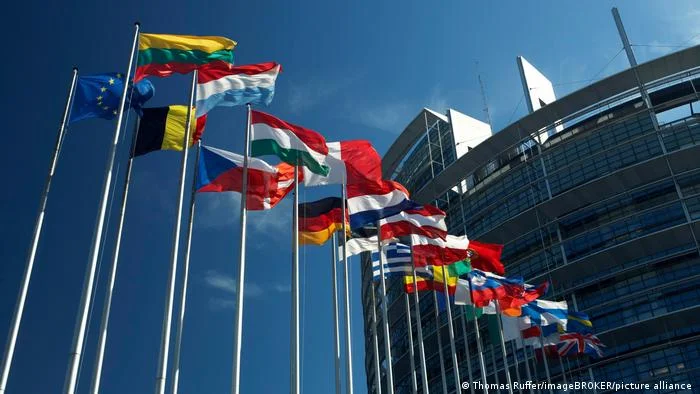
But more stir from recent proposals made French President Emmanuel Macron's proposal. On 9 May, Macron said in front of the European Parliament in Strasbourg and shortly later in Berlin that the European Union cannot be the only means for restructuring the continent. He proposed a “European political community” for those states that are not ripe for EU membership.
According to Macroni, such an approach would allow Ukraine, Georgia, Moldova, the Western Balkans and the “that have left the EU” to become more quickly part of a political Europe. “is a way to anchor countries that are geographically in Europe and that share our” values, he said. Macron proposed in other words a second level of co-operation with the EU, where states would be trained for EU membership.
Reaction in Germany to French EU Enlargement Ideas
These proposals are simply images right now. But they draw more attention than non-papers, unofficial letters of speculation that circulated extensively a few years ago, because they were publicly formulated by political personalities in office in the European Union.
In the initial reactions to some German media, the Macroni's latest proposal was characterised without high chances of being implemented. It was seen in the line of previous French presidential proposals, sometimes viewed as <x0 water loss with havan”, but are positive, as threats that want to set Europe in motion. The fate of such proposals depends on the outcome of the circumstances of whether there are majority in the EU and Berlin's stance.
At the press conference with President Macron in Berlin (09.05), Chancellor Olaf Scholz hailed the Macroni proposal as “ -- very interestingly” and said it could be discussed. Such support, however cautious, for Macroni, who faces parliamentary elections in his country, which may weaken his position, can be soothing to French often skeptical of Europe. In addition, the possibility that with a new model to get politically closer to the EU, Great Britain, which does not want to join the EU, sounds tempting.
But shortly after the assessment, the German Chancellor no doubt indicated that “is clear that this proposal should not and will not prevent us from advancing what we have started, to enable the membership processes that we have worked for so long. This applies especially to the Western Balkans. ”
Even ten days later, in the government statement that held (19.05). Before Bundestag, Chancellor Scholz said that Ukraine is not the short road to the EU “since we have to be fair to the six Western Balkan countries”. “The EU must now give to the Western Balkans. And I am committed to this, with talks to achieve progress in negotiations, and to remove the recent obstacles within the EU”.
In June, an EU summit will be held just for the Western Balkans. Without detailed his proposal, Emmanuel Macroni also said in Berlin that there are states that have already begun the membership process and are in the process of membership. I think they should complete this process; they should not be discouraged”.
potentially affected states and CDU sympathies
In the current state of discussion, it seems, therefore, disfellowshipped that countries working for EU membership for years, such as. Albania and Northern Macedonia will end up in a new EU training site. But if they get support for the Macroni proposals as well as similar proposals, in the EU's second”, in a kind of “European Union Light”, they can enter not only Ukraine, Georgia and Moldova, but also Balkan states like Kosovo and Bosnia and Herzegovina.
They would stand there, closer to the EU than if they had just a privileged “partnership until they were ready for membership. Simpati of this proposal expressed in Bundestag the largest German opposition party, the CDU, yesterday. The leader of this party, Friedrich Merz, urged the government to deploy to French proposals.
The discussion of EU membership was reopened by Ukraine's application for EU membership, following the Russian attack against it. It is not disfellowshipped for Ukraine to receive an EU membership candidate status in late June. Fighting Russian aggression against Ukraine has highlighted the geopolitical aspect in the EU, the desire to be protected at the borders of the community as well.
But current proposals also have a background in the interests of EU states. After the communist system collapse, an enlargement to the east of the EU was expected to weaken France's dominant position in the European Union. Geographical proximity and economic power would make Germany the EU's greatest power.
To avoid this, French President Francisco Mitterand proposed that in 1989 a <x0 European confederation” with two circles of rapprochement in which he wanted Russia to join. But the resistance of the eastern states to re-enter under a roof with Russia was one of the factors of his concept's failure.
Times have now changed. The fact that other models are being sought to draw close to the EU, even states that do not want to join the EU, for example. Great Britain is positive. The ideas presented, however, are in the initial phase. If they succeed, it's completely open right now. / DW