5 hours ago
Dom Lush Gjergji: For Mother Teresa, the worst disease was a lack of love
Periskopi(4 years ago)
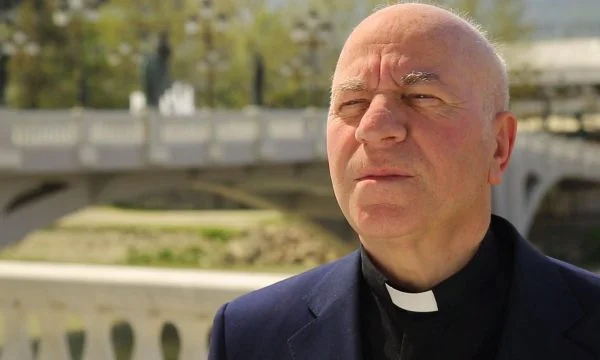
(4 years ago)Dom Lush Gjergji, author of 17 books about Mother Teresa, says that her work and life have an extraordinary current, although 25 years are being accomplished by the death of the Albanian-born Saint. Dom Lush Gjergji of Pristina and Prizren Bishop, in an interview for Voice of America said her message [...]
Dom Lush Gjergji of Pristina and Prizren Bishop, in an interview for Voice of America said her message was that love is above all.
She's the mother of life after all. Wherever life is in danger, that's where we should be. So you teach us how we should appreciate, honor, and love life from the beginning to the last offensive, or switching to the amplification. It's the mother of love. Love is the primary need and the only chance for a person to be happy”, says Dom Lus Gjergji, adding that for Mother Teresa “the worst possible is lack of love”.
Mother Teresa's biographer met her for the first time in 1968 and decades later. He says the elements that characterize some of the values of Albanians as hospitality and generosity have been embedded in the work of Mother Teresa who served people in need.
Mother Teresa has never separated Yahweh from man, nor man from Yahweh. That is why she loved Yahweh in man and man in Yahweh. And this must be our message”, he says.
We need to cultivate the entire Albanian brotherhood as much as possible, in every person to get to know our brother or sister, the more in every Albanian man and to have a concrete, not spectacular, not extraordinary, not only thinker, but also operational”, he says.
Dom Lush Gjergji stresses that relations between religious communities in Kosovo are important for the overall good.
We as a religious community, as well as the Muslim or Islamic Community, as well as the Orthodox Church have an extraordinary duty and a debt to God and to man to make this kind of harmonization so that we do not fall into the effects of evil, so that we are not limited to what is good (only) self - serving, or community (religious). Good is always common and there's no good but brotherhood and together to be good and to be happy”, he said.
Referring to relations with the Serbian Church in Kosovo, he says difficulties are not theological or religious, but adds that the hand of communication should always be laid down. The circumstances are sometimes more favourable, sometimes less unfavourable, but the possibility of talking, for dialogue, there are always” for communication, he said. / VOA