3 minutes ago
“crazed Ukrainian” after Bayraktar, why is Turkish fears considered “the king of heaven”
Periskopi(4 years ago)
(4 years ago)At a trade fair in Azerbaijan's capital, Baku, on May 28th, large crowds gathered to make fulness along with a TB2 Bayraktare (Flamurtar). This event illustrated the fame this butterfly has achieved since its first flight in 2014. Visitors to the Airspace and Space Festival [...]
Visitors to the Airspace and Technology Festival take photographs with a Bayraktar threat on May 28th.
In Ukraine, where at least 36 TB2 butterflies were purchased by the Ukrainian Armed Forces, one song was dedicated to these drones, and some Ukrainian animals have also been appointed Bayraktar in honor of the butterfly. Ukrainian protesters have also recorded themselves singing Bayraktar's song to mock Russian troops.
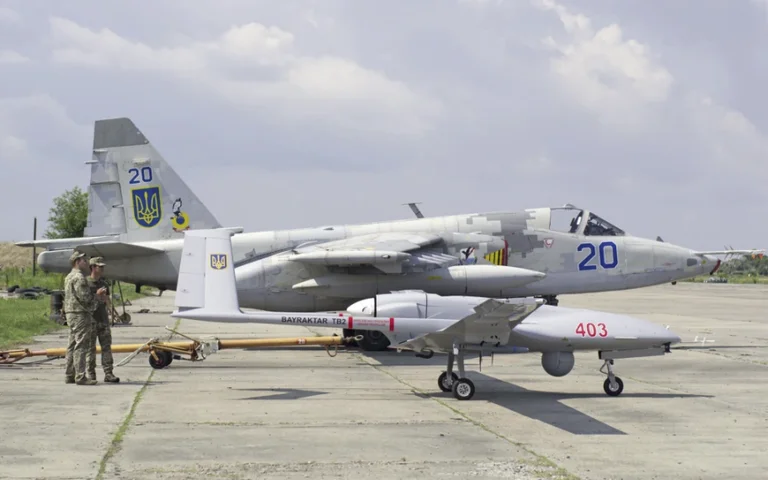
A Bayraktar Ukrainian forces TB2 near a Su-25 aircraft. This photo was taken in June 2021.
The civilian plane size Drone again became headlines on May 29th, when Lithuanians through donations raised 5m euros to buy a TB2 for Ukraine as this country fights Russian invasion.
Droni TB2 has been developed in Turkey by Selcuk Bayrakar, a graduate of the Massachusetts Institute of Technology. He is likened to American Elon Mook, the unique military plane he has developed, and to a presence on social networks, where he is often cruel to his critics.
Bayraktar, who is chief of technology at the Baykar defence company, in 2016 married the daughter of Turkey's president, Recep Tayip Erdogan.
Bayraktar TB2 can stay in the sky for up to 27 hours, which is enabled by a simple propeller engine and can also fly up to 150 kilometers from its base. This butterfly can also be equipped with four anti-x0mic rockets of smart ammunition”, which are precise enough to destroy armoured vehicles from several miles away.
A ground furniture station for controlling Bayraktar TB2 drones.
But this threat is seen as revolutionary because of the real cost of cheapness and slight availability. The large military Drons produced by the United States, like the MQ-9 Ready, cost tens of millions of dollars and even countries that can afford such technology are unlikely to buy these butterflies.
Washington approves military sales for only a few elected governments and costly American fears are widely seen as failing to meet the concept of “coping with loss” of aircraft without a pilot.
Turkey, which leads an Islamist president, has fewer criteria in terms of arms sales, and TB2 is currently being used by at least 11 armies. Other countries are waiting for shipments of these fears, including Poland, which is the first European Union state to buy these fears.
Price for a Bayraktar unit TB2 has not been made public, but Lithuanian organisers of the latest fund collection have suggested 5m euros are sufficient for a threat. It is unclear whether a escort command station will be bought together with the fears.
The TBs have been used by Turkey in what it calls “operations against terrorism” against Kurdish militants, but also in the ongoing civil war in Libya. But their devastating influence was seen during the 2020 conflict on the controversial Nagorno Karabakh region, when TB2 fears were used by Azerbaijan against ethnic Armenian forces.
Tens of videos published by Azerbaijan showed Armenian fighters fleeing as the missiles drove toward vehicles, unlike previous conflicts when their armoured vehicles were safe hiding behind trees or hills.
An Armenian fighter, with whom Radio Free Europe spoke in 2020, said fears could be heard “in the sky during Azerbaijan's massive offensive to retake Nagorno Karabakh, and Armenian soldiers were forced to walk only in open areas such as “defense” against Bayrak missiles. A single warrior seemed not worth killing with an expensive missile.
TB2's impact on the Ukrainian conflict initially seemed to be great, with Kiev posting several videos of large objectives, including Russian sea ships that were destroyed by these fears. But publishing such videos is not happening so often, and the Russian Army claims it has brought down dozens of fears in Ukraine.
Ukrainian President Voldymyr Zelensky has recently hinted that these fears are slow and easy to detect, may have become an easy prey for Russian antiaircraft systems, stating to reporters that a “history” of air defense means that “all respect for Bayraktar fears, and for any other weapon, I can tell you, frankly, this is a different fight of”.
“Drons can help, but will not differentiate”, he added. / REL