15 minutes ago
Citaku: The pipeline has moved even without Kosovo, Kurt's mistake in supporting US project
Periskopi(4 years ago)
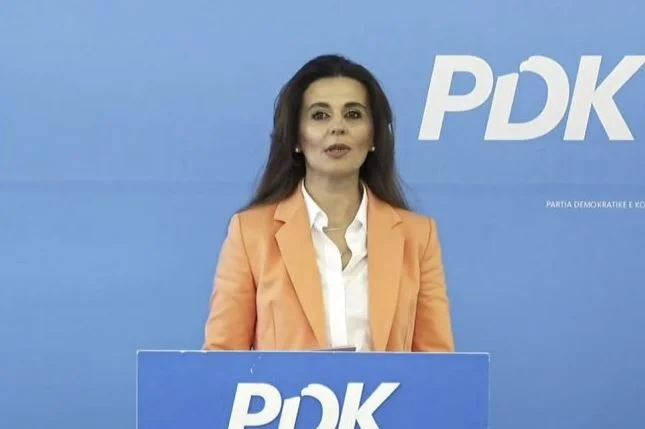
(4 years ago)It is the unfair “” and “ohomane” the way Kosovo citizens are treated on the part of the European Union, says former Kosovo European Integration Minister Vlora Citaku, commenting on the fact that Kosovo continues to remain the only Western Balkan country without free movement in the EU. Citaku, at the time he was minister, has accepted [...]
Citaku, at the time he was the minister, has accepted the guide with the terms of liberalisation, which he says has long been fulfilled.
Speaking to Radio Free Europe, she says the EU, with non-liberalisation of visas for Kosovo, is losing its credibility.
Citaku, who currently serves as deputy chairman of the Democratic Party of Kosovo, also speaks of dialogue between Kosovo and Serbia, the US-backed gas pipeline project, the role of opposition in the Assembly and others.
Radio Free Europe: Ms. Citaku, from the time you were European Integration Minister (2011-2014), or even earlier, visa liberalisation for Kosovo has been spoken and promised to the European Union countries. We are now in 2022, and Kosovo citizens cannot yet move without visas in the area known as Schengen. What is the EU asking for from Kosovo?
Vlora Citaku: It is unfair, it is unhuman how citizens of the Republic of Kosovo are treated in 2022. A few days ago, we saw the European Commission's recommendation to offer citizens of Qatar and Kuwait free movement in the Schengen area. States such as Colombia and Venezuela and others move visa-free to the Schengen area.
I remember when I was European Integration Minister Kosovo has been given visa liberalisation guide, and that guide has had twice as many criteria as other Western Balkan countries have had.
Despite meeting the criteria in question, despite the European Commission's recommendation since 2016 [for visa liberalisation for Kosovo], we have no decision by European Union institutions to recommend freedom of movement for Kosovo citizens.
Honestly, no logic, no explanation. True, it was a moment ago, but we lost it due to the procrastination process of demarcation with Montenegro. In the end, however, our obligations have been fulfilled.
The European Union is putting its own credibility in question, not keeping its pledges to Kosovo.
Kosovo is not seeking charity, it is not seeking favor, it is not seeking short distances. We've done our part of the job in 2016 and the European Union is late. Even tomorrow, if the visa liberalisation decision is made, it is late.
Radio Free Europe: There have been several meetings in Berlin this week over dialogue on normalising relations between Kosovo and Serbia. Do you see any indication that things are moving in this process?
Vlora Citaku: In fact, on the issue of dialogue between Kosovo and Serbia, we have seen a total lack of consistency. On the part of [Kosovo's] Government and Prime Minister Albin] Kurt's been said to be 10th, 7th, 4th, now turns out to be the top priority. So there's been a lack of consistency and a lack of transparency.
Mr. Kurti has met with [Serbia's president, Aleksandar] Vuciq, we know that the menu has not been talked about in Berlin and Mr. Kurti is obliged to clarify what was discussed and is there any progress in the process.
We demand that the prime minister fulfil constitutional obligations, complete the process of dialogue with Serbia and reach a legally binding agreement with mutual recognition in its centre.
You remember that for years in Kosovo, with unbearable ease, big and heavy words have been spoken. People are labeled traitors, as criminals, for involvement in dialogue. We don't do the same, but we, we just, we just demand consistency and transparency, and we want this process to be completed as soon as possible.
Radio Free Europe: The government Kurti has already scored a year in government. How do you evaluate the executive work during this period?
Vlora Citaku: Mr. Kurti understood the limits of government, actually. It's not like I had high expectations. I myself worked in institutions and know things never move as fast as we would like.
But unfortunately I'm saying, we've seen very little government, we've seen a abstention, I'd say, from government and decision-making. I can't mention any major capital project that started this year. I cannot mention any major decision made this year.
In fact, some wrong decisions have been made, as has Kosovo's non-involved gasmen's project, supported by the United States.
Radio Free Europe: Why do you think government Kurti was wrong when he refused the gas pipeline project?
Vlora Citaku: The gasploring project would bring Kosovo greater energy independence, as well as diversify energy resources and diversification is a fundamental criterion of the European Union as well. Moreover, this is not just an economic and energy project, this is a geopolitical project.
The best and direct way to counteract Russian gas dominance in Europe has been by this project, which, as we have seen, has broad support on our continent. But there is also strong support from the United States. So it's wrong, not only with economic consequences but also with political consequences.
Radio Free Europe: Why do you think this project was rejected?
Vlora Citaku: I've heard no explanation from the Government or the Prime Minister's side. In fact, they said they didn't refuse, there is no clear answer. One day they say we didn't refuse it, the next day they say we're analyzing it. But the truth is, the process has even gone without us.
Infographics South corridor alternative Russian gas in the Balkans
Radio Free Europe: The Democratic Party of Kosovo is the largest opposition party in the Kosovo Assembly. Analysts and civil society in Kosovo have criticised the opposition for failing to challenge the ruling party. How would you respond to such criticism?
Vlora Citaku: The truth is that for many years in Kosovo, public opinion has been imposed on a very harsh form of opposition, which has often used nonpolitical instruments. Our task, as an opposition party, is to criticise, offer alternatives, but not use nonpolitical means to achieve our goals.
Our job is to normalize the public record. We are in the political race, but this is not a race for life or death. It's not our job to have fun, politics should be boring. For entertainment, citizens must see something else, but not the Kosovo Parliament.