20 minutes ago
Western officials: Russian Army Is Demoralised in Ukraine
Periskopi(4 years ago)
(4 years ago)A new phase of war in Ukraine is taking shape in the eastern part of the country. Russian troops there are trying to overcome the earlier impasses, striking hard on Ukrainian forces. But success is not an easy task for an army that, according to British Defence Ministry data, has lost about 15,000 [...]
But success is not an easy task for an army that, according to data from the British Defence Ministry, has lost about 15,000 members since it began the invasion of Ukraine on February 24th.
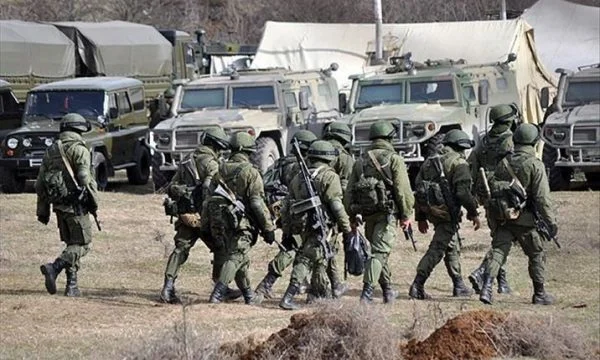
Although more than Ukrainians, Russian soldiers are viewed as demoralised by Western officials, especially after Moscow's failed attempts at a quick victory in Ukraine.
Russia has sent a large part of its military arsenal to the battlefield, including some of its most modern equipment.
However, there are some doubts about the size of its military stocks until Western countries, on the other hand, continue to send more and better military equipment to Ukraine.
To learn more about the battles expected to be fought, Radio Free Europe has talked to Margarita Konaev, associate at the Georgetown University's Centre for Security and Development Technology.
Radio Free Europe: Russian officials have stated that one of the goals of the second phase of war in Ukraine is to establish full control over [the Ukraine's eastern region] Donbas and on southern Ukraine, as well as the creation of a land corridor that would link Crime and Transdniester ʹ the separatist, pro-rus region of Moldova. How do you interpret this, and how real is this to the Russian army?
Margarita Konaev: All who pursue the war have found that the Russian army's intentions should be adjusted, taking into account the realities on the ground.
I think the statements to block Ukraine's access to the sea, controlling all of southern Ukraine, and then living on the land bridge to the area of Moldova controlled by Russian forces are alarming. I would read them not as something that the Russians will necessarily try to achieve at this round of fighting and at this stage of war, but as something they are positioning as an option, which they may pursue in the future.
At present, from the availability of forces they have and from their logistical abilities, the Russians are unable to pursue these important military goals.
Radio Free Europe: As a new phase of war takes shape, the West has increased military supplies to Ukraine. Yes, what supplies and forces does Russia have that it has not yet exploited, and how do they compare to the equipment in Ukraine?
Margarita Konaev: We've paid very much attention to what Ukraine needs [and] what Russia's missing, but we're less focused on what Russia has in reserve.
The heavy American photoarmament being sent to Ukraine
A field they [the Jews] have not effectively used and it remains questionable whether they are able to use [even in the future] It's Air Force.
We have not seen considerable involvement of the Russian Air Force in this war. Even when they hit targets, they do so very quickly and return to safer areas controlled by the Russians.
The broader involvement of the Russian air force could shift the balance a little more towards [Russia].
For Russia, the workforce will be questioned [and] to what extent it will continue to engage troops in this war, especially after massive staff losses. At a certain moment, you should start asking how you can justify those kinds of losses.
Where the staff will be brought in is also a big question. That's why we hear reports of mercenaries from the Vagner Group [and] even recruiting some Syrian forces. Although I have not seen reliable evidence showing that the number [of mercenaries] is as high as some reports suggest... it is not impossible for the Russians to exploit such resources to meet shortages.
Radio Free Europe: Russia has claimed late that it has taken over Marioupolis. In some cities in the south, we see how Russian forces try to create pro-Russian local governments. The Herson also talks about holding a referendum to proclaim the “Herson People's Republic”, supported by Moscow. How do you feel about these field tactics used by Russian forces?
Margarita Konaev: Since the early stages of war, one of the most frequent questions asked has been how Russia plans to invade Ukraine or Ukrainian areas that are clearly not interested in any kind of Russian rule?
We know that in the east and in parts of the south [of Ukraine] there are larger areas of the Russian-speaking population, but even among them, Russian incidents have not been welcomed at the level Russia has expected.
That is why they [Russian soldiers] should rely more and more on violence, oppression, and destruction of those areas rather than trying to convince or gain local support. But I personally do not foresee any kind of eternal military occupation in the south [of Ukraine]. It will be a very different kind of relationship that they will try to create with the local population there. And yet, they are relying mainly on destroying those areas so that they can then declare victory and be able to say they have fulfilled their goals.
Radio Free Europe: In view of the brutal tactics we have seen during the war and then the attacks, like those in Butka, what kind of relationship could be created between Russian forces and Ukrainians on the ground if there were a referendum?
Margarita Konaev: Any kind of referendum I think is important to clarify is absolutely illegal, because this is an illegal fight. Initially, the referendum would be against international law and whatever is declared there should be seen with much scepticism.
Unfortunately, in any kind of conflict, you have local actors seeking to take advantage of chaos. In this conflict, no doubt there were fewer examples of this because we have seen true unity among Ukrainians. But what Russia will try to do is empower some of those who are willing to co-operate on the ground, or even bring people from abroad, such as from Russia or parts of Ukraine controlled by separatists.
Another thing to observe is the population's displacement and the effort to remove a portion of the most pro-Ukrainian local population. [Russian forces] could probably restore some people from other areas of Ukraine or even parts of Russia to give the perception of legitimacy.
Radio Free Europe: What element do you think should be given attention at this stage of war?
Margarita Konaev: I think our expectations for prolonging this war must be moderated. [My assessment] is that this will be a war more long, than crucial, only because of the balance of forces and political component, that Russian President Vladimir Putin simply cannot afford to lose.
And Ukraine, on the other hand, is reluctant to withdraw when it is in a relatively good position to continue the war.
My advice is not to wait for a crucial [wheat], but to wait for a long-term stalemate and keep paying attention to the humanitarian costs of this war, because the price of reconstruction [of Ukraine] will exceed the price of military support the West is now offering.