 an hour ago
MA UNMIK does not accept Constitutional decision, says it constitutes limited assessment
Periskopi(4 years ago)
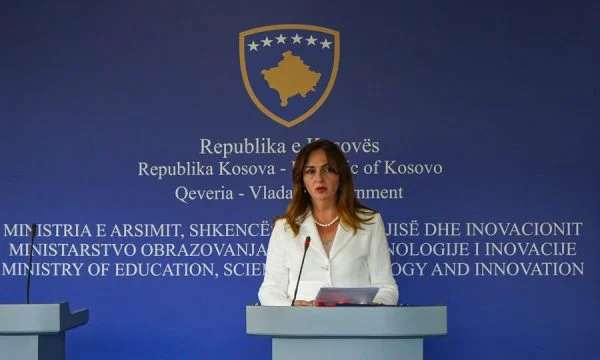
(4 years ago)The Ministry of Education, Science, Technology and Innovation ( MASTTI has been declared regarding the Constitutional Court's decision, which has rejected the Education Ministry's decision to organise accelerated alternative learning and to organise teaching in school facilities in the Kamenica municipality. MAST said he considers the Act [...]
MAST has said it considers that the Act constitutes a limited assessment (due to the objective character of its jurisdiction) of the state created.
“We respect the Action in full, just as the letter and spirit of the Constitution define. However, as the Action device is noted in itself, there is only a non-recognition of an actual situation that has ceased to exist at the end of July 2021. Such a fact is an indication that the Ko145/21 Act stipulates no constitutional differences currently present, or such as would have to be interrupted, judicial consequences (Parage 92 of the Act)”, said in the MSTI communiqué, which was published in its account by Minister Arberie Navci.
Full communique:
Communication for media concerning Constitutional Court Act of Cor145/21
The Ministry of Education, Science, Technology and Innovation has been announced by the Constitutional Court regarding the KO145/21 Act, which is the result of the Kamenica municipality's parade, in which MASTI “'s decision to organise alternative education accelerated for 441 Kamenica municipality students” has been contested.
We recall that the 01B/24 decision was taken on April 23rd 2021, in order to enable students of the five municipalities in Kamenica municipality, the partial compensation of lost hours as a result of the failure to learn from the start of the 2020/21 school year. 441 students aged 6-14 have not been teaching for 8 months, and more than 100 have not continued learning for about two years. Thus, under this decision, MASTI has considered fulfilling the legal obligation to provide the remaining children outside the school with the right to education, considering that protecting child interest is part of the category of primary obligations.
Without stopping in the interpretation of the Act, because of recognition of the tribunal's function as a translator of the Constitution, recalling to attention that the actual situation created from the end-July 2021 and following is fully in accordance with the definition of the Act of action in question, so MASTI does not need to take any action in such direction. MASTTI considers that the Act constitutes a limited assessment (due to the objective character of its jurisdiction) of the state created.
We respect Action in full, as the letter and spirit of the Constitution define. However, as the Action device is noted in itself, there is only a non-recognition of an actual situation that has ceased to exist at the end of July 2021. Such a fact is an indication that the Ko145/21 Act stipulates no constitutional differences that currently exist, or which would have to be interrupted by judicial consequences (Pictagium 92).
After an analysis of the findings of the Act, MASTI notes that the latter has assessed the constitutionality of the MASTI decision in terms of its compliance with the principles of local self-government, this assessment of the largely formal nature, while the Constitutional Court, due to the lack of jurisdiction in the concrete case, has failed to assess the aspects of the compliance of the 01B/24 decision with the right to ensure education with Article 47 of the Constitution (related with Article 2 of the European Convention on Human Rights and Human Rights). Such a conclusion is made by the Court in paragraph 126 of the Act. As a result, we appreciate that the Act is limited only to the assessment of the formal compatibility of the controversial decision, not to the associated with the rights of children in education as far as compulsory primary schooling is being offered to each student equally.
The 01B/24 decision by MASTI was taken in order to fulfill the positive obligations of the state of Kosovo in terms of children's rights in the Kamenica municipality, in proportion to the delivery of primary school service to students who had remained for more than two years without the possibility of pursuing public schooling. We have fulfilled an obligation that was also literally defined in Article 3 of the Pre-university Education Law (A. MASTI, municipalities, educational institutions [are forced] to plan and provide effective, effective, flexible, inclusive and professional services designed to provide all children with equal educational rights [...]. THE MASTI could not fail to fulfill such a obligation despite the fact that it could be subjected to constitutional control by the Constitutional Court. After balancing the rights and obligations of the subjects involved, child interest protection enters the category of primary legal obligations. The emphasis on the letter of the law in question was on our obligation to take action against the demands of their students/presidents. Fulfilling such a MASTI obligation has done it without prejudice to anyone's right to seek revising such a decision from a judicial instance, which is a perfectly normal process in a liberal democracy.
It is noteworthy that, in this regard, the ombudsman, on August 19th 2020, had issued the Report, which has recommended the then chairman of the Kamenica municipality, and then the Education Minister, to re-evaluate the decision 02 No. 26397, the date 30.08.2019, so reshuffle of schools can be done in full support of legal provisions and in co-operation with MAS. The report has also been addressed to the Commission for Human Rights, Equality Gynor, Invisible Persons, and Petitions. It states that failure to develop the teaching process in Kamenica schools constituted violations of the right to education defined by Article 47 of the Constitution. The decisions issued are contrary to legislation and legal standards, the health of children and, contrary to their best interest, have developed as a process without having full consultation with the parties involved in the process.
The ombudsman has found that the educational system should be the same in all municipalities, so organising the education system can only be done by MASTI and the entire territory of Kosovo.











