5 minutes ago
Russia towards partition: Chaptering in Ukraine expected to break up state in dozens of ethnicities
Periskopi(4 years ago)
(4 years ago)From Dan Negrea “National Interest” The catastrophic Russian invasion in Ukraine recalls Britain and France's military campaign at the Suez Canal in 1956. Degrading attraction also marked the end of their status as first-ranking powers and the beginning of a turbulent period of political crises and territorial losses due to [...]
The catastrophic Russian invasion in Ukraine recalls Britain and France's military campaign at the Suez Canal in 1956. Degrading attraction also marked the end of their status as first-ranking powers and the beginning of a turbulent period of political crises and territorial losses due to independence movements.
History can repeat, as Russia fails in its attempt to invade Ukraine. It is suffering major military losses, economic power, and international position. It is now clear that Russia is not a major force in the same category as the United States and China.
And it is entering a period of political unrest, which will likely include renewed demands for independence on its constituent republics, just as it once did during the breakup of the Soviet Union. Britain and France appeared very strong in 1956.
They were victorious in World War II, the European dominant powers, permanent members of the UN Security Council, and rulers of major colonial empires. So it felt strong enough to invade Egypt to prevent local President Gamal Abdel Nasser from nation-owned Suez Canal.
But the true superpowers of that time opposed that attack the United States threatened with economic sanctions, while the Soviet Union with military vengeance against Britain and France were forced to withdraw humiliated.
British Prime Minister Anthony Eden was accused of lying to parliament and was forced to resign. Feeling London's weakness, Britain's colonies intensified their quest for independence. The pro-britanic Royale in Iraq collapsed in 1958. This was followed by the independence of Cyprus and Malta. By 1967, more than 20 British colonies had gained independence
The crisis in France was even worse. The retreat from the Suez Canal came two years after the French garrison in Dien Bien Phu surrendered to Vietnamese-vereires, and as some soldiers attributed these to a spineless political class.
In 1958 a group of military and colonial officials organized a coup in Algeria. The Fourth Republic collapsed, and Charles de Gaulle regained power as leader of the Fifth Republic. In 1962, the Algerians won their long war for independence, while 900,000 European-Algerians fled to France for fear of revenge.
Movements for independence were strengthened throughout the French colonies. Vladimir Putin's Russia-Ukrainian war has been beyond Moscow's potential. It will force Russia to recognise its restrictions and reduced status. This failure is likely associated with new demands for independence from constituent republics and territories.
The whole world is witnessing the inability of the Russian Army to design force in a neighboring country, which is equal to 1/3 of population size. The Russian economy is shrinking due to the cost of war and sanctions. Inflation is going above 20 percent. This year alone, the economy will drop by 10 percent.
The Russian Stock Exchange is not functioning, while Russian stocks traded in London have suffered a 90 percent decline. The effect of very severe and sweeping sanctions imposed on Russia by most of the world's major economic powers will only increase over time.
The international political consequences of this conquest are also grave. Russia has no major allies in this war. China is just giving a silent support. Belarus is allied, but there is very little to offer. Meanwhile, nearly all of Europe, the United States, Canada, Japan, Australia, and many other free world countries are lined up against Russia and are helping Ukraine a lot.
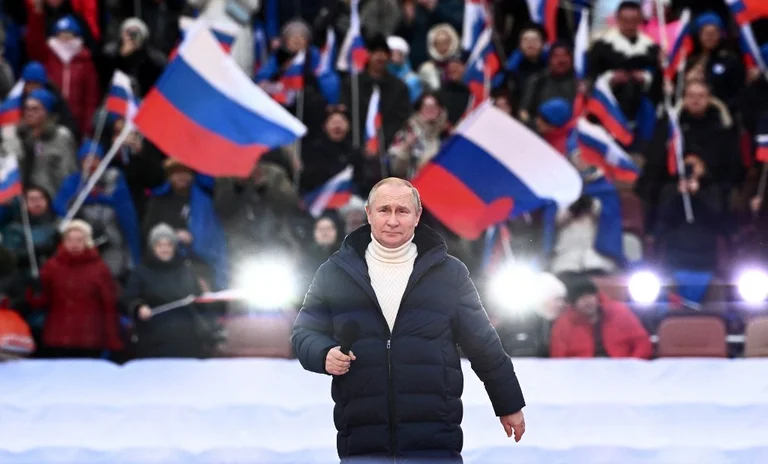
These major challenges are being addressed by a fragile political system built around Putin's personal dictatorship. His cabinet deputy chief, Vyacheslav Volodin, summed up this mentality “Without Putin, there is no Russia! To cope with growing dissatisfaction with the war, Putin will have to further increase internal depression.
But even this has its costs and borders: today in the Russian security device there are more people than in its armed forces, and more people in prison than in Brezoyev's time. The invasion of Ukraine has been a major miscalculation. Putin thought it would be like Hungary's invasion in 1956 or Czechoslovakia, which made the Soviet Union stronger.
It is more like the Afghanistan War of 1979-1989, after which the Soviet Union was disbanded, and some of its constituent republics became independent. It is not unprecedented for Russia's constituent republics to seek independence when Moscow is weak. One such moment was the Russian Revolution in 1917.
Several constituent republics then declared their independence, and some remained independent for years. Among them were Lithuania, Latvia, Estonia, Tatarstan, and the republics of the Northern Caucasus. After the collapse of the Soviet Union in 1991, some republics became independent countries - Molddavian, Belarus, Ukraine, Georgia, Armenia, Azerbaijan, Kazakhstan, Kyrgyzstan, Uzbekistan, Turkmenistan, Tajikistan, and the Baltic republics of Lithuania, Latvia, and Estonia.
The process of dissolution could have gone even further, as several other Russian regions, such as Siberia, Urales, Carelia and Tatarstan, declared their “sovrine” at that time. But to prevent more territorial losses, President Boris Yelts suggested a federation, which promised the republics as much “sovence as they could afford”, and negotiated the signing of agreements with the most troubled regions.
What, though, fuels claims of independence in today's Russia? The Russian Federation consists of 85 <x0). Russia has over 190 ethnicities, and many live in such remote countries as Siberia and the Caucasus region.
But why would they choose to leave Moscow? For two main reasons: economic and cultural. Today's Russia, like the Soviet Union once, is not a story of economic success. Russia is an average economic power, with a GDP the size of Spain or Texas in the United States.
Its GDP per capita is even less impressive. In the 2020 World Bank index, Russia ranked 85th, between Bulgaria and Malaysia. Alexei Kudrin, former deputy prime minister and minister of finance, and Russian economist perhaps more influential, said in an interview in 2018, that Russia could be dissolved just like the USSR, if the Russian “leadership does not give up the Soviet mentality”.
Among the risk factors he mentioned were dependence on oil, sanctions, limited access to technology, lack of workforce, and low productivity. Meanwhile, many of the republics and regions have closer ties with other countries than with Russia.
They think they get little or no benefit from the central government in Moscow, which they see as corrupt and incompetent. The other main motivation is cultural. Russia expanded mainly through invading wars, most of them long and bloody. She maintained her rule through terror, often moving populations to distant lands. The Russian state is clear to the central role of its Slavic culture, as well as to the privileged role of the Russian Orthodox Church, a major supporter of the regime. But this doesn't like the republics very much in non-Russian and non-Christians.