25 minutes ago
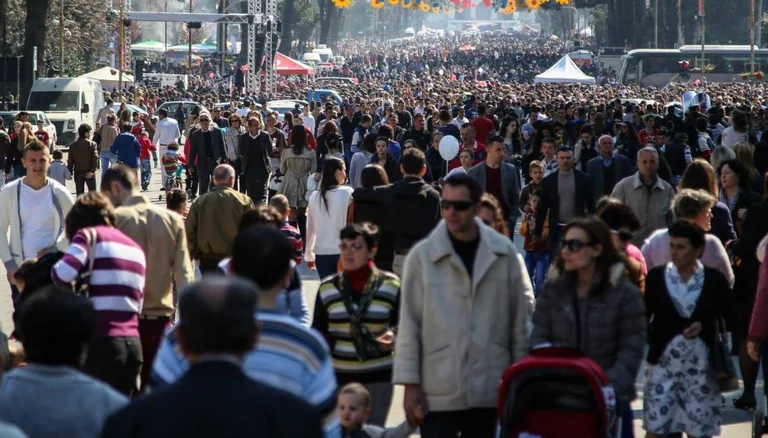
Albania no longer has three million residents
Periskopi(4 years ago)
(4 years ago)Population age, high migration rates, and the effects of Covid-19 on population health have resulted in a population decline in 2021. I NSTAT reported that Albania's population on January 1st, 2022, results in 2,793,592 inhabitants, suffering a decline of 1.3 %, compared to January 1, 2021. This is the fifth year in a row [...]
INSTAT reported that Albania's population on January 1, 2022, results in 2,793,592 inhabitants, suffering a drop of 1.3 %, compared to January 1, 2021. This is the fifth year in a shrink year of the number of residents.
During the year 2021 the natural addition of the population (born-death) was -3.296, marking for the first time the extra natural negative.
During the year 2021, a significant migration increase was confirmed and the number of returnees remains low.
INSTAT reported that the number of immigrants in 2021 was 9,195, and the number of immigrants was 42,048. The number of fugitives, according to INSTAT graphics, was the highest since 2019 and 2014.
Net migration (divinity between immigrants and immigrants) experienced an absolute increase, compared to a year ago: from -16.684 to -32,853 people to 2021.
The average population age was on the rise.
According to INSTAT, on January 1, 2022, the population's media results in 38,2 years from 37.6 on January 1, 2021.
On January 1st, 2022, the youth addiction report (0-14-year-old population report with the population of 15-64) decreased compared to January 1, 2021: from 24,2 % to 24,0 %, while the proportion of the elderly (the 65+ population report with the population 15-64) increased: from 22.3 % to 23,1 % during the same period.
The total gender population report on January 1, 2022, has suffered a decline compared to 1 January 2021: from 99.3 to 98.6 males for 100 females.
The gender report in the east increased, marking the value 107.5 in 2021, from 106.6 in 2020.
During the year 2021, 27.284 babies were born, undergoing a 2.8 %, compared to the year before. The death toll in 2021 was 30,580 people, with an increase of 10.8 %, compared to a year ago. Deaths rose significantly due to the health consequences of David-19.
In 2021 the number of immigrants was 42,048, and the number of immigrants was 9,195.
Tirana, Durres and Fieri have the highest weight in the total population.
On January 1, 2022 Tirana accounts for about 32.9 % of the total population, continuing to be one of the country's most populated districts, followed by Durres and Fieri with 10,4 % and 109 % respectively.
As for other counties, five of them occupied between 2 and 5 %s of the total population, respectively.
On January 1, 2022, the population grew only in one district of the country
Population estimates on January 1st 2022 show that only one district of the country marks population growth, compared to a year ago, while the other eleven districts marked population decline. The increase was marked in Tirana (+ 0.8 %).
By contrast, the biggest population reductions were recorded in circles: Gjirokastra (- 4,7 %), Berat (- 3.7 %) and Debar (- 3,6 %).
The circuit with the above - youth addiction report is Kukesi (33.5 %), which also turns out to be the circuit with the proportion of the highest elderly (26.2 %), followed by Lezha circuit with (26.1%).