4 minutes ago
The wage bill risking the outbreak of social discontent, Government is transparent
Periskopi(4 years ago)
(4 years ago)Kosovo risks being involved in social discontent, due to the wage bill. Unionists of various public sectors have warned protests and strikes as the form of pressure for the quickest adoption of this bill. The salary law was passed once in February 2019 and has entered into force the following month. But one [...]
Kosovo risks being involved in social discontent, due to the wage bill.
Unionist of various public sectors have warned protests and strikes as a form of pressure for quick adoption of this bill.
The salary law was passed once in February 2019 and has entered into force the following month. But, a month before its implementation began in January 2020, the ombudsman institution has sent it to the Constitutional Court for, as it has said, “the assessment of its compliance” with the Constitution of Kosovo.
The court, then, has ruled that The adopted law is not in line with 11 provisions of the Constitution and that it causes “regimes of disparity division of the Judiciary and independent institutions”.
The law has been abolished and has since been on hold, largely because of political developments, which have included several parties of elections in the country.
Kosovo Government officials have told Radio Free Europe that the bill is now in the final phase of the revision, and that approval from them is expected to take place next month. They have also pledged public consultations for it.
After adopting Government, the law must be passed to the Assembly, signed by the president and released in the official newspaper.
The wage bill envisions salary increases on the basis of the cofficient, or tasks that public employees have.
Until the adoption and start of its implementation, various unions have asked the Government to share additional means, along with monthly salaries.
According to them, they are necessary, due to increased inflation. Last month. Kosovo inflation has reached 7.5 percent, compared with 0.7 percent in February 2021.
The Union of Independent Trade Unions of Kosovo (BSPK) has warned protests in Pristina on April 8th if the Government of Kosovo, according to him, does not make a solution to the wage bill.
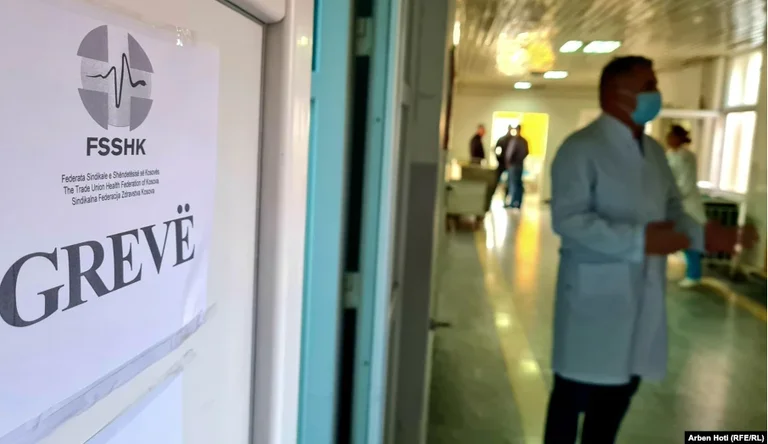
Health Union has said that April 7th will decide “Sindical operations”
Education Union has said he will host a meeting of government officials until April 2nd, on the contrary, will go on strike.
The administrative staff union in the justice system has said it gives the executive deadline for up to six months; if the wage bill does not meet its demands for salary growth, even this union could be raised with expressions of discontent.
Unions: Government not transparent
Blerim Syla, chairman of the Federation of Kosovo Health Unions, tells Radio Free Europe that the worker's discontent has grown after government officials have pledged that the wage bill will be adopted by them in March.
We are unhappy with wages, but we have given dialogue opportunities. There is no dialogue. Then the last tool is union reaction. We didn't have a meeting with government officials, they promised, but only a symbolic meeting was held. Everything is going nontransparently”, Syla says.
The last one-day strike, the Federation of Kosovo Health Unions, has held on November 25th of 2021, precisely with the requirement for salary increases.
Medical expert salary In Kosovo it is currently 600 euros; with the law abolished it would be 1,195 euros.
The chairman of the United Trade Union for Education, Science and Culture (SBASHK), Nundman Jasharaj, says the institutions have provided no information on which phase of the drafting is the wage bill.
The biggest disappointment is why the Government is closing its doors and escaping dialogue with the SBASK and other trade unions... This dialogue is missing and this is creating additional tensions, because we are not having official answers to many questions”, says Jasharaj for Radio Free Europe.
According to him, the SBASK requires authorities responsible for sharing additional means of 100 euros per month for all employed in the education and culture system, until the wage bill is strengthened and starts implementing.
The abolished law has seen the salary increase of an elementary school teacher from 470 euros to 612 euros; of a high school educator from 525 to 621 euros; and of assistants and university professors from 1,080 euros.
Court administration workers and prosecutors have been on strike from March 1st to March 18th, also demanding salary increases.
The chairman of the Union Association at the Constitutional Court in Pristina, Naim Rrustemi, says their main requirement has been that, under the draft wage law, the salaries of administration workers be linked to those of judges and prosecutors.
According to him, the average salary of administrative staff is about 400 euros a month, while judges and prosecutors between 1,800 and 2,700 euros.
Until the Law for Pay starts implementing, Rrustemi says the union he heads requires an additional 150 euros a month for each administration worker, as well as the payment of a daily shift and travel.
Rrustem says the strike has been suspended to give government time -- up to six months -- to meet the demands of its union.
“If we are eventually unhappy with the wage bill, then the last tool is the strike, because the strike has been suspended and it has not been suspended”, says the Rrustem for Radio Free Europe.
Kosovo Government officials have said public consultations on the wage bill will begin during March, when all trade unions, media and civil society will be invited. By the 30th of this month, however, there has been no announcement of any such debate. / REL