15 minutes ago
Russia's Four Other Neighbors Fearing occupation
Periskopi(4 years ago)
(4 years ago)By Thomas De Waal “Carnegie Europe” Who could be next to Ukraine? As Russian invading forces further penetrate Ukraine, other post-Soviet countries have reason to fear their future. Five countries other than Ukraine, Armenia, Azerbaijan, Belarus, Georgia and Moldova are classified by the EU as its neighbours in the Eastern Partnership. [...]
“Carnge Europe”
Who could be next to Ukraine? As Russian invading forces further penetrate Ukraine, other post-Soviet countries have reason to fear their future. Five countries other than Ukraine, Armenia, Azerbaijan, Belarus, Georgia and Moldova are classified by the EU as its neighbours in the Eastern Partnership.
Three of them celebrated on Wednesday the 30th anniversary of their membership in the United Nations. But they are currently trapped in a grey <x0zone” outside the EU and NATO. There is much to say about the failures of governance and the weak institutions in all these countries.
But three decades after the collapse of the Soviet Union, they are all full-fledged sovereign states. The terrible paradox is that even in the worst days of the 1990s, none of these countries faced the challenge of its existence, which Ukraine is facing in 2022.
Russian President Vladimir Putin is not returning us in 1991. On the contrary, he is sending us back to 1939, or even 1918, when an imperial power could easily force her army into a neighboring country. The EU must quickly change a neighborhood policy focused on reforms, in a policy aimed at the survival of these countries as states.
In this context, the weaknesses of these five countries are worth considering and how each of them can be supported. Belarus is de facto in Russia's region. Minsk is Moscow's full military partner in the new war that has begun.
Among the massacre taking place in Ukraine, it is easy to overlook the fact that Russia has annexed Belarus. A country of 9 million has surrendered its independence. But 18 months ago, he experienced a democratic uprising that nearly brought President Alexander Lukashenko down.
How different would the situation be if those massive protests had succeeded? The EU must continue to support Belarus's bold democratic opposition, but things there will take time to change. Russia has a major impact on Armenia, a country that is a member of the military and economic blocs led by Russia, the Organisation of the Kolektive Security Treaty and the Eurasian Economic Union.
Russia also rules the majority Armenian enclave of Nagorny Karabakh after the end of the 2020 war between Armenia and Azerbaijan. Armenian Prime Minister Nicole Pasinyan came to power, aiming to lead Armenia towards Europe. In his Donocyotesk populism, he does not look as much like anyone in post-Soviet space as Presidentukraines Volodymyr Zelensky.
But Ukraine and Armenia are on the different sides of the current geopolitical division. It was an achievement Armenia managed to abstain from the March 2nd resolution of the UN General Assembly condemning the Russian invasion of Ukraine.
An Armenian expert describes the prime minister as a useful “trofe for Putin”, as the man who committed to implementing the ceasefire agreement imposed by Russia, which ended the 2020 war. But Russia has many long-term economic and political leverages available in Armenia that it can use, and many useful friends like former president and opposition leader Robert Cochryan.
Through its comprehensive Agreement and Expanded Partnership (CEPA) The European Union and Armenian diaspora organisations that opposed Pashiyan because of the 2020 war must now support the democraticly elected Armenian government.
Azerbaijan is maintaining a balanced position between Russia and Ukraine. President Ilham Aliyev visited Kiev in January. Then it was called to Moscow just two days before the Russian invasion, to sign a “co-operation agreement”tam drafted by the Russian side. The first point of the agreement is territorial integrity and “respect the principles of non-interference in each other's internal affairs”. (See how brazen this normic language is in view of what Putin did two days later).
But Azerbaijan is more vulnerable in the economic field. The deal narrows Bakuu to Moscow, speaking more about economic co-operation, which can turn Azerbaijan into a shelter for Russian companies trying to avoid Western sanctions.
The two most endangered countries are Moldova and Georgia. The first one's kind of lucky. It's geographically closer to the EU and further from Russia. The constitution is neutral, and the pro-European government of Maya Sandu faces a very strong pro-Russian opposition, and now with the humanitarian crisis as tens of thousands of Ukrainian refugees have already entered the country.
The most frightening scenario for Moldovans is whether the Russians continue to progress along the Black Sea coast in Odessa, and troops are related to those currently located in Transdniestria, the separatist province of Moldova funded and armed by Russia for 30 years.
The administration in Transdniestria will play a two-way game: political support from Moscow through a small Russian military force, and support from Moldova and the EU as its economic partners. Russia has very little interest in Transdnestrian in itself. But there can be a strong interest in him as a new military base.
Meanwhile, Georgia is in many ways similar to Ukraine. The 2008 Bucharest declaration, which created for the two countries a not-so-clear prospect for NATO membership, left them in a vague situation: without an official plan for NATO entry and in the face of a more hostile Russia.
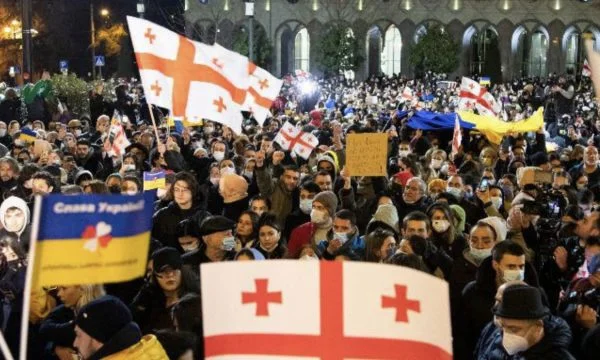
There have been big protests in Tbilisi for days in support of Ukraine. President Salome Zurabishvili is supporting Ukraine by conducting a series of visits to European capitals. Prime Minister Irakli Garibashvili has been much more shy by refusing to openly condemn Russia's action -- behaviour that has been criticised by his Ukrainian counterpart.
The once very successful policy of the Georgian reformist government in managing Russia's behaviour has degraded. Tbilisi currently has disagreements both with Brussels and Washington over the back steps it has taken in terms of democracy.
And the soft approach towards Russia, and not to line up with its traditional Western allies, could put it in a delicate situation. Moreover, war has encouraged the opposition, and is worsening the prolonged political crisis in the country.
If Putin has ambitions to take control of Georgia, he will do so with far less force than in Ukraine. Support for Russia stops at the de facto borders of Abkhazia and South Ossetia. The new generation barely speaks Russian. No political party respects joining Russia. But as we see in Ukraine, Putin can give way to a new war. /Express