14 minutes ago
“Mysterie” of the Russian convoy, how are the Kremlin tactics in Ukraine changing
Periskopi(4 years ago)
(4 years ago)Last week, there has been a marked change in tactics by the Russian Army, while the extent of the war in Ukraine has expanded, writes AL Jazzera. Advanced weapons, especially the opposing systems and human mobile air defence, as well as small arms and ammunition, have been used in Ukraine. These have had an impact on [...]
Advanced weapons, especially the opposing systems and human mobile air defence, as well as small arms and ammunition, have been used in Ukraine.
These have had a significant impact on the battlefield as Russian tanks, armoured vehicles, supply trucks and helicopters are constantly targeted and destroyed.
These attacks have helped slow Russia's advance as it continues its move towards the country from three directions north to capital Kiev; from the east, with the focus of siege of Kharkiv and Mariupol; and from the south, where Russian units, after taking the Kherson, have crossed the Dniper River into two countries and are now advancing along its two sides, as well as putting pressure on the city of Mikolev and Ukrainian protection near the town of Zaporzhija.
Russian units have consolidated their control in Marioupol, taking the surrounding cities and expanding the corridor linking the Crimea with Donetsk. Only a small generation of coastline, centered around the port city of Odessa, is now under Ukraine's control.
Foreign Warriors and Russian Stallation
It's not just the guns that are flooding into Ukraine. Volunteers are entering the country with every means they can to fight.
More than 60,000 Ukrainians from its diaspora have returned to the country and are now engaged in fighting Russia, according to Ukraine's defence minister, Olexia Reznikov.
All foreign fighters are making their way, driven by a series of ideologies and reasons, with Ukraine saying 20,000 people have applied to join the international Legion created in response to the Russian occupation.
Russia has announced that it too will accept foreign fighters, mainly Syrians experienced in urban fighting, in an effort to support its armed forces, which have so far been in poor performance.
This is one of the major surprises of the war so far: that the Russian army with its professional army “new” has barely achieved any of its strategic goals and, in terms of the applied war force, logistics, command and moral control and overall focus has been misrepresented across the board.
Military communications have been so bad that Russian generals have had to move much closer to the front line to exercise some control over the tactical situation there. Three generals have been killed so far in the war, an almost unprecedented number in no modern conflict. Communications in some countries are based on normal unpublished civil networks, allowing Ukrainian military and intelligence to monitor Russian military communications traffic.
War Goes West
Russia has finally fulfilled the fact that this large flow of weapons and workforce is affecting its army and has now taken steps to stop the course.
Ukraine's air bases at Ivano-Frankivsk and Lutsk in the western part of the country were attacked and severely damaged in an effort to degrade the Ukrainian Air Force -- a move that could be expected in the opening hours of the occupation, but came nearly three weeks late.
A Ukrainian base in Yavoriv, near the Polish border, which is used to train foreign fighters, was destroyed by missile attacks as Russia tried to stop the flow of people and materials spilling over borders.
Russia has clearly restored its sights from the immediate battlefields to the relatively intact Ukraine West.
After the Kremlin threatened to target shipments of Western weapons to Ukraine, NATO had warned that they would be protected if attacked beyond the borders of Ukraine.
This is now a possible flash point that can attract NATO in a broader conflict, as Russia is desperate to stop the flow of weapons to the east for the Ukrainian Army.
A general war in the region, including nuclear powers, is that all sides are trying to avoid because the results would be catastrophic for Ukraine, Russia, Eastern Europe and beyond.
Civilians as Guns
Russia's tactics have been exacerbated as hospitals and other civilian infrastructure have been constantly hit by air strikes and artillery shells.
The coordinates of these hospitals are known for Russian military planners, buildings are large and easily detectable by air. One or two attacks may be a mistake, one of the terrible realities of the war, but more than that indicates a deliberate strategy to make life unbearable for local civilians who will then flee to the uninvasive areas, quickly defeating few city resources. And cities close to the front.
These tactics have been seen in Marioupol, Kharkiv and will likely be implemented in the capital Kyev and Odessa, while Russia focuses on the next phase of the conflict.
North ï Kiev and column
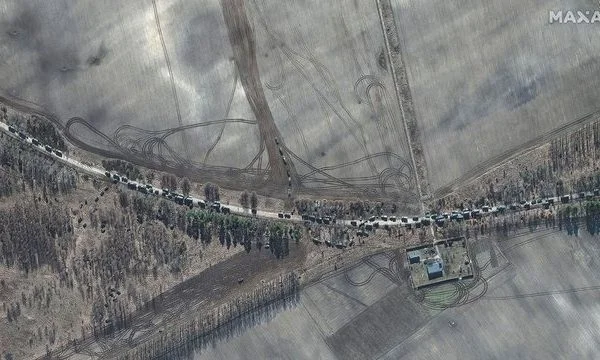
The Ukrainian capital has been a Russian strategic goal since the beginning of the war. A large column consisting of hundreds of vehicles, tanks, artillery, armoured personnel carriers and supply trucks advanced toward Kiev, only to stop about 25 km (15 km) from the city, many within the range of Ukrainian artillery.
There he stood, a possible target about 64km (40 km) long, motionless on a one-way route for 10 days.
It's one of the great mysteries of war so far. Why did the Russians advance so close and then stop? And why didn't columns at least lay down to defend themselves?
There have been reports that the head of the column has been attacked, so its advancement has stalled; that the Russians ran out of fuel, or less likely, than the cheap Chinese tires used by the Russians couldn't afford the difficult roads and went off.
But there is a second part of this mystery: Why didn't long-range Ukrainian artillery destroy at least part of the column?
At the beginning of the war, the Ukrainian Army had 354 multiple rocket launchers (MRL), including over 80 of the MRL accurately directed Alder produced in the country, which, with a radius of 70km, could easily target the entire column.
But it didn't.
The fact that Ukraine did not attack such an apparent virtually motionless target has surprised outside observers, but the most common explanation among Ukrainians is that they did not want to escalate the conflict by causing a large number of Russian victims.
The opportunity to destroy the column has passed, as it has spread out and is now part of the Russian effort to take over the city. The peripheral cities have been heavily promoted and Kiev itself has been hit many times, the frequency of attacks rises from day to day as the capital prepares for a ground attack by Russian troops and armoured forces.
South é Marioupol and Odessa
As Russia focuses on surrounding cities, the southern front is where it has been most successful. Most of the coastline is now in Russia's hands.
The city of Marioupolis is the only obstacle for Russia connecting the Crime Peninsula with Donetsk. Witnesses of some of the fiercest fighting, the city has been severely damaged by entire neighbourhoods that were torn down by Russian artillery and air strikes.
As Ukrainians continue, the supply is becoming a problem and the humanitarian situation is getting worse despite successive efforts to open humanitarian corridors for civilians to leave the city. The northern towns of Marioupolis have been taken from Russia as the cordon around the besieged city expands.
Odessa, Ukraine's largest port, is preparing for a Russian attack. A former Russian tourist destination, its 40-mile stretch of the beach and the coast has now been mined, hard spots have been built throughout the city as the Ukrainian Army and volunteers prepare for the urban battle they fear will come soon.
It is reported that a large Russian amphibe fleet is now approaching Odessa from the Crimea Peninsula. The Russians had carefully established a remote port blockade so far, avoiding a direct attack on the city.
If Odessa falls into Russia's hands, it will be a serious blow to Ukraine's war effort, as the port deals with two thirds of all cargo from the sea.
Mechanised Russian infantry units are now slowly advancing to the north along the two sides of Dnieper. The strategic cities of Zaporizhja and Dnipro have turned into castles as they are flooded with refugees fleeing fighting, further straining the already excessive resources. Set to the bend of the Dnieper River, which bisects Ukraine from north to south, their ownership is vital for both sides, as Russian forces slowly push their way north.
Much has been said about the slow Russian progress, but despite Ukraine's powerful efforts, they are progressing. The siege of the western cities of Ukraine is continuing. The entire area around Kherson is now under Russian control and a successful attack on Odessa would close Ukraine from sea, turning it into a land without access to the sea, blocking most of the country's most necessary imports.
With so much at stake on both sides, the conflict does not seem to end soon. Victims are expected to rise significantly, Ukraine's neighbours are already close to the extraction point, as refugees continue to pour over the border. The risk of escalation is always present as Russia tries to maintain its military offensive in Ukraine and also its control over public opinion in the country.
Vladimir Putin's political survival is increasingly linked to a successful outcome for Russia in this war, increasing the number of deaths, and the slow speed of pursuing it by constantly supporting it in a corner, and closed presidents are dangerous.