15 minutes ago
Pay law close to drafting away from implementation
Periskopi(4 years ago)
(4 years ago)The public sector wage bill is expected next month to arrive at the Kosovo Assembly for approval, government officials say. If it manages to be approved in this period, its implementation cannot begin until the second half of the year, said members of the Commission for Economics and Finances in the Assembly [...]
But the police and education workers' union say that approval and implementation of this law should be accelerated due to rising consumer prices.
Consumer products prices in December of last year have increased by 6.7 percent.
The salary law was adopted in February 2019 and entered into force in March. But, in December 2019, the ombudsman institution sent this law to the Constitutional Court for, as it was said, “the assessment of the compliance” of this law with the Constitution.
According to the Court's decision, the law is incompatible with 11 provisions of the Kosovo Constitution and causes “power-sharing disorder in the region of the judiciary and independent institutions”.
The abolished law, currently, is in the final phase of the draft and is soon expected to begin the process of preliminary consultations, then public consultations, is said in a response to Radio Free Europe, from the Kosovo prime minister's office. In response, the government is said to have begun to contact all relevant unions.
The Police and Education Union have confirmed that they have received invitations to submit their representatives' names, but no meeting has been scheduled so far.
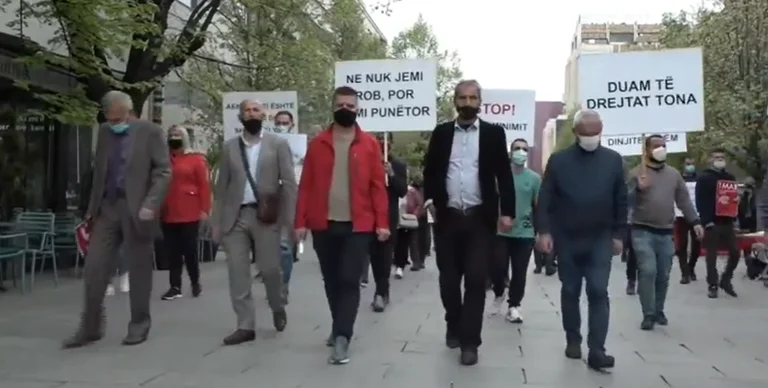
But, they have stressed that they will not comply with the wage bill if their demands are not included in the document.
Imer Zeqiri, chairman of the Union in the Kosovo Police, says the same wage coefyctor for police officials and co-aficit officials in the abolished Law will not be accepted.
In the abolished law, the cofficiency for members of police has been 2.2 or around 470 euros, while with the current union bill it requires that the basic wage is not below 600 euros, including compensation for overtime, night shift and risk.
More than 9,200 are estimated to be the number of Kosovo Police officers. Their base salary is currently 392 euros.
It's the only institution where work is at high risk for the lives and health of employees, which is worth thinking about as far as pay rates are concerned. It is one of the most important institutions deserving of growth so that police feel they are respecting someone and have a dignity of”, Zeqiri says.
Under the suspended Law, the basic salary is that part of the salary, which benefits the full - time work of a certain function or position. The value of a basic salary is calculated by multiplying the pay class's cofficient at the monetary value of the coeficent. The cofficiency report is one with ten (1:10).
The highest challenger is 10, which is held only by the president of the Republic of Kosovo, then is the 9th level, attended by the Speaker of the Parliament, the prime minister and president of the Constitutional Court of the Republic of Kosovo. With the cofficient 9, the salary totals 2,150 euros.
Besides the Police Union, the adoption of this bill has already been sought by the Education Union, Health Union and the Fireship Union.
The doctor's professional salary is currently 600 euros, 470 euros of monthly salaries receive teachers in pre-university education, while between 280 and 330 euros is the salary for firefighters.
Gjerman Jasharaj, chairman of the United Trade Union for Education, Science and Culture, says that unless the SBASK's demands are included in the bill, in “the pre-university education system will have no calm”.
The SBASK's demands are to level the salary of low-cycle educational workers with high-school employees.
The teachers and educators with the new law should be equal in terms of the cofficient, as they are already. If our controversial proposals are ignored, then let the government know that it is leading us to another situation, and Congress can bring a general strike decision throughout the entire educational system”, Jasharaj claims.
But even if the wage bill is adopted in March in the Kosovo Assembly, its implementation cannot be launched immediately, because this bill is not included in this year's budget, says Commission for Economy, Industry, Intervention and Trade in the Kosovo Assembly Chairman Ferat Shala.
The wage law must have high budgetary implications and cannot enter without a review of the budget or early next year. Its cost is not yet known, since it has not yet reached the commission for review”, Ferati points out for Radio Free Europe.
Reviewing the budget-changing Law for the Republic of Kosovo budget is usually in the second half anniversary, respectively, in June.
The number of employees receiving salaries from Kosovo's budget is around 83 thousand. The average net salary, according to data from the Kosovo Statistics Agency, is 542 euros.
In contrast, the minimum wage is 130 euros for employed under 35 and 170 euros for employees over 35 years of age. The minimum wage value in Kosovo is the lowest in the region, provided by Albania by 248 euros. In Bosnia and Herzegovina the minimum wage is 300 euros, in northern Macedonia 359 euros, in Serbia 401 euros and in Montenegro the minimum wage is 533 euros.