an hour ago
Should Germany send weapons to Ukraine, at least for protection?
Periskopi(4 years ago)
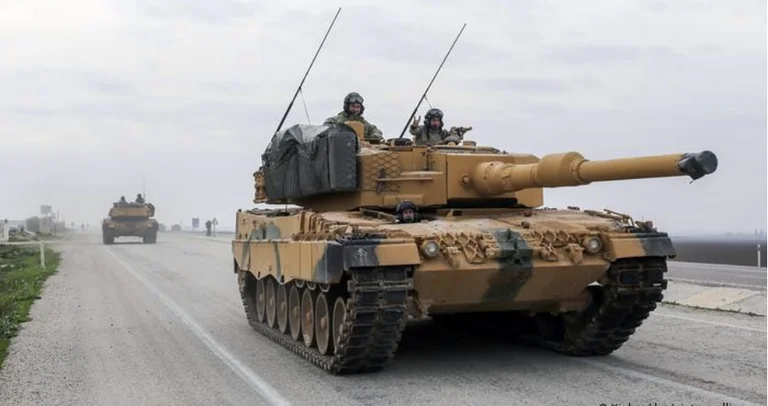
(4 years ago)Germany will not even send weapons to Ukraine for protection. The country is avoiding discussions on the subject and has so far sent only helmets. This is and has been one of the main conflicting topics in German foreign policy for many years: Germany is one of the biggest exporters of [...]
This is and has been one of the main conflicting topics in German foreign policy for many years: Germany is one of the largest arms exporters in the world. It is currently in fourth place, after the US, Russia and France. German arms producers have recently exported their products for nearly nine billion euros, mainly in South Korea, Algeria and
Egypt.
At the same time, the new and old government remains in the stance that no weapons should be sent to conflict regions. This is happening even now, in the increasingly deep crisis at Ukraine's external borders, in which Russian movements have often taken on frightening proportions, while the US claims that the Russian attack on Ukraine could begin in the coming days. But Chancellor Olaf Scholz and Foreign Minister Annalena Baerbock rely entirely on diplomacy. After weeks of strange hesitations, they launched a real offensive talks, which culminated in Scholz's visit to Kiev and later in Moscow.
Contention in Difficult Situations
There is good reason for this German stance not to supply arms to crisis regions or involved in war. Especially in a region that once suffered from a terrible German invasion. The danger of promoting conflict with sending weapons is certainly huge. It's also true that there are no shots as long as the conflict parties are still talking to each other.
Another bigger problem is that in Germany, especially among the ruling parties, there is no really serious debate about when this stance is no longer in order. And this has to do with the fact that it is firmly embedded in the German post-war mentality for the country to hold back when the situation becomes difficult. Every shipment of Bundeswehri abroad has been rejected and still rejected by most of the population in the polls. The parties have long understood that. Germany does business with the whole world, including arms trade. But conflict remains nearly pacifist although there have been exceptions.
In the case of the Social Democrat party, the SPD, for example, this stance goes far back, until the time of Willy Brandt's decision to retire. While the Greens have their roots in the peace movement of 1970 and 1980. Many voices have long said that such attitudes cannot always stay. At the last convention of ecologists, there have also been beggars for military assistance to Ukraine. But requirements have not been approved.
One of the few exceptions was German participation in the Kosovo war in the Balkans more than 20 years ago. A decision that almost dissolved the Greens, then headed by Foreign Minister Joschka Fischer.
Traits of Conflicts
What is needed now is a sincere debate about what role Germany wants to play in a changing geopolitical situation, including its military role. It has long been clear that the United States, for example, is increasingly addressing the Pacific region, while Europe is seeking to take over the conflicts in its region. This will remain so, and if US President Biden focuses more on Europe than his predecessor Donald Trump. But in the medium and long term, Germany can no longer rely solely on Americans, perhaps British and French, for them to do dirty work.
This is not a call for unlimited weapons and export, which does not take Germany's history into account. But no matter how reliable the current position of government may be, there would be just as many good arguments to the contrary in the case of Ukraine. And yet there is. Ukraine has been demanding a large number of German antitank missiles these days.
The appeal is: Let's be honest and make a special decision on any conflict by always maintaining the basis of the German stance. On the other hand, we finally have to deal seriously with arms exports. Because content has long been exceeded as a principle especially of states in which human rights are violated by foot.