an hour ago
23 years from publishing the report “Terror Week in Drenica”
Periskopi(4 years ago)
(4 years ago)American Human Rights Organization “Human Rights Watch”, 23 years ago released the report “Terror Week in Drenica”. In this report, which was released on February 8, 1999, it describes how Serbian special forces in late September 1998 slaughtered 21 civilians in the Upper Abria, and killed 13 men in [...]
In this report, which was released on February 8, 1999, it is described as Serbian special forces in late September 1998 slaughtered 21 civilians at the Upper Abria, and killed 13 men in the nearby village of Golloboc.
Extrected by Drenica's Human Rights Monitoring Report: Kosovo humanitarian laws violations
Battles at the Upper Abria. Middle of July, 1998, Yugoslav Army and Serbian police launched a general offensive against KLA. It had almost lost control, according to an assessment, in over a third of Kosovo's territory. The offensive, accompanied by heavy artillery, tanks, the Air Force, had a high effect on forcing KLA forces to withdraw from most of their positions towards the mountains between the trees.
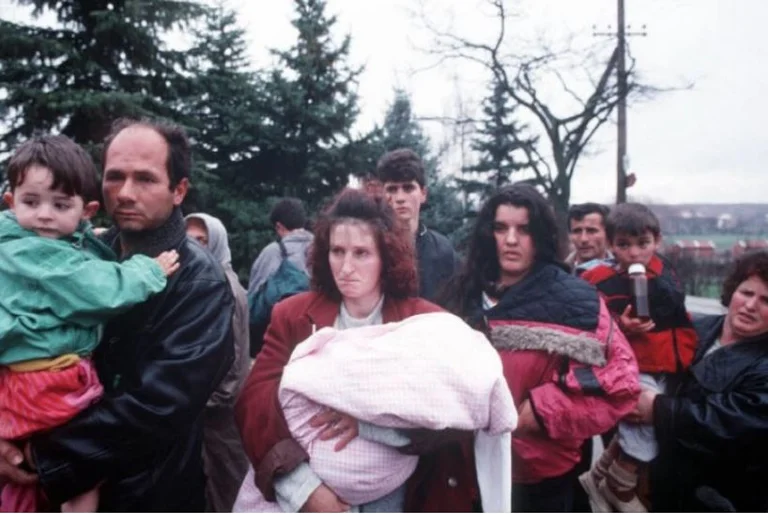
And at the end of this offensive, only a few KLA fighters were killed or captured. The worst suffering was experienced by Albanian civilian populations living in the fighting areas. Over two hundred villages are destroyed, and 300 thousand people are left homeless. Most of the more than 2,000 killed during September are civilians. The danger faced by civilians in Kosovo was articulated in a public position of the International Red Cross Committee, issued in September: “At the present moment reigns a serious and unchanged state for several weeks. Tens of thousands of civilians are in iron circles of attacks and displaced by their own lands. They have been exposed to violence - even life, destruction of homes, separation from families, and ambition.
Thousands of them have no place to take refuge or seek self-defense... from mid-September, international pressure on Milosevic to disrupt this offensive had increased. But, the government had already managed to destroy KLA centres and sites, pushing them towards the mountains. Destruction had also run out in an important area; Drenica, the central part of Kosovo, where the most fighting had taken place between the KLA and government forces. The final days of the offensive were suspected to have been carefully calculated.
Milosevic and his military leaders knew they had little time to complete their goal in Kosovo and then manipulate with a request for the rapid withdrawal of forces from Kosovo, as the West requires. The village of Abri the Top is located on the territory of Drenica's Glogovac municipality. The 500-year-old villages, which had about 300 houses separated into large family compounds, with fields and trees in between, also calculated Deliu and Hysenia neighbourhoods, which take special place in this report. Three kilometers north, there is Licoci, who was in service of the KLA, but since 13 September (1998). ) St. B) is re-arranged by Yugoslav forces. During September, government forces took an offensive in Drenica region aimed at deslocking U n CK from this powerful triple. Police and army attacked from Kline's direction, southwest of Glogovac, then even from Qychavica, mountains east and efficiently will surround KLA forces on the coast of Abria.
Referring to Naim Malokut, a command of KLA and former Yugoslav Army officer interviewed by <x0 York Times”, Yugoslav forces faced KLA resistance between Abria and Licoci... After Likoci's invasion, Serbian forces were heading towards Abria. According to Zeyniye Deliu, who was with her family in Abri, at the beginning of the offensive, government forces began bombing Deliu, from Licoci, about eight o'clock in the morning, on Friday, September 26, from different kinds of artillery and mortars. Most of the neighborhoods had taken refuge in the forest to escape the promotions.
The only civilian left in the neighbourhood during the promotions was the 21-year-old Deliu Union, who had to care for his father, Fazliu, 94-year-old and disabled. The Union explains that the attacks continued on Saturday morning after Friday evening the police had returned to Likoc. Half the convoy of tanks in Likoc, which were about 68 in total, had moved towards Deliu neighbourhood.
They kept throwing cannons at the tanks over our neighborhood. The infantrymen came after the tanks, and most of them had beards. I continued to stay with my father, who needed my help, water, and food. We were smoking from a cigarette when the grenade fell on the roof of the house. I jumped out of the second floor of the house and ran through the yard. I looked through a hole in the yard door and saw that soldiers and paramilitary men had entered the neighbor's house. I saw the soldiers coming toward my house no farther than 30 meters. They had brown military uniforms, and many had large knives or small axes besides fiery weapons. I continued to run as hard as I had toward the Bashdrallaks (neighing)... For several days then Yugoslav forces will keep Abrin under control, committing the alleged wrongdoing in this report.