2 minutes ago
19-year-old from Istog to Germany for nearly tenfold pay
Periskopi(4 years ago)
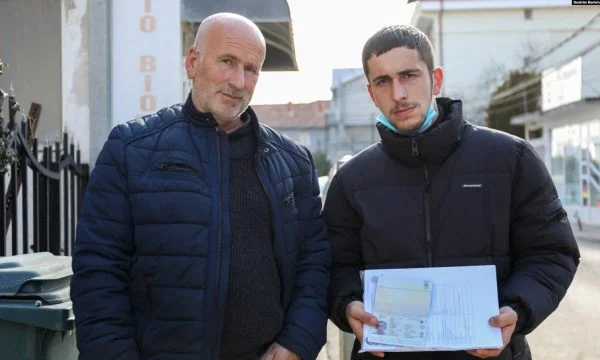
(4 years ago)Erion Shala from Istog intends to leave for Germany. Accompanied by his 19-year-old parents, an automechanic profession, applied for a working visa at the German Embassy in Pristina on 15 February. As he spoke to Radio Free Europe, he said he could no longer work for 15 euros a day. Erion Shala is waiting [...]
As he spoke to Radio Free Europe, he said he could no longer work for 15 euros a day.
Erion Shala is awaiting the German Embassy's response in Pristina regarding the working visa.
For more than eight hours of work, I have been paid 15 euros, there [in Germany] will be paid 17 euros per hour”, Erion said.
In the documents he had collected to apply for visas, there was also a work contract. He said he had provided it to a family member who runs a car repair company in the town of Heilburn, Germany.
Erion will wait a week for the Embassy's visa response.
His parents, though concerned about him, said that this is the only way that Erion can live a better life and help them and his brother.
I didn't think it would be this way, but now I don't have what to do, there's no more difficulty where it goes”, said his father, Ismet Shala, Kosovo war veteran.
“
On Tuesday, February 15th, when the REL stood before the German Embassy in Pristina, dozens of citizens were mainly young people who expected to apply for visas.
Although many of them refused to speak openly, some said the economic situation, poor working conditions, and low wages force them to flee Kosovo.
I've been hurt at my workplace and I've got no compensation from my employer. Although I have problems with this injured leg, I will go to Germany and I will neither live nor work in Kosovo”, said a citizen who refused to be identified.
Germany is the most popular state for Kosovo citizens, when it comes to issuing work visas. Most of the Kosovo diaspora is concentrated there.
The REL requested data from the German Embassy in Pristina on the number of working visa applications and the number of visas issued during the past year, but, until the publication of this text, received no response.
According to media reports in Kosovo, only in December last year and in January of this year, over 100,000 citizens have applied for working visas in this embassy.
In January, the German government announced it would open 300,000 jobs for foreigners.
In order to avoid shortage of workers, a large scale migration of” must occur in Germany, said German deputy cadre Robert Habeck.
Over 43,000 immigrants in two years
According to the Kosovo Statistics Agency (ASK), the number of Kosovo immigrants in 2020 has been 8,724, or 0.49% of the resident population.
All migrants are involved in this number, regardless of why migration and their status legal or illegal.
The family union, finding a job, and permanent migration are cited as reasons for migration.
As destinations of immigrants from Kosovo have been identified: Germany, France, Austria, Croatia and other states.
In 2019, before the Corleone pandemic began, the number of Kosovo immigrants, according to the AK, was much higher: 34,911.
The data for 2021 has not yet been published.
A survey by the US-based International Republic Institute, published in November last year, has shown that 78% of Kosovars between the ages of 18 and 35 would eventually leave “” or “maybe” from their country if they could.
The Social and Economic Effects of Youth Escape
Economists and sociologists in Kosovo see the flight of young people as disturbing.
The increased youth interest of “leaves Kosovo without a labour force. This will reflect on the pace of economic development”, says the executive director of the American Economic Ode in Kosovo, Arian Zeka.
According to him, the state should create real offers for international investors, who would generate new jobs.
Shemsi Krasniqi, professor of sociologistry at Pristina University, says the consequences are broader than just economics.
With youth removal, the creative and creative potential diminishes. They are young and have life ahead. It would be best to make [live] in their own country, but the reality is that. They're leaving”, he says.
Youth Unemployment - Over 48 percent
Politics in Kosovo do not go in favour of motivating young people.
According to the European Statistics Agency dealt with Eurostat, Kosovo is the country with the lowest minimum wage in Europe. Employees under 35 are paid 130 euros per month, while those over 35 are paid 170 euros per month.
Despite government authorities' promises of growth, the minimum wage value in Kosovo has remained unchanged since 2011.
The average gross salary in the public sector is around 620 euros, while in the private sector around 380 euros.
In 2021, Kosovo's unemployment rate has been nearly 26 percent. Compared to the preceding year, there has been an increase of 0.1 percent. The youth unemployment rate is 48.6 percent, according to the AK.
Last year, inflation has also increased. The KSF has announced that the annual inflation rate in November, 2021, has reached 6.9 percent, up from 0.1 percent in the same period in 2020.