3 minutes ago
Middle-term US elections: Who leads and who lags behind, see the result so far
Periskopi(4 years ago)
(4 years ago)The first election results in America are beginning to become known. The latest NBC News assessment says the Republicans have won 219 seats in the House of Representatives compared to the Democrats 216, which means they will continue to take over, but with far less authority than profits [...]
A 13-nation error gap to this assessment, so what it really means is that each side can win.
And after the Democrats won the Pennsylvania Senate seat, this race is also very balanced, with only seven remaining states to declare itself.
Competition for the House of Representatives
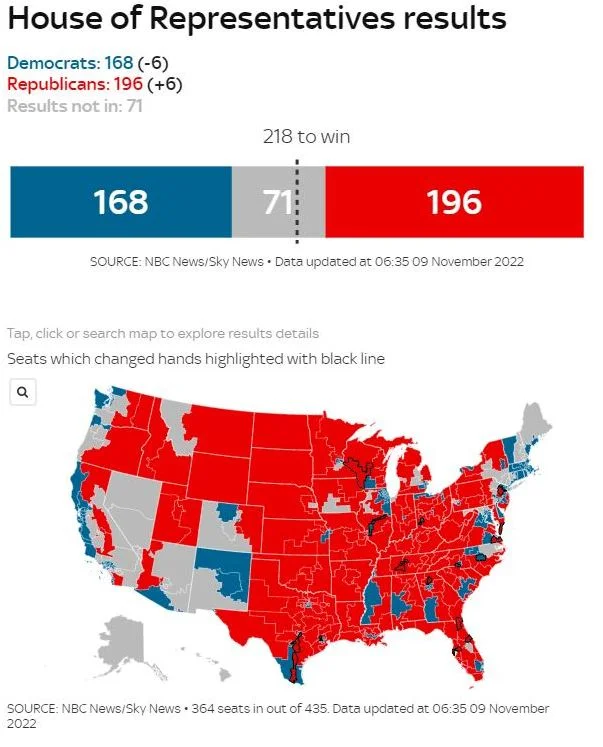
There has been a remarkable profit for Republicans in several countries, such as Jen Kiggans, who defeated the January 6th investigator Elaine Luria in the 2nd area of Virginia's battlefield.
But most of the view is clouded by the reparation that has occurred since the 2022 elections. Many of the countries listed as profitmaking are new circuits entirely or representing almost unknown geography to those they replaced.
These benefits, for both sides, while generally benefiting the Republicans, do not necessarily reflect the change of political preferences of Americans, but the regulation of the American political map.
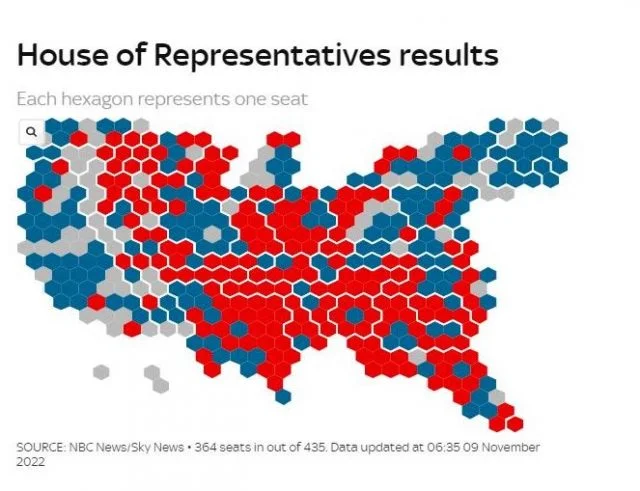
Although the map above appears to be highly ignored with Republican reds, this too can be deceptive.
Each country has a population similar to each other, but some are much smaller than others geographically. This is usually in areas of town where there is a denser population.
This map shows each other's size, which can give a better understanding of the balance of power across the country.
The Senate Race
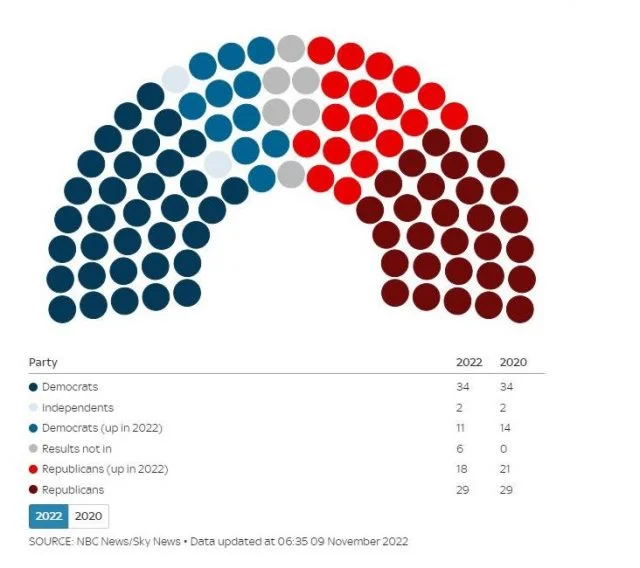
The balance of power in the Senate was always expected to be placed more delicately than the House of Representatives, and with only eight remaining seats to declare that we are not close enough to determine who will take the lead.
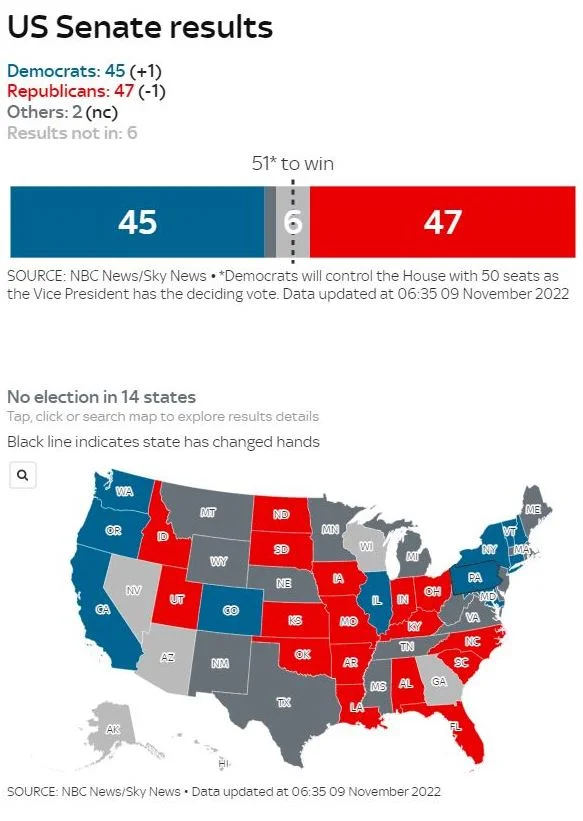
The Democrats made a potentially decisive profit in Pennsylvania, but they are still struggling with strong protections in Nevada and Georgia, which can send the Senate back to the Republicans. They had only one profit in this choice in general to take control.
The challenge of the Democrats in Wisconsin, a state won by Biden in 2020, also appears to be closer than expected.
Including non-election countries this year, the Senate's balance will appear until the 2024 elections.
What does that mean for Donald Trump?
The former president has not yet officially announced his intention to run again for elections, but is still the host's favourite to win in 2024.
Even though it is less prominent in social networks these days, it certainly has not avoided politics. During the campaign for these medium-term elections, he has approved 174 of the Republican candidates in the House of Representatives, and dozens more for Senators, governors and possible Republican State Secretarys.
But initial results suggest this may have resulted in reverse. Republican candidates to the Trump-backed House of Representatives have actually performed worse than those who were not.
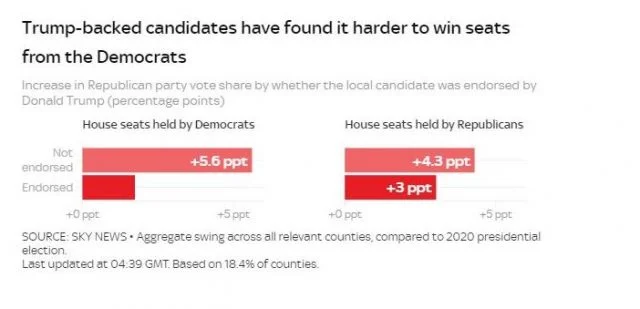
The percentage of republican votes in areas contested by a Trump-backed candidate has increased by only 3.2 percentage points compared to the 2020 elections.
That is much less than the 6.9 percentage point increase in areas where the republican domestic candidate did not have such support.
These approvals, valuable weapons in the republican preliminary elections in recent months, seem to have shown little benefit in winning over independent Democrats and voters.
In countries held by the Democrats, trump-backed candidates achieved an average growth of 1.7 percentage points, compared to 5.6 percentage points reached by them without such support.
Even in republican areas, trumpet-backed candidates have gone relatively wrong, achieving an average growth of 3 percentage points, compared to 4.3 percentage points for candidates not supported by the former president.
This analysis is based on early results from only 18% of the circuits, so it may not be representative of the final outcome, but at least give us a glimpse of how things are going.
What does this choice mean for America?
After the 2020 elections, it was the first time since Barack Obama's first term that both chambers of Congress and the presidency were in the hands of the Democrats.
It is much easier for a president or a party to approve their policies if all three are held by the same party.
If Joe Biden's Democrats lose control of one or two rooms, they will lose the ability to set the agenda for major issues that divide the country, such as gun control, economy, abortion, immigration and climate change.
The president's parties usually lose seats in the medium mandates -- 28 on average -- even though the Democrats will certainly hope to reject this trend as George W Bush did for the last time in 2002, a year after 11 September.
However, with the assessments of President Biden's approval on a low historical level, this seems impossible.
The question remains is whether it will be enough for the Republicans to win the five seats they need to get into the House of Representatives and what they need for the Senate. /abcnews.al/