12 minutes ago
For killing 13 civilians during the Kosovo war: Appeal lowers Goran Stanisic's sentence from 20 to 15 years in prison
Periskopi(4 years ago)
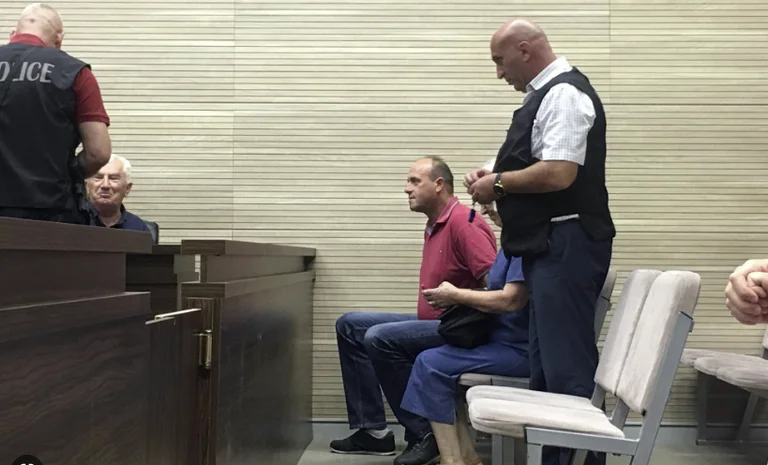
(4 years ago)The Appeals Court has partially approved it as being based on the appeal of the defender convicted of the killing of 13 civilians during the war in Kosovo, Goran Stanisic, changing the first degree act against him, due to the sentence on sentence, so that he has reduced the sentence of the same from 20 to 15 years in prison. [...]
On October 5, 2021, the Constitutional Court in Pristina, Goran Stanisijqi had sentenced him to 20 years in prison for killing 13 civilians during the Kosovo war., reports “Justice Vow“.
In Apel's decision, which results in publication on October 27th, 2022, Stanisic is said to be tried with prison sentences of 15 years, in which sentence will be counted even past time in detention.
“APROVOW is partly based on the complaint of defendant G.S., av. Lubomir Pantovic, the act of the Constitutional Court in Pristina, P.P.N.11/20, date 05.10.2021, is largely changed to the sentence, so that the Court of Appeals, accused G.S. for the crime he was convicted of and sentenced to prison terms of 15 (five years) years, in which his sentence is counted the previous time in custody from 20,07.2019 onward, said the Appeals Court ruling.
This court has found that the claims of convict Stanissic's defender, lawyer Lubomir Pantovic, are based on sentence.
In the decision, the Court of Appeals reportedly finds that according to Article 38's provision, paragraph 1 of LPJ, the sentence of imprisonment cannot be shorter than 15 days or longer than 15 years, but according to paragraph 2 of this article, only for the criminal acts for which the death penalty has been anticipated can serve 20 years in prison.
“With UNMIK Rule No.199/24, December 12, 1999, which has entered into force from June 10th 1999, only capital punishment has been abolished by death (neni 1.5) and the 40-year long-term prison sentence has not been determined instead of the death penalty. With the change of regulation exalted to Rule No.2000/59, the 27th of October 2000, with Article 1.5, the prison sentence has been lifted, while with the provision of Article 1.6 of it has been determined that for any criminal act for which by law in effect in Kosovo on March 22, 1989 the death penalty is put forward, the sentence will be in prison among the minimum set for that work and the maximum of forty-fivex1 years, the decision states.
On the other hand, the ruling says that with the transitional provisions (entire 4) of this regulation, it is seen that this regulation comes into force on October 27, 2000, while the new Article 1.6 applies only to crimes committed after that date.
The second resolution has not created new criminal legislation, but it has only changed the death penalty to forty years in prison since with the first regulation it has only abolished the death penalty and has not been determined to serve long term prison sentences until its change of June 10, 1999, to the 27th 2000, namely, the fact that there is no basis for the long-term sentence on the long-term sentence of imprisonment, which has determined the longer term for crimes committed after October 27th 2000, given the principle of preventing reactive action of the criminal law, the fact that there is no basis for the long-term sentence of imprisonment, and the more favourable principle of the Court proves that all acts of criminal crimes are committed by October 27th, and that the sentence is set to be carried out by the 15th of prison.
According to Apel, it is fair to point out in the defendant's complaint that the maximum prison sentence, which in this case could have been pronounced by the accused, has been the prison sentence for 15 years, so even the second degree court has changed the first degree sentence regarding the 20 - to 15 - year sentence because it has found that the maximum punishment for this criminal act is less than the maximum sentence the Founder has received, and therefore ruled as a safeguard in this act.
The Court of Appeals criminal co-operation estimates that this sentence is in proportion to the weight of criminal acts, the degree of criminal responsibility, the circumstances of the conduct, the consequences caused, and the conviction that punishment would affect the prevention of future criminal acts and influence other persons not to commit criminal acts. Thus, the pronounced punishment is sufficient to achieve the sentence”, said by Apel.
Otherwise, indictee Goran Stanisic's defender, lawyer Lubomir Pantovic, had also filed a complaint because of the essential violations of criminal procedure provisions, violation of criminal law, wrong and incomplete confirmation of the actual situation, but the Court of Appeals for the same claims has found they do not stand and are unfounded.
While the Special Prosecutor of the Republic of Kosovo had answered in complaint with the defendant's defender, proposing that the defender's complaint be rejected as unsubstantiated, while the complaining plea be confirmed.
According to the indictment filed by the Special Prosecutor of the Republic of Kosovo, accused Goran Stanisic, as a member of Serbia's Ministry of Internal Affairs reserve police, in April 1999, during the war in Kosovo, in opposition to the rules of international humanitarian law, during a broad and systematic attack by Serb paramilitary and police forces against the Albanian civilian population, in the villages of Slovi and Trbov, in co-operation with other members of this entity, had participated in the expulsion of the Albanian civilian population and in committing illegal acts and other illegal acts.
As reported in the indictment, on April 15, 1999, in the village of Slovi in the Lipjan municipality, the defendant in interaction with other members of the unit had gone to the G family's backyard, ordered members of this family out of their homes, and after they had left, had separated the males from the women, forced women and children out of the yard on the street.
The indictment is said to have later, in the presence of witnesses Mr.G. and her daughter J.H., who had not yet left the courtyard, lined them up near the wall of the M.G. court, his two sons O.G. and E.G., and his two nephews, A.G. and B.H., and then shot them with automatic weapons and they had all killed them on the spot, then forced Mr.G. and X.H. to leave the courtyard.
On the other hand, the indictment says that the same day and in the same village, in interaction with other members of the unit, by vehicle had gone to the courtyard of the family home B. After they left the car, they had fired automatic weapons towards F.G., B. B, F.B. and R.B., who had been in the yard near the well, and they killed F.B. by shooting him in the back, and F. G, B.B. and R.B. had escaped running in different directions from the scene.
Always according to the indictment, the same day and in the same village, in the vicinity of the old village school, had been separated from the pillar of Albanian civilian population that had forced them to abandon the village, J. K, B.G., V. P, R. K, A.I. and F. B, and after being lined up in front of a wall, they fired on them with automatic weapons, killing them all in place.
On April 16, 1999, it is said that in the village of Trbovc in the Lipjan municipality, at the site called “The Lakes Lugu”, a defendant along with four other uniformed and armed persons, had banned the injured A.I. along with now the late Mr.G, who had been going through the mountains to join their fellow villagers and families.
As said in the indictment, damaged A.I had issued a pack of cigarettes at the request of the defendants, and by giving them cigarettes to other people, she had taken advantage of the case and had started running to escape, while the defendant with other armed persons had shot at her in the direction of killing her, where she had been hit in the right thigh, for what she had collapsed, and had rolled up to the stream, where the villagers had found her in the evening, and since she had shown them where she had been separated to feel Z. G, the villagers had gone there and they found the same guy dead.
For this, according to the prosecution, Stanispi -- in co-operation with other unknown members of the Serbian police reserve unit and other armed persons -- has committed the criminal work “war crimes against the civilian population” by Article 142, regarding Article 22 of the former Yugoslav Socialist Republic's Criminal Law, currently penalised as war crimes in serious violation of Article 3 of the Geneva Convention by Article 146, paragraph 1, and Article 2, premil 2.1, related to the 31st Code of the Republic of Kosovo. /A Vow for Justice