29 minutes ago
Emergency Agency urges municipalities to identify shelters, such as Pristina only
Periskopi(4 years ago)
(4 years ago)Kosovo institutions since the post-war have not worked on providing and maintaining accommodations for its citizens in case of natural disasters or in case of wars. Public housing even has only the capital, but it does not meet the needs of all Pristina residents. Other cities, however, have mostly cellars [...]
Kosovo institutions since the post-war have not worked on providing and maintaining accommodations for its citizens in case of natural disasters or in case of wars. Public housing even has only the capital, but it does not meet the needs of all Pristina residents. Other cities, on the other hand, have largely objective collective cellars built in the time of the former Yugoslavia, which even during the last war had been used for housing, but now their situation is not good.
In order to create necessary spaces, new constructions are proposed to include the aspect of shelters.
Security director Drizan Shala emphasises with the creation of shelters with the aim of protecting citizens in case of disasters no one has been taken over.
According to Shala, in case of any disaster Kosovo citizens are only at God's mercy, as the state has not thought in this respect.
“In terms of shelters in cases of disasters not only of atom bombs and other disasters, Kosovo is not prepared in this regard to provide aid to Kosovo citizens, because if they are taken for frequent construction base, overcrowding of capital and other cities, it is well seen that urbanism has not in advance of this element, which is essential for the survival of Kosovo citizens. Even the Civil Emergency Agency hasn't dealt with this element and never spoke up. It should be as soon as possible that the matter of shelters to live... in case of any human disaster, natural technicalities Kosovo's citizens are at God's mercy because the state has not thought in this respect since the end of the war from then on”, Shala said.
The conflict between Ukraine and Russia and Russian nuclear threats have prompted several Kosovo municipalities to begin with identifying these assets, which date back to the time of the former Yugoslavia.
Some municipalities have declared for Kosova Press that they have recently accepted a request by the Agency for Emergency Management to identify these spaces in municipalities, but despite efforts by the Agency have not confirmed anything like that for Kosovas.
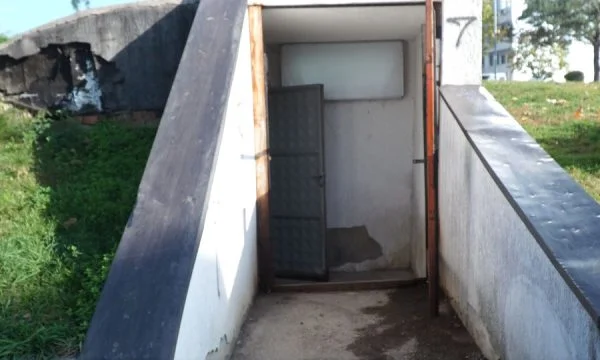
Pristina alone has underground shelters. While in other municipalities hope remained in the basements of collective objects that were built during the 70-80s.
The Kosovo capital numbers a total of 5 underground shelters, three of them are renovated and meet the conditions for housing, but the other two are in serious condition filled with fecal and waste.
So has been shown for Kosova Preress, chief of the emergency sector at the Public Service Directorate, Fatmir Bilalli, who indicated that these shelters are located one in Ulpiana, three on the Sun Coast and one in space known as Lesna.
Bilalli stated that the three shelters are already exploited, the one in Ulpiana is exploited by Horticulture, where even during the visit by the Kosovo team, the equipment of this company was seen.
In two others on the Sun Coast, however, young organizations have been exploited.
Pristina's <x0munum has a total of 5 shelters, with three shelters renovated and met conditions for housing the population in the event of natural disaster or other war disasters. Three of them are renovated with lighting, aquifers, sewers, and then there's the air filtration done through their ventilation filters and they're here where we are in Ulpiana, which meets the conditions for citizens' housing, and two are on the coast of the sun that are similar to citizens' housing. Two others are innovative and we don't meet the conditions we've planned in the coming year to renew them, and we make them like these other conditions that meet the citizens' housing conditions... Three of them that are renovated one of them is in use, the Pristina municipality has given them in the use of Horticulture, while two others on the Sun Coast are two NGOs, but even though they're decided freely to say within two hours or three hours it can be completely emptied” he stressed.
The underground shelters in the capital, along with the ventilation, lighting of the pipeline, have no other equipment, but Bilall stressed that for next year they are making plans to equip.
The “are empty, but in case of need, these are very quickly able to meet because there is no need for excessive luxury, mattressing or whatever is in danger or just to enter into the population, but we're thinking in the next year of making a plan and project and equipping us with other equipment”, Bilall stressed.
Bilal said that since these shelters do not meet the necessary capacity, they are looking at opportunities since next year to identify cellars within collective objects.
We've recently received an email from the Emergency Management Agency where they're doing a Kosovo-level recording recently... Capacity does not meet conditions very few by counting the population number in the Pristina municipality... We've planned and we'll see that in the coming years we're also looking at collective objects that are built, especially prewar ones that have their basements, some of them are littered with garbage, and some are usurped in cooperation with citizens to help us and to renew them for their needs to the objects that inhabit those “, Bill said.
Unlike Kosovo's capital, which has this kind of special housing in case of natural disasters, but also wars, in Gjakova do not possess such special spaces.
The leader of the Gjakova urbanism sector, Elida Bejtullahu, tells of Kosovo Press, that housing is only within the framework of residential construction, which had been exploited for housing even during the country's recent war.
She says that after a call from the Agency for Emergency Management, they have begun to investigate and re-evaluate the state of these shelters.
“We are in the process of evadenting and re-evaluating housing situations, but in the Gjakova municipality we don't have, actually, shelters are in the process of many residential objects that were built before the war, where it was legally binding that the basements of buildings, mostly in the 1980s, not entirely early ones, have been mandatory that basements with many purposes and that has been the key function of housing... We have established the upper group of non-identified, not only to make a number of inspections, to make the results that come out of what's not said 23xH).
The member of the Parliamentary Commission for Security Affairs, Hysen Berisha, says that with the state of underground shelters, no government has been taken, nor has the current one, even as a matter, even in the National Security Strategy.
According to him, the current shelters that were built in the time of the former Yugoslavia are not in good shape and their standardisation is needed.
MP The PDK also estimates that construction of protective spaces in case of disasters should be envisioned during the new construction process.
The problem is that they are not maintained and the time when they are built has been limited capacity for the presence of citizens how many citizens can be taken inside. There should be little hope in them, so far these have not been the subject of treatment or objective of our governments or institutions that should deal with security issues and their plan of action on these topics. Unfortunately, even in the security documents, including the highest document currently in the National Security Strategy Convention, this topic is not at all addressed at this level because we don't deal with issues related directly to the citizen unfortunately... The housing needs to be addressed, to be processed and standardised because there are now new standards for safety in such cases of chemical weapons. As far as these are local in cities, governments have to be devoted to seeing their situation, to the extent of this situation, and certainly to think of the treatment of other forms if in the case of natural disaster or the human element.
The Pristina municipality in the time of the former Yugoslavia had major infrastructure developments. Two of the largest shelters in Pristina were built in 1984.