16 minutes ago
Peach for Franco-German proposal: Worth Consideration
Periskopi(4 years ago)
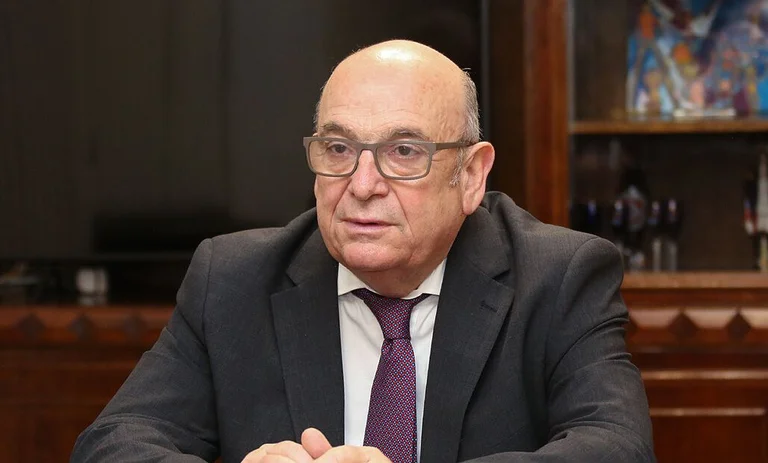
(4 years ago)For Sir Stuart Peach, the United Kingdom's special envoy for the Western Balkans, any talk about border changes is simply bringing unwanted discussion in the future. “United Kingdom clearly opposes attracting borders along ethnic lines, whether these exchanges of land or division: we do not support it, we will [...]
For Sir Stuart Peach, the United Kingdom's special envoy for the Western Balkans, any talk about border changes is simply bringing unwanted discussion in the future. “United Kingdom clearly opposes the attraction of borders along ethnic lines, whether these exchanges of land or division: we do not support it, we would object to”, the British emissary said.
Sir Stuart Peach, the special envoy of the United Kingdom for the Western Balkans, has ruled out the possibility of returning to the dialogue table the territorial exchange option between Kosovo and Serbia as part of a final agreement between the two countries.
Sir Peach visited Kosovo this week, where he denied even the possibility that the Serb-run north would secede Kosovo, he also expressed concern for the armed groups operating in this part.
In the interview, Sir Peach has talked about the importance of a quick agreement reaching between Kosovo and Serbia, of the Association of Serb majority municipalities and even of the impact Russia has on the region.
Sir. Peach, why is there a recently added international pressure for a quick deal between Kosovo and Serbia?
Sir Peach: The UK and long-standing international partners have encouraged Kosovo and Serbia to reach comprehensive normalisation agreements and have supported the dialogue process facilitated by EU special representative Miroslav Lajcak. It is true that there has been significant commitment from the EU, as a facilitator of dialogue, but also from the QUINT countries. The new reality caused by Ukraine's Russian invasion has made progress more urgent.
It is now more important than ever to resolve long-term disputes in the Western Balkans to ensure European security and prosperity. I know the leadership of Kosovo and Serbia knows that. They must work to resolve unresolved issues and reach final agreements in the interest of regional stability and citizens of the two countries.
We have long supported the final agreement. Dialogue has no option”
KOHA: Has the West given up a final agreement in this phase, since mutual recognition of Kosovo- Serbia is not aiming to arrive now? And why should energy be spent on an agreement that does not solve the main conflict of non-recognition? If the final agreement does not ensure mutual recognition, when would agreement be reached?
Sir Peach: First, let me be clear that the United Kingdom is steadfast in supporting Kosovo as a sovereign and independent state. We will continue to help deepen Kosovo's international integration and encourage others to do the same, as we are doing with Kosovo's application to the Council of Europe.
We have long supported the final agreement. A final agreement is something that can be achieved only by the parties involved in the process. And Prime Minister Kurti remains clear that mutual recognition would have to be the final result of the dialogue process with the EU. I don't see this position change soon.
Dialogue has no alternative. During the last ten years of dialogue facilitated by the EU has had considerable progress in relations between Kosovo and Serbia, and this has improved the lives of ordinary citizens. Solving the daily problems facing citizens in Kosovo and Serbia is essential. They do not benefit anyone except those who seek to promote division among neighbours and hinder progress towards a better future.
At the moment, much is being discussed for a new dialogue proposal. I think any initiative that might help give a new moment to process is worth considering.
KOHA: What is the framework of the current agreement that the United Kingdom would now provide support?
Sir Peach: The United Kingdom has long said it will support a comprehensive, final, legally binding agreement acceptable to citizens of both countries and that will bring long-term benefits to them and to the entire region.
KOHA: Within how long is the agreement intended to arrive, and what issues should be addressed in it? So what would Kosovo benefit from it?
Sir Peach: I won't speculate about the deadlines. The UK wants to see agreements between Kosovo and Serbia as soon as possible, and I know that view is shared by all international Kosovo partners. There is now a window of opportunity in Kosovo and Serbia, where there will be no elections or changes in the government for some time. Kosovo and Serbia should benefit from this.
COHA: Finally, has the option for an agreement meant to change territories left the dialogue table?
Sir Peach: The United Kingdom has been clear that we are against any agreement involving border changes on ethnic lines. As far as I'm concerned, this is off the table.
“How the Association looks depends on the parties in the” dialog
KOHA: According to the authorities in Kosovo, the Association of Serb-run municipalities could create a third power, something like Republika Srpska in Bosnia and Herzegovina? What do you think about this and, if this mechanism is lifted, should the Constitutional Court's decision be made, or should the Constitution be changed on behalf of Association? Does the West have a unique attitude toward this?
Sir Peach: The UK, the US and the EU are fully compatible with accessing dialogue facilitated by Miroslav Lajcak. As I have said before, we will support the agreements the parties agree on and work together to support Kosovo and Serbia in their implementation.
One of them is the Association of Serb-run municipalities. What the Association looks like depends on the parties in the dialogue. It is also important that the parties change the alternative and reject some of the myths of the “Republika Srpska” that have made the idea of association so toxic issues. The Kosovo Constitutional Court's decision reached to some extent to say what was not possible under existing legislation; however, also showed that the Association of Serb-run Serb-run municipalities as a whole was not against the Kosovo Constitution.
KOHA: If, in this phase of dialogue, Kosovo's biggest compromise will be the formation of association, which the internationals insist on, will Kosovo be required more compromises, whenever the issue of mutual recognition comes in line?
Sir Peach: The implementation of this agreement should not be seen as concession, nor as a threat to Kosovo. Rather, it would show that Kosovo is a constructive participant in the dialogue that, based on its data as good global citizens, it is fulfilling its international commitments, including in the context of minority rights.
Negotiations are about compromise and giving and taking. Just as we cannot choose our neighbours, we cannot choose who we will negotiate with, and it is rare that we negotiate with people who see the world the same way we do. In the end, negotiations should lead to acceptable solutions for both sides. No game without winners.
Russia's Goal in the Western Balkans
KOHA: Do you see the potential for destabilising Kosovo, if an agreement is not reached soon?
Sir Peach: I don't think the status quo is in the interest of Kosovo or Europe in any timeline. But it's in Russia's interest.
Russia's goal is to maintain the Western Balkans as a remote instability zone from the EU and NATO. To do so, there is no need to destabilise Kosovo, but only to ensure that Kosovo's international integration is blocked.
COHA: How important is stability in the region and do you see efforts to encroach on it?
Sir Peach: With continued Russian aggression in Ukraine and closer to the country, threats to the unity of the state in Bosnia and Herzegovina, regional stability is essential. All must share their responsibility to create stability. It is clear that there are those who seek to undermine regional stability and, as I said, unresolved issues dating back to the 1990s, which will always be weak points that can be exploited until resolved.
KOHA: In recent months armed groups have been seen in Kosovo's mainly Serb-inhabited north. How would the international community respond to any uprising and tolerate efforts to divide this part of Kosovo?
Sir Peach: We remain concerned about the presence of armed people who were seen at barricades in northern Kosovo in July. The potential for violence at the time was particularly high, and we are glad that the situation remained calm. KFOR was an important stabilising factor. I am also convinced that leaders of both countries understood the seriousness of the situation.
The United Kingdom clearly opposes attracting borders along ethnic lines, whether these exchanges of land or division: we do not support it, we would object. Any discussion of border changes is simply bringing unwanted discussion in the future.
KOHA: How afraid are you of Russian influence in the region? And who are the most exposed states to this impact?
Sir Peach: The United Kingdom is concerned about Russian influence across the globe. The UK has taken a strong and public stand against Russia's actions in Ukraine and will continue to do so. In Ukraine we see Russia using mismanagement and dezinformation, cyber attacks and other means to destabilise the country, we have also noted that some of these tools have been used in the Western Balkans.
What we want to see and what we want to help in the formation is a Western Balkans that is flexible to Russian misinforms and disinfects and whose critical infrastructure is safe.
Kosovo was very quick in support of Ukraine, has imposed sanctions on Russia and Belarus, and has generously provided support to journalists and refugees. We are grateful to the Government of Kosovo for its support. Others in the region have different positions and face different challenges in their relations with Russia. We are working with governments throughout the region to support them from Russia.
“It is important that Serbia join the rest of Europe”
KOHA: How do you assess Serbia's approach in relation to Russia's aggression over Ukraine and how will the West treat it if it does not change access?
Sir Peach: The United Kingdom will continue to engage with Serbia's Government together with the US, the EU and other partners to encourage a united stance. The Russian invasion of Ukraine has restored the war on our continent, and it is important that Serbia join the rest of Europe. We are also working with governments throughout the region, including Serbia, to support the transition towards green energy and reduce dependence on Russia.
KOHA: Sir Peach, although Serbia preserves special reports with Russia, the West has opened many doors to it. Meanwhile, Kosovo continues to have neither visa liberalisation in the Schengen Zone nor the launch of procedures for EU and NATO membership. What is Kosovo's prospect in its quest for membership in Euro-Atlantic mechanisms?
Sir Peach: Kosovo has come a long way in its short history as an independent state. I understand sometimes it may be difficult to assess progress, but I see a marked change from the time I first came to Kosovo in 2000.
Kosovo is increasingly showing its merits as responsible global player whether it is a member of international organisations, participating in exercises and shifts with NATO allies or demonstrating the joint power through the president's summit on Women, Peace and Security last weekend. All this is recognition of the international community that views Kosovo as a growing part of international order based on rules.
I understand disappointment with the pace of Kosovo's international integration compared to other countries. Full integration will be a slow process, but I encourage Government to continue engaging with non-recognitional partners and states in dialogue. Only through these will Kosovo's integration be completed.