 3 hours ago
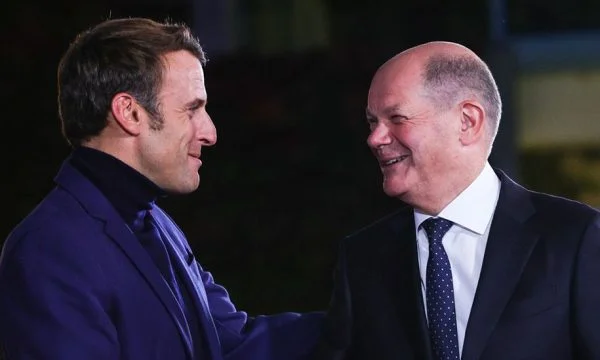
Macron and Scholz will meet in Paris today, what is expected of discussions
Periskopi(4 years ago)
(4 years ago)Emmanuel Macron and Olaf Scholz will meet in Paris today. The lunch between the French president and German Chancellor comes after a cancelled ministerial meeting, originally planned for this week, but already postponed for January, Euronews writes. The meeting is usually held each year, but it has not been held personally since the pandemic [...]
The meeting is usually held each year, but it has not been held personally since the COVID-19 pandemic. Officially, the reason for the postponement of the meeting is that some German ministers are unavailable due to holidays.
But difficulties in finding common bases on a host of topics, including the best way to address rising energy prices, as well as protection.
The two leaders are currently not expected to hold a joint press conference after their meeting. Berlin initially said both leaders would talk to journalists, but Paris denied the news.
Both Macron and Scholz tried to downplay their differences as EU leaders gathered in Brussels last week for a summit to discuss ways to curb energy prices.
Energy, defense and China.
For energy, the two countries agree with the European Commission's proposals for joint gas purchase and the creation of a new standard that should result in lowering prices.
But Germany opposes the proposal to set a gas price limit across the EU, or extension of the so-called Iberian model, which limits the price of gas used for producing electricity in the rest of the bloc. It also argues that the measures Paris supports may, respectively, lead to supply issues or an increase in consumption.
Elysie also reportedly is not satisfied that Germany failed to consult them before discovering a 200 billion-euro bailout package to ensure that its citizens and businesses can survive this period of high energy prices with the argument that it can distort competition within the Single Market.
In defence, a traditionally strong French issue, there is also dyvergence. Russia's war in Ukraine has prompted a security review in Berlin with a 100 billion-euro plan to strengthen its capabilities.
The problem for Paris, which is supporting EU sovereignty, is that both initiatives would see Berlin invest heavily in US-made weapons systems instead of European equivalent.
EU sovereignty is also at the centre of their differences when it comes to China, which Scholz is scheduled to visit next week with a delegation of German business leaders, despite calls for the EU to give up its trade dependence on Beijing.
The apparent “position only made of Berlin” was burdening Paris, who had invited Angela Merkel and Jean-Claude Juncker, then Chancellor and chief of the German Commission when Xi visited Paris in 2019.











