5 minutes ago
German Ambassador: Without an association settlement, neither Kosovo nor Serbia will be in the EU
Periskopi(4 years ago)
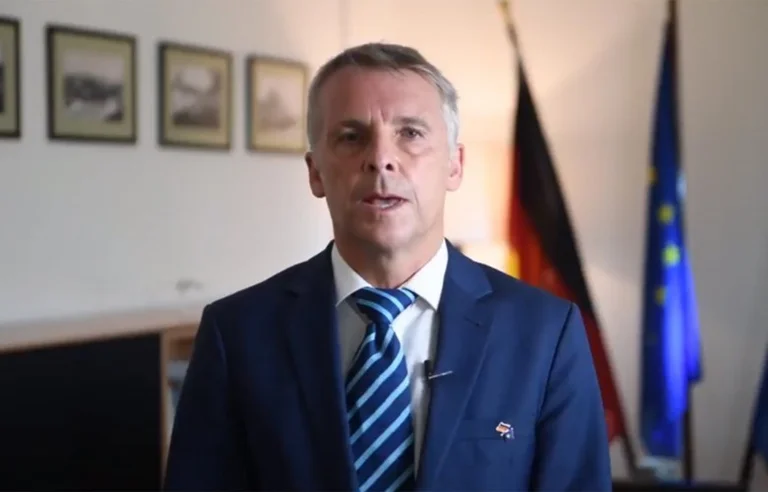
(4 years ago)German Ambassador Jörn Rohde has demanded that the issues between Kosovo and Serbia be addressed as soon as possible, especially the issue of association of Serb majority municipalities, as it is part of agreements reached in Brussels, which Kosovo has signed. German ambassador has said we need urgent progress [...]
The German ambassador has said we need urgent progress, and for this the political leaders of both states must make difficult political decisions and have the will for compromises that have sustainable results.
As for the visa liberalisation issue, Rohde has shown optimism that there will be a positive decision very soon within the year, as the technical meeting will be held on 13 October and the final decision will be made by the Council of Ministers by the end of this year.
Ambassador Rohde emphasises Kosovo. LIVE, that in Kosovo each registered vehicle should have Kosovo signs. To achieve this, I think a sufficient period will have to pass. I think more than what was actually offered for those who should register their vehicles. The lack of progress so far is regrets, because by acting this way, both sides act against their own interests, since you are reluctant to implement what reconciliation has been achieved in Brussels, certainly will not bring any party closer to the EU.
Is this moment the most important moment for reaching the final agreement between Kosovo and Serbia?
Germany wants all six Western Balkan states in the EU. Russia's aggression against Ukraine has shown that a strong and unified European Union, including the Western Balkans, is needed to preserve peace, stability, freedom and security in Europe. Urgent progress now is extremely necessary to achieve our common goal, which for Kosovo and other Western Balkan states is the fastest membership in the Euro-Atlantic family. Thus, mutual recognition between Kosovo and Serbia will be the necessary prerequisite for both states to join the EU, as it is unimaginable that we have two states in the Union that do not know each other. Chancellor Scholz made this very clear during his visit to Pristina in June of this year.
Are the international community losing patience in relation to Kosovo and Serbia?
As I said earlier, we need urgent progress. To achieve this, the leaders of Kosovo and Serbia must prepare to make difficult political decisions, as well as have the will to reconcile compromises that produce sustainable results and improve the lives of citizens. In view of this, I again want to stress our full support for EU Special Representative Lajcak's efforts for relief in finding permanent solutions within the Kosovo-Serbia dialogue. The Berlin process is another example of Germany's strong pledge to speed up the process of bringing the entire Western Balkan region closer to the EU. Chancellor Scholz is strongly committed to this: He has invited all 6 Western Balkan leaders together with Berlin Process partners to attend a summit in Berlin on 3 November. Before the summit, Germany will call three high-level meetings at the level of energy ministers, internal affairs and foreign affairs by the end of October. We want and are working hard to achieve concrete results.
Since Germany is a true friend of Kosovo, how do you assess it, the final agreement is near or far away?
It is up to both sides, Serbia and Kosovo to answer that question. My assessment is that more commitment is needed by both sides to progress, for example on issues still unresolved, such as signs, energy guide, or the establishment of the Serbian Majort Commission Association. Not only me, but we as QUINT ambassadors have been declared on certain issues. So it is clear to me that in Kosovo each registered vehicle should have signposts
Kosovo. To achieve this, we need to have an adequate transitional period. I think more than what was actually offered for those who should register their vehicles. The question of association should also be addressed, because it is part of the agreements reached in Brussels, which Kosovo has signed. The lack of progress so far is regrets, because by acting this way, both sides, in my view, act against their own interests, since you are reluctant to apply what reconciliation has been achieved in Brussels, certainly will not bring either side closer to the EU.
What real expectations do you have from Prime Minister Kurti in this process? And how do you assess that the opposition in Kosovo, almost indiscriminately, has given government support for dialogue?
It's not up to me to perform expectations by the heads of government of sovereign states. As a true friend of Kosovo I hope for both sides to act constructively and show the flexibility required in their positions. Kosovo citizens expect concrete progress on a range of issues.
How did you analyze the issue of visa liberalisation for Kosovo, will it end this year?
I am very optimistic that there will be a positive decision to that effect in Brussels, very soon. The Czech presidency of the Council has decided on this issue for a technical meeting held on 13 October, and the final decision will be made by the Council of Ministers by the end of this year. Applying that decision would then be completed in the spring of 2023.