13 minutes ago
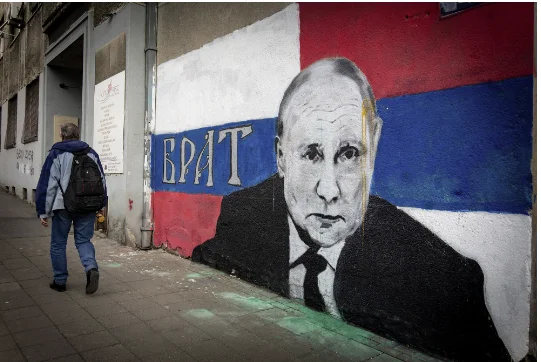
Bloomberg: Putin is using Serbia, Bosnia to fuel divisions in Europe
Periskopi(4 years ago)
(4 years ago)Although Russian President Vladimir Putin is focused on his brutal but failed war in Ukraine, he continues to extend his ambitions further. In fact, Russia is trying to undermine democracies across Europe, and it does so by distributing funds and support to groups of [...]
But Putin has found a particularly fertile ground in the Balkan region, spreading his view that the North Atlantic Treaty Organisation aims to marginalise the Russian, Slavic and Eastern Orthodox world. At the centre of these efforts is Serbia, the most important former Yugoslav state, which is not a NATO member.
When I was supreme commander of NATO allies during 2009-2013, I have often visited the Balkans. The alliance had more than 15,000 troops on a peacekeeping mission in Kosovo, a small republic that challenged Serbia and declared independence.
The issue had sparked a significant war in 1999, during which NATO aircraft bombed the Serbian capital, Belgrade. However, Serbian governments of recent years have worked to improve relations with the West and achieve membership in the European Union.
However, there are still increasingly dangerous forces supporting Vladimir Putin in Serbia, but even in the smaller neighbouring countries. Russia has refused to recognise Kosovo's independence. It has almost certainly been behind a coup effort in Montenegro in 2016.
It has also supported separatist elements in Bosnia and Herzegovina. Above all, the Russian president wants to keep Serbia and Bosnia out of NATO and the EU. He also wants to boost support for his catastrophic fight in Ukraine and in general aims to distract the West by producing tensions, especially between Serbia and Kosovo.
Serbian President Aleksandar Vucic has maintained a balanced approach between Moscow and the West. His government voted in favour of a United Nations resolution condemning Russia's invasion.
She rejected last week's annexation by Putin of territories occupied by Russia in Ukraine, while being to some extent supportive of allowing the transport of humanitarian and nonlethal military equipment to Kiev.
But unfortunately, Vucic signed an agreement with Russia on gas purchase in May.
Putin, meanwhile, continues to cultivate support even within Bosnia and Herzegovina's complicated policy. Last month he hosted a meeting in Moscow, Milorad Dodik, a Serb hardline nationalist who leads the ethnic Serb entity within Bosnia, Republika Srpska.
Many rightly doubt that Dodik would gladly destroy his country to please his master in Moscow. Under these conditions, how can the West oppose Russia's efforts? Some 3,500 peacekeeping forces remaining in Bosnia are significant, but not defining.
As real competition has shifted to the fight of information and economic commitment. And in the first place Moscow is an advantage. Since it is very busy spreading false Narrates for war, aiming to portray Russia's “special military operation” as a pan-slav mission to unite Ukrainians (who are themselves Slavs) with Mother Russia.
As expected, this gear is working very well in favor of the extreme right, but even among the population as a whole. A June survey showed that nearly 2/3 of Serbs said NATO was guilty of war, while only about 10 percent viewed Russia as largely or completely guilty of conflict.
But fortunately, Moscow has little to offer in terms of economic incentives. Serbian exports to Europe are nearly 15 times larger than those in Russia, and will grow dramatically with the country's EU membership. Serbia and Bosnia want to maintain their citizens' ability to travel visa-free to the European Union, at a time when Russians are becoming more isolated.
The core of the mission for the United States, the European Union and NATO is simple: Don't name the Balkans, especially Serbia and Bosnia, as a priority 100 percent safe parts of the Western alliance.
These two nations must be kept on the gradual road to EU membership, even if sometimes they are not the perfect allies against Russia. NATO should also continue to work closely with them in military training and exercises.
Russia will continue to create gaps between the Balkans and the West. Serbia and Bosnia must understand that while Moscow can offer gas supplies, it is a tactical temptation that has no comparison with the strategic value of belonging to Western Europe.
Note: James Stavridis, retired US Navy Admiral and former supreme commander of NATO allies. It's currently dean at the Law and Diplomacy School at Tafts University.