 an hour ago
ZERE's proposal: The price of belts to rise for these categories of consumers
Periskopi(4 years ago)
(4 years ago)The Energy Regulatory Office has published today a consultative report under the extraordinary review that it has been made to change electricity tariffs. Z THE RHR estimates that increased electricity consumption observed in 2021 is also responsible for a change in the Tatar structure in 2017. [...]
Tariphorus structure changed in 2017, according to Z. The RRE has had considerable negative impact on the system, resulting in increased demand per current and therefore spending on purchasing electricity.
Taking on a commitment from the Ministry of Economy that it will allocate 75m euros to ease the impact of the energy crisis on tariffs, Z. RRE says there is no need to increase the electricity price for consumers who don't spend more than 600 kWh per month. Therefore, the body that regulates activities in Kosovo's energy sector says the tools separated by the Government would avoid the need to increase the price of electricity for this category of consumers.
“The government's subsidies effectively influence business consumers' tariffs not to suffer growth and household customers' bills not to increase for consumption that could be offered with the existing tariff from local capacities in Kosovo (up to 600kWh per month)”, the ZRR report said.
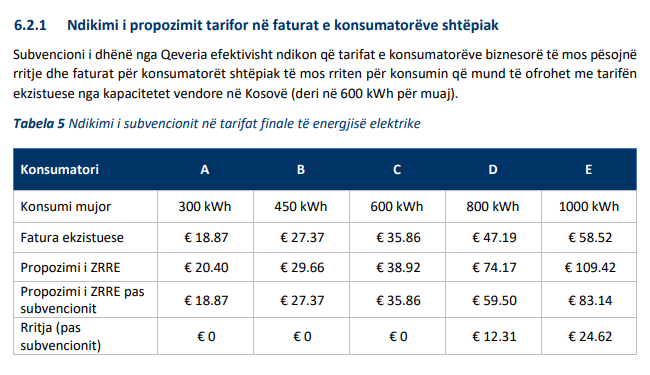
According to the ZERE, consumers who spend up to 800 kWh per month and those who spend even more will not help the government's subsidy.
The ERC report proposes that the fee for consumers at 800kWh spent monthly will rise to 13.31 euros. While consumers who spend 1,000 kWh of electricity per month, according to the ZRRE proposal face a 24.62-euro electricity price increase.
Energy price increase proposal in case Government does not allocate 75m euros
If the Kosovo government does not subsidise, Z RRE considers it necessary to raise the price of electricity.
In this case, Z The RRE proposes that electricity tariffs be changed so that business consumers can increase the electricity price for 9%.
The electricity price hike for 9% has also been proposed for home consumers, who are considered to spend up to 600 kWh per month.
In this case, the fee application of 0.11/kWh for energy consumed at the time of the high fee (during the day) has also been proposed and 0.09 .kWh for energy consumed in the low fee (night).
How are consumers classified?
The consumer who spends 300 kWh/months is estimated to be a consumer who spends the energy needed to cover essential needs for a four-member family. During the year, 20.5% of consumers do not pass this threshold in no months during the year, according to the ZRRE. These consumers get into category A.
The 450kWh/month consumer represents the average consumption of a household consumer over the year. Based on KED's data, average consumption (from 2012 to 2020) from households that spend over 300 kWh/months is~ 460 kWh/months. Average consumption in 2021 for household consumers who spend over 300 kWh of electricity is about 440 kWh/months. During the year, 44% of consumers do not pass this threshold in no months during the year. These consumers get into category B.
The 600kWh/month consumption consumer shows minimal consumption of a consumer with electricity heat during the winter, based on analyses during the bloc's deployment on previous tariffs, 69% of consumers do not pass this threshold in a month during the year, and 79% of consumers do not cross this level during summer months. These consumers get into category C.
The 800 kWh/month consumption consumer presents a consumer with consumption over the proposed bloc. These consumers get into category D.
The 1000kWh/month consumer represents a consumer with higher electricity consumption. These consumers get into category E.
The ERC has offered companies, consumers and other interest parties the opportunity to review the data and attitudes presented in the published report and comment on them, presenting arguments against or offering new data.











