 3 hours ago
The volcanic eruption in Tonga destroyed an island and created many mysteries
Periskopi(4 years ago)
(4 years ago)For many years, the Hungarian Tonga-Hungga Ha'apai volcano exploded over waves like a pair of narrow rocky islands, one called Hungga Tong and the other Hunghapai. An explosion in 2014 built a third island that later connected the train to a land mass. And when the volcano woke up in December, the uninhabited island [...]
An explosion in 2014 built a third island that later connected the train to a land mass. And when the volcano woke up in December, the uninhabited island on top of the top slowly grew as rock and volcanic ash built new ground.
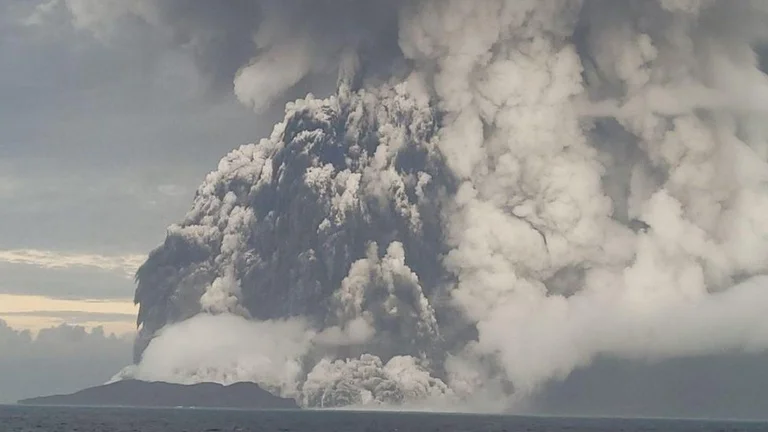
Then came the catastrophic explosion on January 15th. As seen in satellite images, only two small rock exits now betray the beast hidden in the waves. But if it happens in weeks or years, the volcano will rise again.
This cycle of destruction and rebirth is the blood of volcanoes such as Hunga-Hungga Ha'pai, which is just one of many in the Kingdom of Tonga.
However, the extraordinary energy of this recent explosion, which NASA estimated to be equivalent to five to six million tonnes of TNT, is not like any first in recent decades. The blast caused a tsunami crossing the Pacific Ocean.
He launched a Swiss boom that circulated twice worldwide. He sent a cloud of ash and gas to the stratosphere about 19 miles high, with parts reaching 34 miles high. And perhaps most importantly, all these effects came from just one hour or more volcanic rage.
Everything so far in connection with this explosion is strange outside the scale,” says Janine Krippner, a volcanologist with the Smithsonian Global Volcanism Programme.
Scientists are now competing to find the cause after this week's intense explosion and the surprisingly widespread tsunami that followed. Some records of what set the scene for such a powerful explosion may come from rock chemistry that cooled from the mortar in past explosions. In a new study published in Lithos magazine, scientists found major differences between the explosive material of small and large explosions, and now they are curious about what chemistry can reveal.
The meaning of the spark that sparked the recent Hunga Tonga-Hunga Ha'apai explosive event may help reduce future risks. At the moment, however, the greatest concern is for the people of Tonga, and if there may be more volcanic eruptions on the horizon. Almost all of the volcano is now below the ocean surface, hidden from satellite views, and there are no equipment on earth to help track the underground shift of molten rocks.
If we can't find out what's going on in the magma system, we have no idea what might happen next,” says Krippner.
While Hungga Tonga-Hungga Ha'apai has erupted many times in the past, scientists only recently realized how big these explosions could be. Mostly underwater, the volcano is not easy to study.
“No one had actually done any work on the rocks,” said Simon Barker, a volcanologist at Wellington Victoria University in New Zealand and an author of the new Lithos study documenting the history of the volcano.
Barker and his colleagues rented a boat in 2015 to camp for several nights in the ruins of the volcanic island. As they looked at the region and collected rock samples, the team distinguished small cones from the recent explosions placed on the bottom of the sea around the top. They also discovered thick layers of torn rock and ash, known as the pyroklastic streams, from two monstrous explosions that later date back to about 900 and 1800 years.
We found there was much more complexity in the history of the volcano,” says Barker.
The chemistry of the broken material can help break down what made the explosion so powerful, explains Marco Brenna, a volcanologist at Ottag University in New Zealand and a author of the new Lithos study.
As a magma system cools, crystals of various minerals are formed at different times, which alters the chemistry of the molten rocks into reductions. Crystals preserve these changes as they grow up a little like tree rings.
Brenna and his colleagues analyzed crystal rings on rocks that erupted during two major explosions 900 and 1800 years ago. Their work suggests that before the volcano released these eruptions, the fresh magma was quickly injected into the room with a proposed incentive for many volcanic eruptions. But rocks from the most moderate explosions in 2008 and 2015 lacked these rings, pointing to a steady but slow flow of magma, Brenna says.
Scientists now hope to study newly broken rock chemistry to see what it can tell us about this recent event. “will be interesting to see what crystals are recording,” says Brenna.
While these underground processes can trigger some of the explosive, water is also likely to have an impact on this weekend's bombings, says Geoff Kilgour, a volcanologist with New Zealand's GNS Science who was not part of the research team. Water may increase the power of a volcanic eruption, but it remains unclear exactly how it would have caused a surprising boom from Hungarian-Hunga Haépai.
Perhaps, suggests Kilgour, the recent explosion had only the right mixture of magma and water; a surplus of one would have generated a more moderate explosion. The “may be that we have reached this Goldlocks area,” he says.
This recent explosion is straining even more intrigues because its powerful, though energetic, boom produced surprisingly little material. The ash from the major eruptions of the volcano's past can be found on the nearby island of Tongatapu, and that layer is 10 times thicker than the new layer stored there by the last event, says Barker.
Some scientists now speculate that the massive and short - lived burst of energy may have helped fuel the enormous waves of tsunami that followed the explosion.
The tsunami usually radiates from a sudden underwater shift, such as a submarine slide into the wings of a volcano or the rapid movement of the earth into an earthquake. However, after the Munga Tonga-Hungga Ha'apai erupted, the waves appeared in several countries, such as the Caribbean, much earlier than expected from a classic tsunami.
Later waves of tsunamis that crashed on remote shores were also strange. The further away from the cause of a tsunami, the more its waves have to shrink. While the waves that struck the islands in the Kingdom of Tonga were harmful, they were not high enough to calculate the amazingly large waves across the ocean.
The “essentially had a very low displacement of tsunami size across the Pacific, which is really, really unusual,” said Kilgour.
The striking wave that travelled into the air could have been associated with the surface of the sea, causing the wide tsunami. Only such a process was proposed for the outbreak of Krakato in 1883, one of the most powerful and deadly volcanic eruptions in recorded history.
Modeling the spread and wave time along with changes on the volcano map can help explain what caused the great tsunami. Still, Krippner says, the confusing mix of events “will change the way we look at this style of explosion, and this doesn't happen so often”.
The recent event and all its wonders reveal how little is known about submarine volcanoes, says Jackie Caplane-Auerbach, a seismologist at the University of Western Washington. Many of these diving giants remain in the deep ocean, and their eruptions are usually not fatal. This weekend's explosion, however, is a severe reminder of the dangers of the volcanoes that remain under waves.
Right now, Hungga Tonga-Hungga Ha'apai seems to have kept quiet. Locals are helping each other overcome the damage and clear the streets. While communications remain largely interrupted, information on the current situation has finally begun to flow. Three deaths have been confirmed among Tonga residents, with two other deaths in Peru from the tsunami.
The damage to some of the islands is severe. The homes of the 36 people on Mango Island have been destroyed. Only two houses still stand on the island of Fonifua, and major damage extends throughout the island of Nomuka, which has a population of 239. The damage to the largest and most populated island, Tongatapu, where some 75,000 people live, focused mainly on the western side. Tonga's Red Cross estimates a total of 1200 “family affected”.
The ash has contaminated the island's drinking water supply and has delayed landing with additional supplies.
There is still the danger that the volcano may have more explosive explosions. Tonga's Geological services rely on visual and satellite observations to track the activity of many volcanoes throughout the region.
But with the volcanic peak of Hungarian-Hunga Ha'apai now below the surface, scientists have lost sight of any sign that can help understand the activity of the volcano. The potential for additional activity also prevents scientists from flying closely for a closer look, notes National Geographic.











