 an hour ago
A year after prison: Putin's opposition is living on earth
Periskopi(4 years ago)
(4 years ago)The international human rights organisation Amnesty International is marking the first anniversary of the arrest of Kremlin critic Alexei Navalny with calls to the international community to demand Russian authorities release of the opposition politician. This organization has also demanded an end to the unprecedented “printing campaign” against supporters of [...]
The international human rights organisation Amnesty International is marking the first anniversary of the arrest of Kremlin critic Alexei Navalny with calls to the international community to demand Russian authorities release of the opposition politician.
This organisation has also demanded that the end be “the unprecedented printing campaign” against Navalny's supporters, saying there are “hanging out all the freedom rights of expression” in this state.
Marie Struthers, director for Eastern Europe and Central Asia in Amnesty International, has said that a year since the Navlany was imprisoned, he, his supporters and civil society organisations in Russia “have faced brutal oppression”.
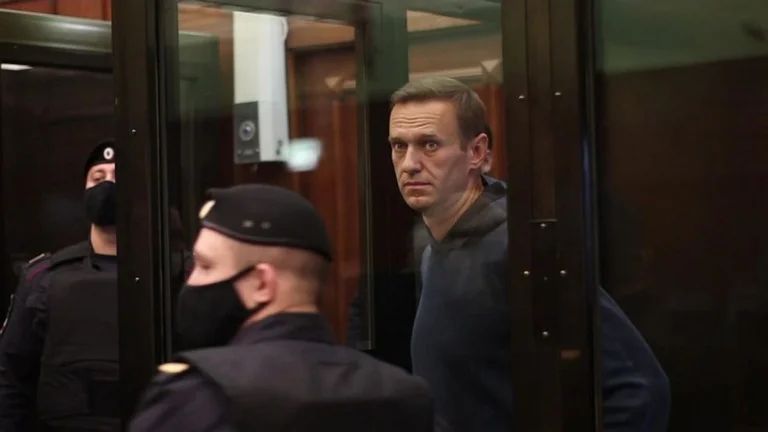
Navalny stopped at Moscow Airport in January last year after arriving from Berlin, where he was treated for poisoning in Siberia in August 2020.
“Navally's dozen supporters and accomplices are facing prosecution, and a large number of them are already in prisons”, Struthers said, while Russian authorities “have declared their organisations as éextremistic and have blocked their pages online”.
Some of the collaborators have fled the state, fearing political persecution, “concerned that their families in Russia will face similar luck”, she said, adding that “on the anniversary of his ban, Navajo and related political activists are living a living hell alive”.
Navalny has been detained at Moscow's Sheremetyevo Airport on January 17th of 2021, and a court in Moscow has decided two weeks later than at the time he was in Germany, violated the principles of a parole sentence for embezzlement, considered politically motivated.
Due to alleged violations, his three-and-a-half-year prison sentence has turned into prison sentences, though the court has said it will spend two and a half years in prison, taking into account the time spent in maintenance.
Navalny has claimed that his poisoning almost fatal é with the Novicok nervous agent has been ordered by Russian President Vladimir Putin.
The Kremlin has rejected the assumption that it has a role in poisoning it.
In June 2021, the two organisations founded by Navlany ʹ the Anti-Corruption Foundation and the Citizens' Rights Protection Foundation have been declared <x0 rectremist” and banned.
Since then, their activists have been penalised.
In September 2021, a criminal case against Navajo and his associates has been opened on charges of creating “acionist”, though the opposition politician faces 15 years of imprisonment, if convicted on charges involving fraud and money laundering in connection with misuse of funds in his nongovernmental organisations.
On January 14th this year, two Navalny co-workers -- Leonid Volkov and Ivan Xhudanov -- have been added to the Russian list of <x0mremists and terrorists” and their properties have been blocked.
Xedanov's father has been handed over to a prison sentence last year for a corruption case, which critics consider politically motivated.
The Kremlin's cold actions, which remain determined to silence and humiliate Alexei Navalny and its supporters, must now end”, have said among other things Struthers, adding that the people of Russia “should not suffer the ruthless oppression of their human rights. ”
According to Struthers, more than 360,000 people worldwide have signed a petition launched by Amnesty International, which calls on Russian authorities to release Navajo immediately and unconditionally.
The European Union, Britain and other states have imposed sanctions on Russian officials due to the imprisonment and poisoning of Navajo.
European lawmakers have chosen Navalny as the winner of the 2021 Sakharov Annual Prize, which is divided for Freedom of Thought. / REL/











