an hour ago
Jusuf Gervala's rare interview for the German newspaper TAZ)
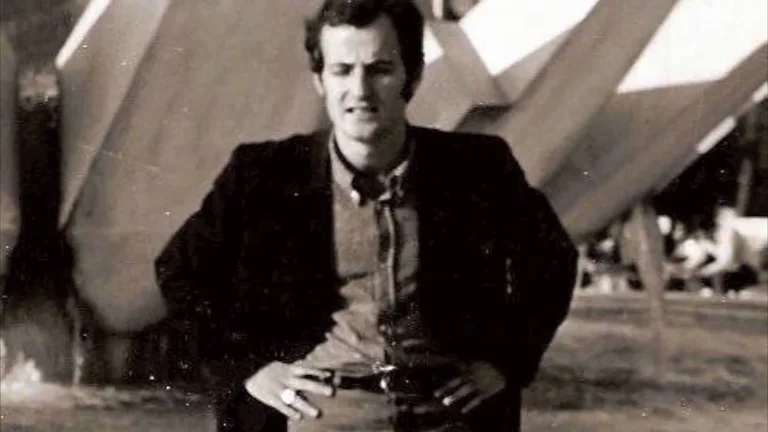
Periskopi(4 years ago)
(4 years ago)The newspaper TAZ / Die Tageszeitung ( “Daily Journal” is published in Berlin on January 20, 1982, throughout its seventh page, published the news about the murder of Yusuf and Bardosh Skake Gerdilla, as well as an interview with Yusuf Gervall, which this newspaper had done two years earlier but did not [...]
In the opening text of the interview, editor of the newspaper “Die Tags Zeitung” (day journals) writes:
“... Long-handed regime... Yusuf Geralla and his brother were members of the Kosovo Liberation Movement. He came in early 1980 to the editorialisation of our newspaper in Stuttgart in order to inform us of the Albanian Movement for Independence in Kosovo.
Yusuf Gervala had fled Kosovo in mid - December 1979.
His brother Bardech lived in the German Federal Republic since 1974. He worked as a social worker at Arbeitter Wolffart in Ludwigsburg.
After Yusuf Gervala did not know German at all, his brother translated. We did a four-hour interview, where they patiently explained the situation in Kosovo. They knew that the Yugoslav regime has long hands, so they asked if “Day Tageszeitung” is an independent newspaper, which does not hang that long hand. Then Yusuf Gervala told us about his biography. He presented himself as a literary, who has been employed in an Albanian newspaper in Yugoslavia. Yusuf Gervala has published three volumes of poetry and has made numerous translations from the Serbian language into Albanian. According to his data, he has been active for five years, in the Democratic Movement in Kosovo. He had escaped during a detention campaign in this region. His brother had been arrested in Pec on December 15, 1979, because of the hostile “action”. Yusuf's residence in Pristina was also raided in his absence. He said that the Yugoslav secret service over the past years had questioned him several times, trying to force him to cooperate.
Yusuf Gervala flees to Germany and applies for asylum. Meanwhile, arrests in Kosovo have been frequented. Yusuf spoke of a figure of 2,000 prisoners, which we then found incredible what it has already proved to be. In these two years the situation in Kosovo has become very tough. Massive imprisonment has been made, a state of emergency has been imposed. During this time, Bardosh Gervalla had gone to the social center in Stuttgart to beg him to announce, to a solidifying demonstration near the Public Order Ent.
White Garvala always felt persecuted by the Yugoslav Secret Service. During the demonstration, especially at the windows of the Yugoslav consulate, photography was eagerly taken. But even on the streets many have seen photographers photographing. When demonstrators tried to extract films from photographers, arguments and police arrests occurred. Bardhosh Gervala was also one of those arrested.
Jusuf Gervala and his brother praised the situation of the Albanian population in Yugoslavia as the situation of a poor people struggling for freedom like other peoples of the world. Yusuf wanted to announce his opinion in the Federal Republic of Germany about this war.
He and his brother and acquaintances have been killed. Everything says that the Yugoslav Secret Service was going to do this murder...” said in this introduction of this article, broadcast last night on radio “Dojce Vele”, where a long interview, published on January 20, 1982, is being released, with the announcement that it was an interview of 1980, but still unpublished:x3>
This is an interview text from 1980 (published on January 20, 1982, in the Berlin newspaper TAZ (Dine Tageszeitung):
TAZ: You have co-operated with an illegal organisation of the Albanian minority in Yugoslavia, in the Liberation Movement. How is the work of this organization generally presented?
Yusuf Gervala: War has several stages. First, it's about knowing history and knowing the truth. The next step is to spread such knowledge to the people. This is the stage of Enlightenment through Thracians, newspapers, slogans, and other ways.
In the second phase, much depends on relations in the world, Europe and the country. Stage two contains armed warfare. The transition to it seems to be speeding up, due to the forced Yugoslav terror of the Albanian people. But right now we're not prepared for this yet.
TAZ: What support does this movement have for the Albanian minority?
Yusuf Gervala: It's very hard to give concrete numbers. But it can be said that the majority of the Albanian people are behind the goals of this movement, but no one is openly declared as afraid of the consequences.
TAZ: How is this movement built in organizational terms?
Yusuf Gervala: The movement has its bases, wherever Albanians live within Yugoslavia's political borders. It consists of a Central Committee of five. Then there are district committees sending representatives to the Central Committee. The bases are cells, consisting of three members and working conspirably. Kosovo is a rich country that explodes Serbia...
TAZ: How is Belgrade's policy presented, in the area of the autonomous region of Kosovo, respectively, and what impact does it have on judicial and cultural policy?
Yusuf Gervala: National discrimination is done in many ways. In 1946, Yugoslavia banned the use of the Albanian flag in the name of” International Proletar”. A year later, in 1947 respectively, the decision was made to hand over surplus cereals in the name of some solidarity. So Albanians themselves were forced to live without bread that year. A few years later, agricultural collectiveisation, experiment, which was done only in Kosovo. The goal was for the Albanian lands to mix with those of Serbs. In 1956, while Rankoviqi was still in power, an arms collection action took place only in Kosovo. Many Albanian men were then imprisoned and tortured. This happened then during the winter. Almost all night, they have been forced to remain in water canals or tied naked to tree trunks. As far as economic policy is concerned, Kosovo is a very wealthy country, in terms of agriculture and high-ray wealth. People talk about a second California. Kosovo contains 64 percent of all chromine and chromium reserves, 65 percent of the net and lead reserves, 28 percent of the magnesium reserves. All, this data, is published in Yugoslav newspapers. Despite that, there is no processing industry in Kosovo. All of these products are still sold to Kosovo with multiple benefits. Two Kosovo immigrations...
TAZ: This means that Kosovo is the most back-end compared to the average of Yugoslavia?
Yusuf Gervala: Yeah. This can also be witnessed by average gross income per capita. The income of a Kosovo resident in 1953 has been 43 percent smaller than that of a resident of Slovenia, the republic most developed in Yugoslavia. Twenty years later, in 1977, they fell to 37 percent. Even though Kosovo is the main supplier of electricity, 250 villages out of 1300, which has a total of Kosovo, are still unappreciated. That, said briefly, Kosovo's development and operation is oriented for Yugoslavia's supply. This major economic discrimination results in major unemployment. According to officially accepted data, unemployment in Kosovo is over 20 percent. This results in domestic migration and external migration. Internal immigration means within Yugoslavia, while foreign to European states. Between 1968-1978, for example. Half the rural population was forced to emigrate.
TAZ: What about the language and cultural plan Belgrade policy looks like?
Yusuf Gervala: At first, there has been discrimination through ignorance of national history. Albanians are descendants of Illyrians and are the oldest people in the Balkans. By 1968, Albanians have been forced to learn Slavic history, which means the history of various Serbian dynasties. We didn't dare learn our story. After World War II, there were schools where English could be taught. Through pressure from Albanian intellectuals and politicians, the number of those schools increased, so mass schooling was made in Albanian. But those people were later sentenced to many years in prison. At first, only elementary schools were established, later in high schools. In 1965 the Faculty of Albanology opened at Belgrade University. While in 1968, there were student riots in Kosovo, which have really achieved some success. Thus, Albanian was then recognised as an official language in Pristina and was founded the University in Albanian. Use of the native language has not been allowed, and mainly Serbs have been employed there. Now the region is officially two languages -- Serbian and Albanian. It has even been prescribed by law that anyone who does not know Albanian could not be employed at all, but in practice almost no one adheres to this law.
TAZ: But what is the purpose of the liberation movement?
Yusuf Gervala: Not only is the goal of the liberation movement but also of all progressive forces is the break from Yugoslavia and the Union with Albania Amma!
TAZ: Does this reason only with national affiliation, or are there also social and political aspects? Would you ask for unity despite that, in Albania, the radical communist, radical democratic system, or a rule of law system, reigns?
Yusuf Gervala: Regardless of any system!
TAZ: Such a union of these areas of Albania, of course, can be praised by Albanian hegemonism. At least in some parts of this space, Albanians are minority and suppose in northern Greece there are no nationalist movements like in Yugoslavia?
Yusuf Gervala: A real substance is hidden in this assumption. In Greece, for example, a large majority of Albanians was able to assimilate. In Western Macedonia, village populations are completely Albanian, while cities have managed to slave. Even in southern Serbia within 100 years, Serbs have achieved through terror and massacres to expel Albanians towards South. Although the majority in those spaces are Albanians, within the Albanian population a small number of Albanians have been assimilated.
TAZ: The liberation movement is fighting for union with Albania, does it have ties to Albania?
Yusuf Gervala: An answer to that question would be harmful to the interests of Movement!
TAZ: And what difference does joining Albania have with an autonomy statute, which enables them full freedom in terms of economic, cultural and language?
Yusuf Gervailla: A statute of autonomy for us is only beneficial until we are strengthened to impose unity. There is no alternative but to unite.
TAZ: How is the Yugoslav state reacting to resistance within the Albanian minority?
Yusuf Gervailla: 47 Albanian organisations have been banned since 1945. Their members ended up in prisons. There are no recent mass imprisonments combined. These recent imprisonments show Yugoslavia's nervousness at a possible Soviet Union attack. There's never been such a big prison. These are being done only in Albanian spaces and also show that Yugoslavia in this critical situation is becoming aware of the end of Tito's era and that the Albanian problem has not yet been solved! ?
TAZ: Then these mass imprisonments, apparently, should be understood as a result of the reasons for foreign policy and not because of the strengthening of the resistance movement of the Albanian “ ” recently?
Yusuf Gervailla: Both components are mixed. I remind you of 47 banned organizations. A resistance movement has always been present. In the present situation, however, it is thought that its activities and state sensitivity to them have increased. However, activities do not have those sizes, which Yugoslavia will be forced to undertake.
TAZ: From where and where are mass imprisonments becoming and how many people are being hit?
Yusuf Gervala: When I fled in mid - December 1979, I had an accurate record of 750 prisoners, including 73 women. Now immigrant workers are returning and bringing us new information that the number of prisoners has reached 2,000! ?
TAZ: Which layers of the population are more hit, and what concrete charges are made to them?
Yusuf Gervala: Mostly young people. Among them are students and intellectuals but also workers and villagers. The blame contains political activity “against the government” and “the hostile reaction against the people”.
TAZ: Do you feel that imprisonment is being done according to the principle of chance or according to data and concrete information?
Yusuf Gervala: Most have nothing to do with this guilt. Efforts are being made to detect the Movement. But this has not yet been accomplished. Experiences from many banned organizations enabled the liberation movement, to act decisively, and successfully. Yugoslav security organs are shooting in the dark and are often catching up on members of Albanians.