 8 hours ago
The full interview of Ambassador Havenier: There Must Be an Association of Serbian Municipals
Periskopi(4 years ago)
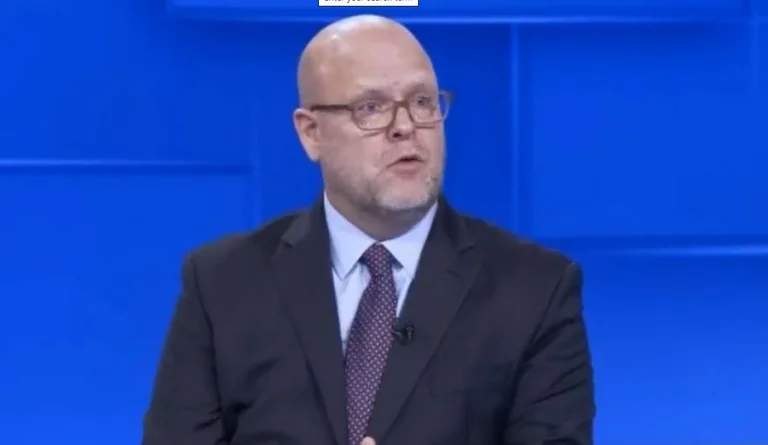
(4 years ago)US Ambassador to Kosovo Jeff Hovenier last night has given his first interview since coming to Pristina, where he has talked about the question of dialogue with Serbia, the Association of Serb Major Communities and the gas pipeline. Hovenier said his arrival in Pristina is an additional indicator that the US is interested in dialogue [...]
US Ambassador to Kosovo Jeff Hovenier last night has given his first interview since coming to Pristina, where he has talked about the question of dialogue with Serbia, the Association of Serb Major Communities and the gas pipeline.
Hovenier said his arrival in Pristina is an additional indicator that the US is interested in dialogue developing and reiterated the position that the US believes dialogue should end with mutual recognition between Kosovo and Serbia.
He also spoke about the issue of Association and said that a Republika Srpska in Kosovo is not useful, but he added that there must be association, but that in what form should be established belongs to the Kosovo government.
Total interview:
(RTK): Z. Havenier, it's a pleasure to have you on our show. RTK Prime.
Ambassador Havener (AMB): Thank you very much. I'm more than happy to be here.
RTK: Thank you again. In the first days of your work in Kosovo you met with the leaders of Kosovo institutions? What are your impressions?
Ambassador Havenier: It was a great first day and week. First, let me say what an honor it is for me personally and for my country but, for me to come here and serve as an American ambassador to Kosovo. As you may know, I worked on Kosovo's career issues and felt honored and privileged to return to this quality.
RTK: You know Kosovo very well because you were at the Rambouille Peace Conference and then in negotiations on Kosovo's final status in Vienna. How do you see Kosovo after so many years?
Ambassador Havenier: It was a privilege. As you stressed, I started working on the Kosovo issue in the late 1990s. I was part of our delegation to Rambouille, worked with Martti Ahtisaari, and worked on the Kosovo issue at the White House during Obama's administration. And I'm amazed at all this progress. I've said it in various ways, including during the testimony to the Senate, when the Senate was considering my appointment to serve as ambassador, which I believe that what the people of Kosovo have accomplished is extraordinary. Next month, Kosovo celebrates its 14th anniversary of independence, and I think that what the people of Kosovo have achieved in these 14 years is extraordinary. There's still work to do, and that was part of my talks with leadership during the first few days, when I had the chance to listen to their priorities. I'm glad to say that I feel our priorities are very close and the things that the United States of America wants to achieve with and for Kosovo are the same things that they want to achieve for their country.
RTK: Has a miracle really happened, Mr. RTK? Ambassador?
Ambassador Havenier: I think it's great. If you think 20 years ago and think about the status of this part of the world and think about what is happening now: a country that is independent and sovereign, a country that is working hard to improve the economy for its citizens, a country that has established institutions of rule of law. You know better than me, if you think of the possibilities someone had just a few years ago to be a law enforcement official, a judge or a prosecutor... Look at what is possible now, you see the system of rule of law, the law enforcement system or security forces or civil society organizations and all that they have accomplished. I think it's great. Yet, there is still work for this miracle to move forward. There is still work to see this country increasingly in its rightful place as a sovereign and independent country that offers services to all its citizens.
RTK: Mr. The ambassador, before we discuss other issues, would like to ask you about the referendum in Serbia, which was not allowed to be held in Kosovo. Mr. Ambassador, why did you ask to allow his holding in Kosovo?
Ambassador Havenier: As we have said publicly, the United States and our partners believe it is appropriate that citizens rightly vote in this case in Serbia's elections have the opportunity to exercise the right to do so. Clearly, these are sensitive issues in Kosovo, and for years, the international community has been working with then Kosovo authorities to come to an arrangement that would allow the Kosovo vote of people with the right vote in Serbia. There's been a little misunderstanding about what the O Mission really did. The SEU because they actually organised or facilitated the elections, not only by carrying the ballot papers, but really by ensuring regular holding of the elections in such a way that it was acceptable to the then Kosovo government. Nevertheless, the US stand on this is clear: Kosovo is a sovereign state. Kosovo has the right to establish what conditions other countries' elections on Kosovo territory can be held. We understand and support that. We had hoped that the Kosovo government would continue with the same arrangement, which we did not believe posed a threat to the country's sovereignty that is not contradictory and absolutely proved by the US and our partners in hopes that those people would be allowed to exercise their opportunity to vote even in Serbian elections.
RTK: Serbia will hold elections in April. What will be the American stance if it is required to allow them to keep in Kosovo?
Ambassador Havenier: I think the American position will continue to be the one that has been -- that we will want to work with the Kosovo government to find the opportunity, acceptable to the Kosovo government, but also enabling individuals in Kosovo to vote if they have that right.
RTK: Mr. Ambassador, you said you would devote yourself to strengthening ties between Kosovo and the US. How are relations between the US and Kosovo currently?
Ambassador Havenier: I think the relationship between the US and Kosovo is currently very good. I mean, as you know better than I do, Kosovo is probably the most pro-American country in this part of the world, if not in the whole world. And in a personal sense, I've only accepted expressions of welcome and recognition since I came to serve as ambassador. We have important work to do together. The United States feels very strongly that the process Kosovo increasingly takes its place must move forward. The government and the people of Kosovo agree. We are committed to working with our Kosovo partners for this to happen. I think this is one of the top priorities of this government; this is also a good sign of our co-operation.
RTK: You are the first US ambassador to attend the ceremony for the Recak massacre. What kind of message does that deliver?
Ambassador Havenier: I thought it was important to be there. As I mentioned in my talk, I remember that event quite well. I was on the O mission at the time The SEU as an official responsible for Kosovo's affairs and for work-related reasons, I was in close contact with William Walker, an American diplomat, who at the time led the OSCE's Verifiable Mission of Kosovo. So I remember the event and the horror of Ambassador Walker's sight. When President Osman asked if I would like to attend and give a talk, my answer was immediate. The United States strongly believes that we should see the past clearly. My government and I are concerned by the efforts of some who seek to review or denigrate history, the reality of what happened. I thought it was an important moment to prove how we understood what happened and what that meant.
RTK: But you know what the leadership in Serbia says about the Recak massacre?
Ambassador Havenier: I am aware of the views of some, but the United States' view of what happened is clear and factual.
RTK: Let's talk about dialogue between Kosovo and Serbia because many people in Kosovo see your coming here as a step towards the Kosovo-Serbia agreement. Is that real?
Ambassador Havenier: I think a lot of work has already been done, and I think there's still a lot of work left to do. And yes, you can take my arrival here as an additional indicator of US interest in helping our partners in Kosovo and helping authorities in Serbia reach a normalisation agreement. The US believes this should be a comprehensive agreement focused on mutual recognition. I'll work on it. I think you can see signs that even our European partners are making every effort in this EU-enlightened dialogue to achieve progress.
RTK: Are you saying you have the same goal for the dialogue process as the EU?
Ambassador Havenier: I think we have had the same goal as the EU for this process from the beginning, and it is to see Kosovo take its place in the community of countries. The sovereignty of Kosovo, the territorial integrity of Kosovo, these issues are not in question. They're set.
RTK: For the U.S.?
Ambassador Havenier: I'd say these are historical facts. Kosovo is an independent state. Some people may choose to oppose it, but that is so. Kosovo is a sovereign state. Some people may choose to oppose it, but that is so. And people can argue as much as they want, but reality, facts on the ground, speak for themselves. The challenge in dialogue is to achieve such an arrangement for normalisation to be achieved, this agreement on normalisation [of relations] and, as I said, from the US point of view, should focus on mutual recognition.
RTK: In Kosovo it is hard to believe there can be an agreement between Kosovo and Serbia without direct US involvement. Is there any chance that there will be US special envoys in this process?
Ambassador Havenier: My answer to that would be that this is the dialogue between Kosovo and Serbia with much help from others. The United States has been and will continue to be active and in support of this dialogue. We believe it is appropriate that is eased by the EU. This should not be understood as the attraction of America by the leading role. It is also a recognition of the reality that Serbia's long-term trajectory and Kosovo's long-term trajectory are in Europe. We believe it is fair that the EU is facilitating this dialogue since it has the opportunity to offer incentives to reach this normalisation agreement.
RTK: Many say with you here in Kosovo, Mr. Chris Hill in Belgrade, Serbia and Mr. Eskobar for the Balkans will see new dynamics in this process.
Ambassador Havenier: I think it's fair to say that you're going to see... there's been a strong American commitment in the past, but I also think you're going to see strong American engagement now. It would be hard to find that you know more about these issues and the history of these issues than Chris Hill. I look forward to the Senate confirming it soon. I too have some experience, as well as of course with Gabe Escobar, who has been appointed I Special Envoy for the Western Balkans, you have someone who has great experience in the region and as diplomat. We want to take this matter forward and I think we've been clear about it.
RTK: But, a complex issue is the Association of Serb majority municipalities. How can a solution be found?
Ambassador Havenier: That's an interesting question, and it's an unresolved question how long in this conversation. I remember when this issue was first mentioned from the time of status talks under President Ahtisaari and I had the honour and satisfaction of leading negotiations on arrangements that would protect ethnic communities in Kosovo. So this was mentioned for the first time there, this idea of having an Association of Serb-run municipalities. And if you look at Ahtisaari's Annex 3, there are even signs of something like that, a kind of entity of municipalities that are given very specific functions through decentralisation, more competency than that municipalities usually have because of the concerns of certain communities wanting to have local governance, that they have the opportunity to co-ordinate, to exchange better practices, to have joint training and to exchange experiences. The question of what would be the issue for the Kosovo government. I would say that even then, in Ahtisaari's time, nobody had in mind anything that would have another layer of government, something of executive function, something that... I'm aware of concerns about another Republika Srpska. Nobody's interested in that. This does not help Kosovo. It's not useful. But there are some benefits in coordination. And the last point for this: The Kosovo government has pledged to have an Association of Serb majority municipalities. As I said, it was the element (even though not by that name) in the Ahtisaari process and then, of course, in the Brussels process and the Brussels agreement specifically refers to it. My government continues to think I'm not telling you anything new that we expect the Government of Kosovo to pledge. Which means that we believe there should be an Association of Serb majority municipalities. But, as we've said many times, even my colleague Matt Palmer told you right at this table, we don't know what to do and what it should be like. This is the sovereign decision the Kosovo government must make. There are models that we think can function and encourage the Government of Kosovo to examine those models and examine that issue.
RTK: Mr. The ambassador, what is the current American position regarding the Washington Agreement, signed by former Kosovo Prime Minister to the White House before former President Trump?
Ambassador Havenier: I'm glad you asked about it. This was also released during a confirmation hearing in the Senate when Senator Johnson asked the same question, and I am pleased to tell you what I told Senator Johnson: this administration continues to maintain that Washington's pledges were important pledges and we expect authorities in Pristina and in Belgrade to apply them as much as they can.
RTK: So you're saying this agreement has to be implemented?
Ambassador Havenier: I'm saying Washington's vows were important vows and there are important things that must be made. There are vows to missing persons; there are pledges to cross the border; there are pledges concerning cross-border trade. We believe all these would benefit Kosovo and Serbia.
RTK: Recently there are numerous debates on the Open Balkans. What is the U.S. position on this project? Should Kosovo be part of it?
Ambassador Havenier: So, my colleague, Gabriel Escobar, the special representative for the Western Balkans, has already spoken publicly about this. What I'm gonna say is: Kosovo is an important country, but it is not the biggest country, even in this region. And our advice for a while has been that any arrangement that reduces trade barriers and facilitates the loose circulation of goods and people is worth considering. We are not telling Kosovo exactly which institutional arrangements are best and how to do so best. But we encourage Kosovo's people and Kosovo authorities to be open to arrangements that would reduce barriers to trade and facilitate free circulation of goods and people.
RTK: The next big debate involves American gas-reference. Has Kosovo rejected this KSM project?
Ambassador Havenier: I think this is probably the wrong way of characterizing what happened. What I would say is that the Millennium Challenge Corporation, the MCC, has a very unique way of defining its foreign aid programmes. It enters into dialogue with the government, the economic government wherever it will work and together identify priorities. There are very strict deadlines and very complicated approval processes. And in fact, the process is still continuing to define what is called „Compact” which is the MCC program leading forward. There were very strict deadlines when gas was considered an element of the energy part of the „Compact” MCC program. There were tough deadlines to determine whether to support gas as an element. The Kosovo government, which is currently doing a very deep and careful study of how it can best pass its energy sources from a system based on two Yugoslav-era coal-polluting thermal power plants at an XXI-century facility to provide energy to the government was unable to make decisions about its future route in the deadlines the MCC requires. This needless is failure. Not necessarily something I'm critical of. It's just reality. We look forward to the Kosovo government making some final decisions for its energy strategy. We welcome the opportunity to support him. Meanwhile, the MCC's work had to continue. Program „Compack” The KSM, if approved, will contain very important assistance in supporting the energy infrastructure for Kosovo to help Kosovo have the energy supply that is safe, sustainable, contemporary, of the century. XI.
RTK: Have you discussed this matter with Prime Minister Kurti?
Ambassador Havenier: We've discussed the US strategy for energy and the desire to help him with some very difficult decisions. To help position Kosovo in the future with a better energy supply.
RTK: Mr. The ambassador, in public opinion in Kosovo, is expected to include politicians and former politicians besides criminal groups, the US's blacklist for Kosovo. Are these actual expectations?
Ambassador Havenier: So I think you're referring to the decisions of the US government to impose specific sanctions on individuals, including recent decisions on sanctioning individuals due to their links to transnational organised crime. We do not sanction people because of political views. We don't sanction people because of political activity. We sanction people if they perform works, which are designed by regulations or law, that allow for imposing sanctions -- that is, if you are destabilising a political system, if you are involved in transnational organised crime. As we have said, anyone who is involved in transnational organised crime would have to worry about facing specific sanctions. Also, anyone who challenges a constitutional order of a country we know and work with should worry. But people who express political views need not worry.
RTK: But what if there are politicians or former politicians who are involved in this crime?
Ambassador Havenier: Well, the question of whether someone was a politician or not is trivial about whether sanctions could be applied to them. So anyone who has been involved in transnational organised crime at such a level that meets our threshold for imposing sanctions should be concerned.
RTK: Mr. Ambassador, let's talk about the justice system. Veting is expected to pass soon. Will the United States be a partner in this and how do you assess this process?
Ambassador Havenier: About property?
RTK: Veting.
Ambassador Havenier: Yeah. It's a complicated issue. I will only say that it is proper and fair that this government, like any government around the world, ensure that judicial authorities are apolitical and do not engage in activities that would be contrary to their community's expectations of bringing judicial officials. There are international standards and guidelines for the best ways to do this. Our advice to the Kosovo government has been to use the Council of Venice's good office and accept recommendations they have given before continuing with actions whether regulatory or legislative. Use the experience, which will ensure that your work framework and actions meet the standards under which Kosovo will be assessed as it follows eventual EU membership.
And the last question: Kosovo has achieved progress in fighting crime and corruption. What do you think Kosovo has made of this?
Ambassador Havenier: Well, hopefully Kosovo will go far ahead for that. Corruption is a huge problem in this region and around the world. And, the United States, we have our strategy President Biden has announced the strategy for fighting corruption. We are committed to fighting corruption as in the United States, but also to helping our partners around the world do the same, and we welcome the pledges of this government to deal with this problem, which, of course, is not unique to Kosovo.
RTK: Mr. Ambassador, thank you so much for the interview.
Ambassador Havenier: It was a pleasure. Thank you.











