 3 hours ago
Will there be decisions for Serbia's elections in Kosovo?
Periskopi(4 years ago)
(4 years ago)Kosovo Serbs' vote on presidential and parliamentary elections in Serbia, which is expected to be held on April 3rd, would have to take place in the same way as in the case of the referendum on Serbia's constitutional changes, which was held on January 16th, said the head of the Vetevendosje Movement Parliamentary Group, Mimoza [...]
The Vetevendosje movement is the ruling party, which is led by Kosovo Prime Minister Albin Kurti.
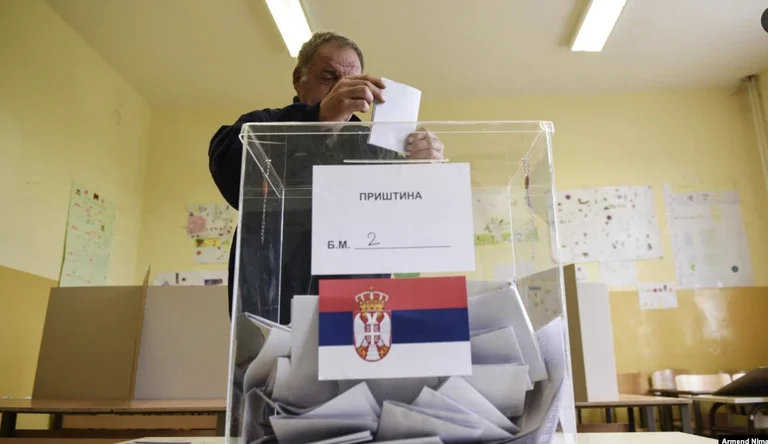
On January 15th, Kosovo's Assembly adopted a resolution through which it voiced opposition to the vote for Serbia's state referendum on constitutional changes in Kosovo.
Kusari-Lila: Voting on Serbia's elections, same as for referendum
At a media conference on January 17th, Kusari-Lila said that Kosovo's Assembly, through this resolution, reaffirmed the will of political parties, in accordance with a process that violates the sovereignty and constitutionality of the Republic of Kosovo.
According to her, the vote, whether for referendum or for parliamentary elections of another state or other citizens of dual citizenship, is envisioned in the Kosovo Assembly resolution.
“There are methods of voting. It is voted into the state where elections are held, by mail or at the embassies or liaison offices of that state”, Kusari-Lila said.
“I believe that as a principle and as a process has been defined and preparations can already be made two to three months before holding elections in Serbia ) so that they can be carried out in this form, in order to understand that Kosovo is a territorial whole, an independent and sovereign state and is a law applicable to all the same, without exception of”, Kusari-Lila added.
The resolutions adopted by the Parliament are not binding, but reflect the political will.
Serbian elections in Kosovo, <x0 unconstitutional”
Constitutional Law Professor at the University of Pristina, Arsim Bajrami, who has been in the group of experts who have compiled the Constitution of Kosovo, tells Radio Free Europe that Kosovo, for a period of time, has tolerated holding Serbian elections on its territory, based on the spirit of the Ahtisaari Document on which the document was declared independence in 2008 but also on the basis of a tolerance, beyond its constitutional obligations.
This practice, he says, has been a constructive approach of Kosovo to give space to dialogue and normalisation of relations with Serbia.
But, as he says, the process of dialogue has not marked progress, while Serbia has misused, as it calls it, “the intensity of Kosovo institutions”, provoking Kosovo's sovereignty and integrity.
“Even this practice [opening deployments to Kosovo for Serbia's elections] is unconstitutional. I think that in the future these issues should be clarified, within the framework of the dialogue [Kosovo-Serbia], especially the issue of holding further Serbian elections”.
Kosovo's “Government and Assembly have the full authority to decide whether to hold or refrain [from Serbia's elections in Kosovo] and no international provision is violated with this if it is carried out the same as in the case of referendum”, Bajrami says.
Similar sentiments are held by Ehat Miftaraj, executive director of the Kosovo Institute for Justice.
He tells Radio Free Europe that Serbia's central-level elections have been allowed to be organised in Kosovo, at least since 2012, on the basis of a consensus, largely based on breaking up reports on developing Kosovo-Serbia dialogue.
Whatever, these practices, in some way, violate Kosovo's legal and constitutional order. Therefore, the same approach of the Republic of Kosovo that has occurred with the referendum would have to continue with the upcoming elections held in April, at the national level in Serbia, enabling Serbian citizens to vote through [Serbia's] Post or Liaison Office in Pristina”, Miftaraj said.
Serb List Threats, Belgrade Officials
On 16 January, Kosovo authorities have not allowed Kosovo to hold Serbia's referendum on constitutional changes for the judiciary. This has prompted numerous reactions by Belgrade officials and the Serbian List, which represents the Serb community in Kosovo institutions.
On January 17th, at a presentation on TV Prva television in Belgrade, the director of the Office for Kosovo in Serbia, Petar Petkovic, said that Belgrade, in co-operation with Kosovo Serbs, will work on organising the 3 April elections when it will be voted for presidential and parliamentary elections.
On 16 January, on the day the referendum was held in Serbia for changes to the judiciary, Serbian List Chairman Goran Rakiq, at the same time minister for Communists and Kthim in the Government of Kosovo, said during a protest in northern Kosovo that Serbs will vote in Serbia's announced elections on April 3rd and warned, as said, imposing reciprocity with Pristina.
“We expect, believe and are sure that elections will be held on April 3rd. If there will be no elections and if the international community does not help organise the election process on April 3rd, we will set all reciprocity measures”, Rakic said, without giving any explanation of what reciprocity measures he is talking about.
Markovik: Speeded “statements” should not be taken seriously
Igor Markovic, from the non-governmental organisation “In northern Mitrovica, estimates that statements by the Serbian List chairman regarding reciprocity measures against Kosovo institutions should not be seriously understood, because there are hasty “”.
He adds that Rakiq “has had to be argued in some way why the Serbian referendum was not held in Kosovo”.
This hasty statement sounds like a immediate threat. April is near, but Kurt's strong attitude towards Belgrade must be taken into account... I don't believe Kurti's government will allow the elections to be held in April, which will organise the Republic of Serbia”, Markovic says.
According to him, the Organisation for Security and Co-operation in Europe has clearly distanced itself, saying it cannot mediate for organising Serbia's elections in Kosovo without the permission of Kosovo authorities.
Markovic recalls that the Serb List, on several occasions earlier, has warned Kosovo institutions or their boycott, but that such a thing has never happened on the ground.
However, he says it is more than necessary to soften the rhetoric of both sides, which, he recalls, the international community has also sought out in recent days.
Anti-unconstitutional practices “do not impose Kosovo institutions”
On January 14th, after the leaders of Kosovo's highest institutions, President Vjosa Osmani, Parliament Speaker Glauk Konjufca, and Prime Minister Albin Kurti have held with the ambassadors of Quint, they have said that the until-now <x0-restacts, applied since 2012, have been anti-unconstitutional” and that they “do not impose the current institutions of the Republic of Kosovo”, released from the “to the citizens' will be expressed in February 14th, 2021.
“ ... Far more so when these practices have resulted only with the empowerment of Serbia's illegal structures in Kosovo”, the three leaders of Kosovo's top institutions have said in a joint statement.
Practices from 2012 onward do not speak of holding any Serbian referendum in Kosovo. One was held in 2006. But, Kosovo Serbs have consistently organised the vote in Kosovo for Serbia's presidential and parliamentary elections, while the election collection has made the Organisation for Security and Co-operation in Europe.
The ban on holding Serbia's referendum on constitutional changes for the judiciary in Kosovo has prompted numerous reactions from ambassadors of Quint countries, the US, Italy, France, Germany and the United Kingdom, as well as the European Union, which suggested allowing its preservation.
Bajrami: EU set same criteria for both states
But are similar reactions expected even if the Kosovo government will not allow the organising of votes in Kosovo for Serbia's parliamentary and presidential elections on April 3rd?
Professor Bajrami estimates that Kosovo's international partners would have to clarify what they want from her.
“As long as they are favouring Serbia with opening chapters [to EU membership] and are putting pressure on Kosovo to continue making compromises, they, in relation to Kosovo, are not using the same criterion because we are the only state we are keeping in touch with the visa issue. I think it's time for the European Union to set the same criteria in relation to these two states and to stop the pressures, which are constantly done only to the Kosovo side”, Bajrami points out.
Miftarian: A Reasoned Answer to International Partners
Ehat Miftaraj estimates that the eventual demands by Kosovo partner countries, for it to make concessions for the April 3rd Serbian elections, would not be in line with Kosovo's constitutional and legal order, nor with international practices and standards related to election organisation.
“I believe that even international partners, if they will receive an rational response based on the Constitutions and on international practices and standards, will find it easier to accept. I believe that the president, prime minister, the Ministry of Foreign Affairs should have constructive dialogue and have campaigns or meetings with international partners, not to wait in April when the elections come, but ahead of time to inform the friendly states of why holding Serbia's elections in Kosovo somehow affects dialogue itself, but also the Constitution and the best international standards and practices, says Miftaraj.
Serbia's elections in Kosovo over years
Just a few months after Kosovo declared independence on February 17th, 2008, Serbia organised parliamentary elections in the majority Serb environments in Kosovo. In these elections, which were held on May 11th, 2008, according to the Republika Srpska Election Commission's data, the right to vote in the Kosovo polls exploited about 900,000 citizens of Serbia.
Serbia's parliamentary elections on Kosovo territory were held in 2012, 2014, and 2016. The last parliamentary elections, which Serbia organised in Serb-run populated areas in Kosovo, were held on 21 June, 2020.
At that time, according to the established practice, the Organization for Security and Co-operation Mission in Europe collected ballot papers. This voting collection practice was established in 2017 and so far has been granted permission by Kosovo authorities for something like this.
Following the closure of polling stations, votes from Kosovo were counted in the Rashka and Vranje border cities of Serbia.
Serbia's presidential election was held in Kosovo in 2017 with the approach of “vote collection”, while Serbia first organised the presidential elections in Kosovo in 2012.
The local Serbian elections in Kosovo were not held after Kosovo's declaration of independence in 2008, as the decentralisation process began in the same year, based on Marti Ahtisaari's plan, when Serb majority municipalities south of the Iber River -- Gracanica, Shtrpca, Novoberada, Kllokoti, Partetashi and Ranillugugu were formed.
In northern Kosovo, four Serb majority municipalities, according to the Kosovo system, were formed only after the signing of the Brussels Agreement between Kosovo and Serbia in 2013.
Even though then Belgrade officially agreed to abolish local self-government under the Serbian system, this did not happen, so that temporary municipal organs throughout Kosovo continue to function, financed by Serbia's budget, and the mayors of municipalities appointed by the Serbian government.











