 3 hours ago
Reciprocytes, tensions, and roadblocks - all that happened within 24 hours in the north
Periskopi(5 years ago)
(5 years ago)The EU and the US call on Kosovo and Serbia to reduce tensions. Kurti says reciprocity is not against Serbs. Vuqiq warns reactions to official Pristina. Serbs in northern Kosovo are keeping roadblocks at the Jarinje and Brnjak border at the Kosovo-Sebi border, thus rejecting the establishment of reciprocity by [...]
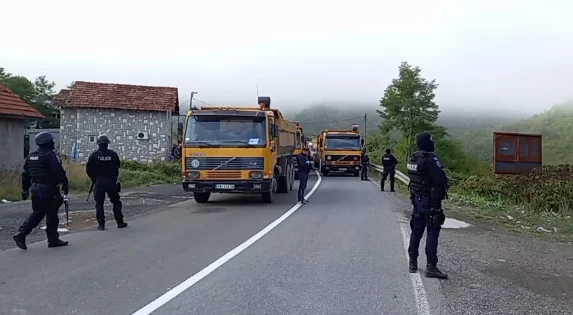
Serbs in northern Kosovo are keeping roadblocks at the Jarinje and Brnjak border at the Kosovo-Sebi border, thus rejecting the establishment of reciprocity from Kosovo for Serbia's car plates.
Serbia's top authorities warned rebuttals, such as President Alexander Vuciq “painful political and economic measures”. Since Monday morning (20.09), Kosovo police are not allowing Serbia's license plates to enter Kosovo territory.
So far, Serbia has not allowed Kosovo license plates to enter Serbia, but has set up temporary license plates.
The same is being done by Kosovo, where authorities are placing in Serbian city license cars, temporary circulation recordings in Kosovo.
Placing reciprocity from Kosovo on car license plates with Serbia sparked tensions in northern Kosovo, respectively, at the Jarinje and Brnjak border points, where local Serb groups are keeping the roads in the north blocked.
And this situation has disturbed the international community, which is calling for calm and tension reduction.
The European Union's spokesman for Foreign Policy and Security, Peter Stano, said that <x0-tensions should stop both sides and said dialogue should be used to resolve such disputes”.
Freedom of movement fundamental EU condition
“We are monitoring the situation closely and I want to stress, that freedom of movement is a fundamental condition of the EU, and we expect it from Kosovo and Serbia to promote it. We call on both sides to refrain and reduce tensions. Immediately and without any delay”, Peter Stano declared from Brussels.
According to him, “Kosovo and Serbia should use dialogue as the only platform to resolve all open issues that these two countries may have, including freedom of movement”.
Even the US Embassy in Kosovo joined the European Union's call for Kosovo and Serbia to refrain and reduce tensions immediately.
“We join the European Union in calling on Kosovo and Serbia to refrain from further unilateral actions and to reduce tensions immediately, without delay”, the US Embassy's response said.
Meanwhile, the EU spokesman, announced that the European in charge of Kosovo-Serbia dialogue, Miroslav Lajcak, has already arrived in Belgrade to discuss the issue with Serbia's president, Aleksandar Vuvilic.
And the latter, after placing Kosovo reciprocity on Serbia's car plates, said he would react to Pristina as what he said with “painful political and economic measures”, following a meeting of the National Security Council that called for Tuesday in Belgrade.
Aleksandar Vuciq accused Pristina of violating Brussels' agreements.
“Soon we will talk about our measures, they will be painful, especially in the economic plan. I hope it's not necessary to take these steps”, Vuçic said. According to him, “Serbia should be ready for dialogue even in the most difficult conditions”, but said that “I don't see reason at this moment for dialogue”.
Kosovo had warned establishment of reciprocity measure
Kosovo Prime Minister Albin Kurti, for his part, said the <x0 actions undertaken for reciprocity on Serbia's license plates are not intended to violate the free movement of Serbian citizens or to provoke any destabilisation”.
“As prime minister, I assure you that actions undertaken today by competent bodies for implementing this have not been directed against Serbian citizens, are not intended to affect the free movement of Serbian citizens or provoke what destabilisation would be. I expect everyone to understand correctly, that today nothing illegal is happening, today the implementation of an agreement Serbia” has agreed to, Kurti said at a parliamentary session.
Kosovo had warned of imposing reciprocity measures for Serbia's car plates during the latest round of dialogue with Serbia, mediated by the European Union.
Deputy Prime Minister Besnik Bislim, who heads the Kosovo delegation in Brussels, had said the agreement for the plates expires on September 15th and that Kosovo would not respect that unilateral one.
The issue of car plates was regulated with the Brussels Free Movement Agreement, reached in July 2011, within dialogue between Kosovo and Serbia. / DW/











